
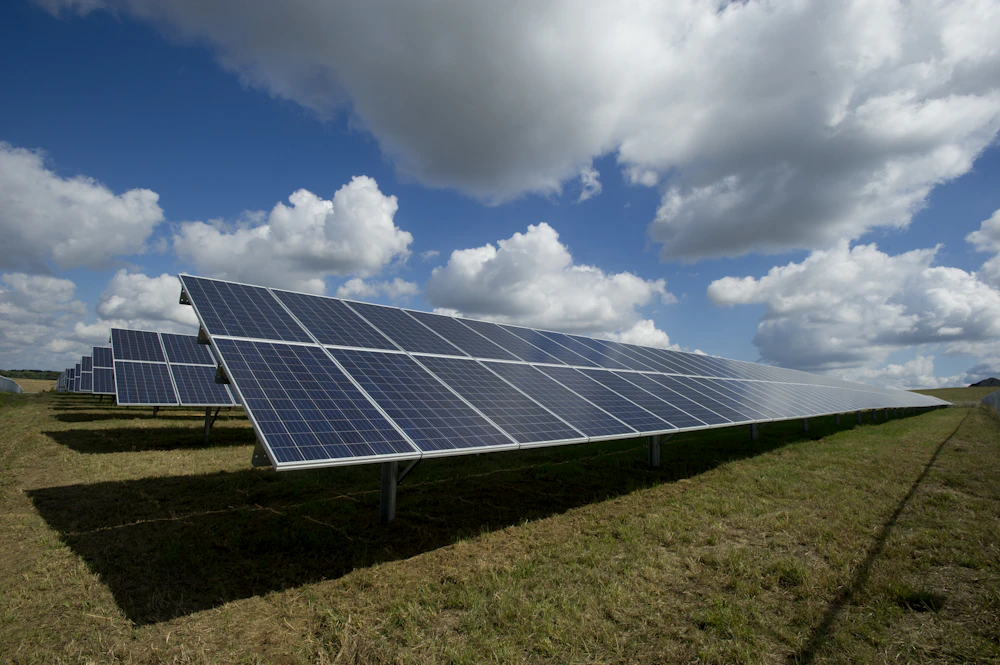
What Is a Ground-Mounted Solar Racking System?
A ground-mounted solar racking system is a structural framework designed to support photovoltaic modules above the ground rather than attaching them directly to a building roof.
A complete ground mount solar system normally includes foundations, posts, beams or rails, braces, module clamps, fasteners and grounding components. Together, these components create a structural load path from the solar panels into the foundation and ground.
Ground-mounted solar panels are widely used for utility-scale, commercial, industrial and selected residential solar projects where sufficient land is available.
Why Choose Ground-Mounted Solar Panels?
Ground mounting provides flexibility in array orientation, layout and structure design, making it suitable for many commercial and utility-scale PV applications.
Flexible Array Layout
Ground-mounted solar systems provide more freedom to optimize orientation, row spacing, tilt and land use.
Independent Structure
A ground mount does not depend on the existing roof structure, allowing the PV array to be engineered independently.
Maintenance Access
Properly planned ground arrays can provide accessible working areas around rows for inspection and maintenance.
Scalable Design
Ground solar arrays can be configured for commercial, industrial and utility-scale projects.
Optimized Orientation
Unlike many rooftop systems, ground mounting can provide greater freedom to optimize azimuth and tilt.
Engineering Flexibility
Foundation and structural configurations can be adapted to different soil, terrain and environmental conditions.
Types of Ground-Mounted Solar Racking
The right ground mount solar racking system depends on project scale, site conditions, module configuration, foundation requirements and energy objectives.

Fixed-Tilt Ground Mount
A fixed-tilt ground mount keeps solar modules at a predetermined angle. It is a common solution for commercial and utility-scale ground solar arrays because of its relatively simple mechanical design.

Single-Axis Tracking System
Single-axis solar tracking systems rotate PV modules during the day to follow the apparent movement of the sun. They are commonly considered for larger ground-mounted solar projects.

Pole-Mounted Solar Structure
Pole-mounted structures elevate one or more PV modules above the ground and can be useful where terrain, clearance or smaller array configurations require a different structural approach.

Commercial Ground Solar Racking
Commercial and industrial systems are typically designed around project-specific module layouts, structural loads, foundation conditions and installation requirements.
Main Components of a Ground Mount Solar Racking System
A complete solar panel ground mounting system consists of multiple structural and connection components working together.
Foundation
Foundations transfer structural loads into the ground. Common approaches include driven piles, ground screws, concrete foundations and other project-specific solutions.
Posts
Vertical posts support the main structure and connect the solar array to the foundation.
Beams & Rails
Structural beams, purlins and rails support the modules and maintain the required array geometry.
Bracing
Bracing components improve structural stability and help resist environmental loads.
Module Clamps
Mid clamps and end clamps securely connect PV modules to the mounting structure.
Grounding Components
Grounding and bonding components are integrated into the system according to applicable electrical requirements.
Ground Mount Solar Design: What Should Be Considered?
Proper ground mount solar design begins with the project site rather than the mounting product. Site conditions determine the appropriate foundation, structural configuration and array layout.
- Solar resource and project orientation
- Land area and site boundaries
- Terrain and elevation changes
- Wind and snow loads
- Soil and geotechnical conditions
- Module dimensions and configuration
- Row spacing and shading
- Ground clearance
- Drainage and water management
- Installation and maintenance access

Ground Mount Solar Foundation Options
Foundation selection is one of the most important decisions in a ground-mounted solar project.
Driven Piles
Steel piles can provide an efficient foundation method where soil and installation conditions are suitable.
Ground Screws
Ground screws can be considered where their load capacity, soil conditions and installation requirements are appropriate.
Concrete Foundations
Concrete piers or other concrete foundation configurations can be used where site engineering calls for them.
Foundation selection should be based on project-specific structural calculations and geotechnical information.
Key Engineering Factors for Ground-Mounted Solar Racking
Ground-mounted arrays are directly exposed to environmental conditions, making structural engineering an important part of the system design.
Ground Mount Solar Installation Process
A well-planned installation sequence can help reduce construction issues and improve project quality.
Site Assessment
Review land conditions, terrain, drainage, soil, access and project boundaries.
System Design
Determine module layout, tilt, row spacing, foundation type and structural configuration.
Foundation Installation
Install piles, ground screws or concrete foundations according to the approved design.
Structure Assembly
Install posts, beams, rails, braces and module attachment components.
Module Installation
Install PV modules using compatible clamps and approved installation procedures.
Grounding & Inspection
Complete grounding, bonding, cable management and structural inspection.
Final Testing
Verify mechanical connections and project-specific electrical and commissioning requirements.
Operation & Maintenance
Maintain the array, inspect connections and monitor the system throughout its operating life.
Ground Mount vs Roof Mount Solar Systems
Ground-mounted and rooftop systems serve different project conditions. The appropriate choice depends on the site and project requirements.
| Factor | Ground Mount | Roof Mount |
|---|---|---|
| Installation Location | Open land | Building roof |
| Array Orientation | Generally flexible | Limited by roof geometry |
| Foundation | Project-specific ground foundation | Roof attachment |
| Maintenance Access | Can be planned around array rows | Depends on roof access |
| Structural Design | Independent structural system | Depends on building structure |
| Land Requirement | Requires available land | Uses existing roof area |

Ground-Mounted Solar Racking Cost
The cost of a ground-mounted solar system depends on much more than the price of the mounting rails.
A project budget may include land preparation, foundation, structural steel or aluminum, rails, clamps, fasteners, labor, transportation, electrical infrastructure and engineering.
- Racking and structural materials
- Foundation and installation method
- Soil and geotechnical conditions
- Terrain preparation
- Project size and module configuration
- Labor and construction equipment
- Transportation and logistics
- Engineering and permitting requirements
Applications of Ground-Mounted Solar Racking
Ground solar mounting systems can be designed for a wide range of PV applications.
Utility-Scale Solar Farms
Large solar farms use engineered ground-mounted structures to support extensive PV arrays across open land.
Commercial Solar Projects
Commercial ground arrays can provide an alternative where rooftop space is limited or unsuitable.
Industrial Solar
Industrial facilities with available land can use ground-mounted systems to expand PV capacity.
Agricultural Solar
Ground solar structures can be considered for suitable agricultural and rural sites subject to local requirements.
Residential Ground Mount
Residential ground-mounted solar panels can be used when homeowners have sufficient land and suitable site conditions.
Distributed Solar Arrays
Smaller distributed ground solar arrays can be configured according to site-specific requirements.
How to Choose the Right Ground Mount Solar Racking System
Compare the complete system rather than evaluating a single component or the lowest unit price.
1. Evaluate the Site
Understand soil, terrain, wind, snow, drainage, corrosion exposure and access conditions.
2. Select the Foundation
Match the foundation solution with soil conditions, structural loads and construction requirements.
3. Define the Array Layout
Optimize module orientation, tilt, row spacing, ground coverage and maintenance access.
4. Check Structural Loads
Verify wind, snow and other project-specific design loads according to applicable standards.
5. Review Materials
Confirm aluminum, galvanized steel, stainless steel and corrosion protection specifications.
6. Evaluate the Manufacturer
Look for engineering support, quality control, manufacturing capability and project experience.
Ground-Mounted Solar Racking Solutions from Singsun Energy
Singsun Energy provides photovoltaic mounting solutions designed for different solar project requirements, including ground-mounted PV applications.
As part of the Guoqiang Group, Singsun Energy combines manufacturing capability with engineering-focused PV mounting solutions for global solar projects.
- Fixed PV mounting systems
- Adjustable mounting systems
- Solar tracking systems
- Distributed PV mounting solutions
- Flexible support systems
- Ground screw foundation solutions
Ground-Mounted Solar Racking FAQ
Common questions about ground solar mounting systems, installation, design and cost.
What is a ground-mounted solar racking system?
A ground-mounted solar racking system is a structural framework that supports PV modules above the ground. It normally includes foundations, posts, structural members, rails and module attachment components.
What are ground mounted solar panels?
Ground mounted solar panels are photovoltaic modules installed on a free-standing structure anchored to the ground instead of being installed directly on a roof.
What is the difference between ground mount and roof mount?
Ground mount systems use an independent foundation and structural frame, while roof mount systems attach to an existing building roof. Ground mounting generally offers greater freedom in array orientation and layout.
What foundation is best for ground-mounted solar?
There is no universal foundation type. Driven piles, ground screws, concrete foundations and other solutions may be appropriate depending on soil, structural loads, terrain and installation conditions.
How much do ground mounted solar panels cost?
Project cost varies significantly according to system size, modules, racking, foundation, land preparation, labor, electrical equipment, engineering and site conditions. A project-specific quotation is required for an accurate estimate.
What is the cheapest ground mount solar racking system?
The lowest-cost system depends on the complete project. A lower-cost rack may require additional foundation work, labor or site preparation. Comparing total installed cost is generally more meaningful than comparing the price of individual rails or brackets.
Can ground-mounted solar panels be used for homes?
Yes. Residential ground-mounted solar panels can be used where sufficient land, suitable site conditions and local approvals are available.
Are ground solar mounting systems suitable for large projects?
Yes. Ground-mounted systems are widely used for commercial, industrial and utility-scale PV projects. Larger projects require detailed structural, civil, electrical and site engineering.
Looking for a Ground-Mounted Solar Racking Solution?
Tell us your project size, module configuration, site conditions and foundation requirements. Our team can help evaluate a suitable PV mounting solution for your solar project.
Request a Solar Mounting Solution Explore PV Mounting Systems