
Weathering steel guardrail is a viable, low-maintenance option only when environmental conditions and inspection regimes are appropriate. Dry, low-chloride sites with documented inspection programs tend to favor it; coastal, high-rainfall, or heavily salted roadways usually do not. Before specifying it, purchase documents should require ASTM-certified material and a written inspection threshold, and buyers can review engineered guardrail options through our guardrails catalog as part of that process.
TL;DR:
- Weathering steel guardrail performs best in dry, low-chloride environments with documented inspection programs, and it is unsuitable for coastal or high-rainfall sites without protective coatings.
- Key specifications include ASTM A588 or A606 grades, 10- or 12-gauge W-beam profiles, proper splice types, and detailed splice and end treatment drawings.
- Regular inspection using handheld ultrasonic gauges, focusing on lap splices and bolt holes, is essential to detect section loss before structural failure occurs.
- Procurement should mandate ASTM certification, traceability documents, and clear detailing of splices, finishes, and lead times for custom parts.
- The service lifespan of weathering steel guardrails varies greatly with environment; in harsh conditions, proper drainage and maintenance can extend durability, but in high chloride settings, alternative steel or coatings are advisable.
Table of Contents
- What weathering steel guardrail is and how it’s specified
- Where weathering steel succeeds and where it fails
- Building a field inspection and maintenance program
- Procurement checklist and customization options
- Supplier capacity and relevant product families
- Cost factors and total investment overview
- Projected service lifespan under different conditions
- A practical recommendation for safety managers
- How to request a quote for engineered guardrail support
- FAQ
- Sources
What weathering steel guardrail is and how it’s specified
Weathering steel is a low-alloy steel formulated to form a stable rust layer, or patina, that slows further corrosion once exposed to normal wet and dry cycles. Guardrail fabricators commonly reference ASTM A588 and ASTM A606 grades for this material, both of which specify the copper, chromium, and nickel content that gives the steel its self-protecting surface.
Most highway guardrail ships as W-beam sections, the familiar corrugated profile, in single or double-rail configurations depending on the barrier’s design speed and expected impact severity. Stock lengths typically run from 2 feet up to 12.5 feet or 10 feet depending on the manufacturer, with weight varying by gauge and length.
Buyers should expect to specify:
- Rail gauge and profile: 10- or 12-gauge W-beam is standard for most roadway applications.
- Splice type: lapped splices are typical, though bolt pattern and orientation affect corrosion resistance at the joint.
- End treatments: terminal sections, anchors, and transition pieces that match the rail’s crash rating.
- Accessories: posts, offset blocks, adapters, and pedestrian gates where the project calls for them.
Custom fabrication is common for interchange ramps, bridge transitions, and sites where standard lengths don’t fit the geometry.
Where weathering steel succeeds and where it fails
Weathering steel’s protective patina depends on regular wet and dry cycling. When a site keeps the steel wet too often, through ponding, splash from traffic, or persistent coastal humidity, the oxide layer never stabilizes and corrosion continues past the surface rust stage into structural section loss.
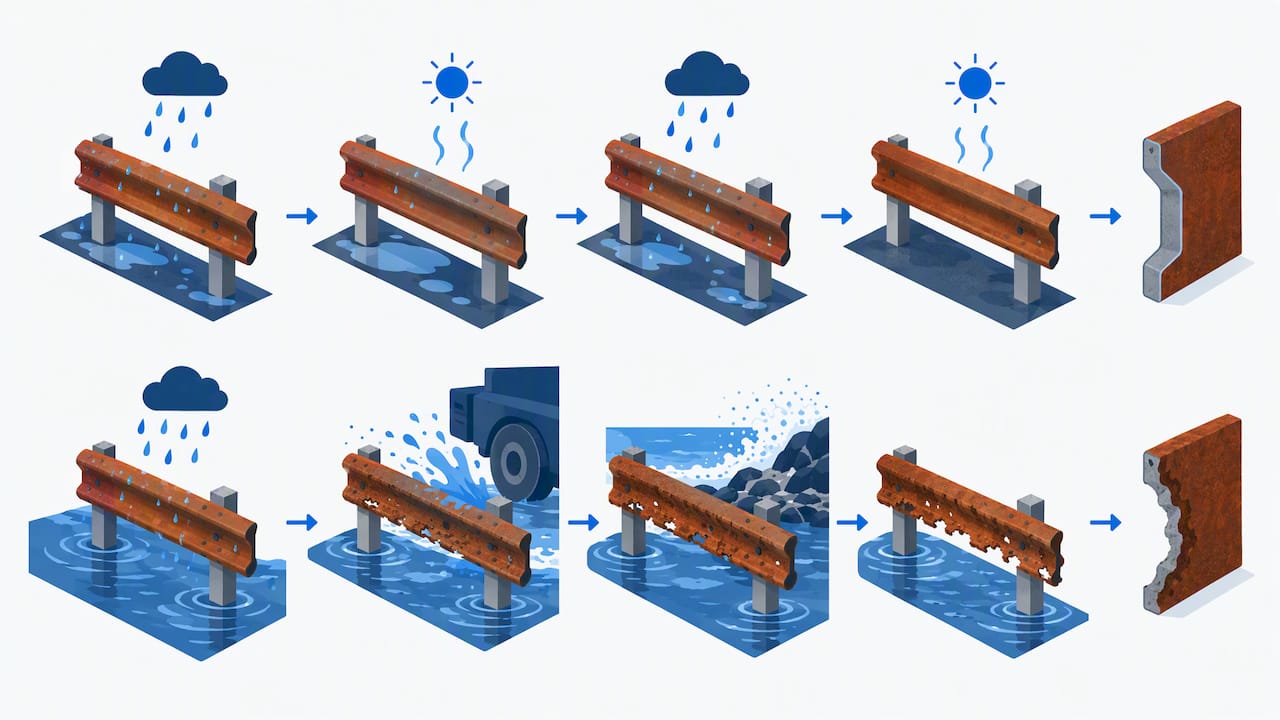
Caltrans research into weathering steel guardrail performance found that lap splices in high-rainfall and coastal environments carry disproportionate corrosion risk, and the Caltrans research summary recommended limiting uncoated installations to areas with annual rainfall below roughly 8 inches, favoring staining or coated alternatives above that threshold. FHWA’s broader research on corrosion-resistant steels similarly found that conventional weathering grades underperform in high time-of-wetness or chloride-heavy settings, where higher-alloy steels such as ASTM A1010 hold up better despite a higher first cost, according to the FHWA improved-steel research report.
Exclusion zones to flag during site selection:
- Coastal corridors within salt spray range.
- Roadways with heavy winter deicing salt application.
- Low-lying sections prone to ponding or poor drainage.
Pro Tip: Detail drainage paths and scuppers to flush salts away from splice connections; crevice corrosion at laps fails faster than open-face rusting ever will.
Where any of these conditions apply, a coated steel or ASTM A1010 alternative reduces long-term risk even though it costs more upfront.
Building a field inspection and maintenance program
A documented inspection regime is what separates a successful weathering steel installation from a liability. The roadside pooled fund research into field inspection technique recommends a two-level sampling approach: broad, periodic spot checks across a rail run, followed by targeted second-level measurement wherever surface condition looks irregular.
- Schedule spot checks at intervals tied to the site’s exposure category, more frequent near drainage structures or splices.
- Scrape to base metal at suspect locations before measuring; surface rust color is not a reliable indicator of remaining thickness.
- Measure with a handheld ultrasonic thickness gauge, which the roadside pooled fund final report identifies as suitable for assessing lapped splices without disassembly.
- Apply the fail threshold: the same study used approximately 0.096 inches of remaining thickness as the practical replacement trigger.
- Log results against a maintenance schedule so section loss trends are visible over time, not just caught at failure.
Lap splices and bolt holes are the most common failure points, since water and debris collect there longer than on open rail faces. Repair options include zinc inserts, approved epoxy fills, or outright section replacement.
Pro Tip: Keep a small stock of matching spare sections on hand; sourcing a single replacement length after a crash or failed inspection is slower and costlier than planned replacement.
Procurement checklist and customization options
A bid package should lock in both technical and commercial terms before a purchase order goes out. On the technical side, require ASTM certification for the specific heat lot, full material traceability documents, and splice detail drawings showing bolt pattern and orientation. On the commercial side, confirm the supplier’s spare-section policy, warranty terms, and any inspection obligations tied to the contract.
- ASTM certification and traceability: confirm the mill certificate matches the heat lot shipped, not just the grade ordered.
- Splice and adapter drawings: request detail drawings for lift-out, angle, and down-guard adapters where the geometry needs them.
- Finish options: some fabricators offer stain treatments to accelerate even patina formation or to match aesthetic requirements.
- Spare-section and lead time commitments: confirm minimum order quantities and how fast replacement sections can ship after the initial order.
Coordinate drainage and detailing requirements with the fabricator early. A supplier that understands crevice avoidance at the design stage saves a maintenance headache later.
Supplier capacity and relevant product families
That manufacturing scale supports both standard and custom guardrail fabrication runs.
Beyond guardrails, several of our product families cover related infrastructure needs on the same project site:
- GQ-FL series flexible support and GQ-A Series Fixed-Adjustable Mounting System: engineered mounting hardware for adjacent structures.
- GQ-F Series Fixed Mounting System: fixed mounting for sites needing coordinated foundation details.
- ODM/OEM Energy Storage Container and Mobile PV-BESS Power Station: relevant where a project bundles safety infrastructure with on-site power needs.
- E-House, OEM & ODM, and GQ-T Chaoyang Series Tracker System: supporting infrastructure for combined transportation and energy projects.
When requesting a quote, prepare a site plan, exposure notes (rainfall, deicing practice, coastal proximity), and desired finish.
Cost factors and total investment overview
Material grade is the largest line item: ASTM A588 or A606 weathering steel typically costs more per ton than standard galvanized steel, though it avoids the ongoing cost of recoating. Rail gauge, length, and splice hardware add incremental cost, and custom lengths or adapters for non-standard geometry carry a fabrication premium over stock sizes.
Installation cost depends on terrain, post spacing, and whether drainage detailing is added to reduce crevice corrosion risk, a design choice that adds upfront labor but reduces later repair frequency. Inspection and maintenance are the recurring cost component: a documented program using handheld ultrasonic thickness gauges requires both equipment and labor time, though it’s far less expensive than reactive section replacement after a failed inspection or crash event.
Total investment should be evaluated over the installation’s service life rather than purchase price alone. A lower-cost uncoated installation in a high-chloride environment can end up costing more over time than a higher-alloy or coated alternative, once accelerated inspection frequency and premature section replacement are factored in. Procurement teams comparing bids should ask each vendor to quote not just material and installation cost, but expected inspection interval and typical section replacement rate for the specific site conditions described in the RFQ.
Projected service lifespan under different conditions
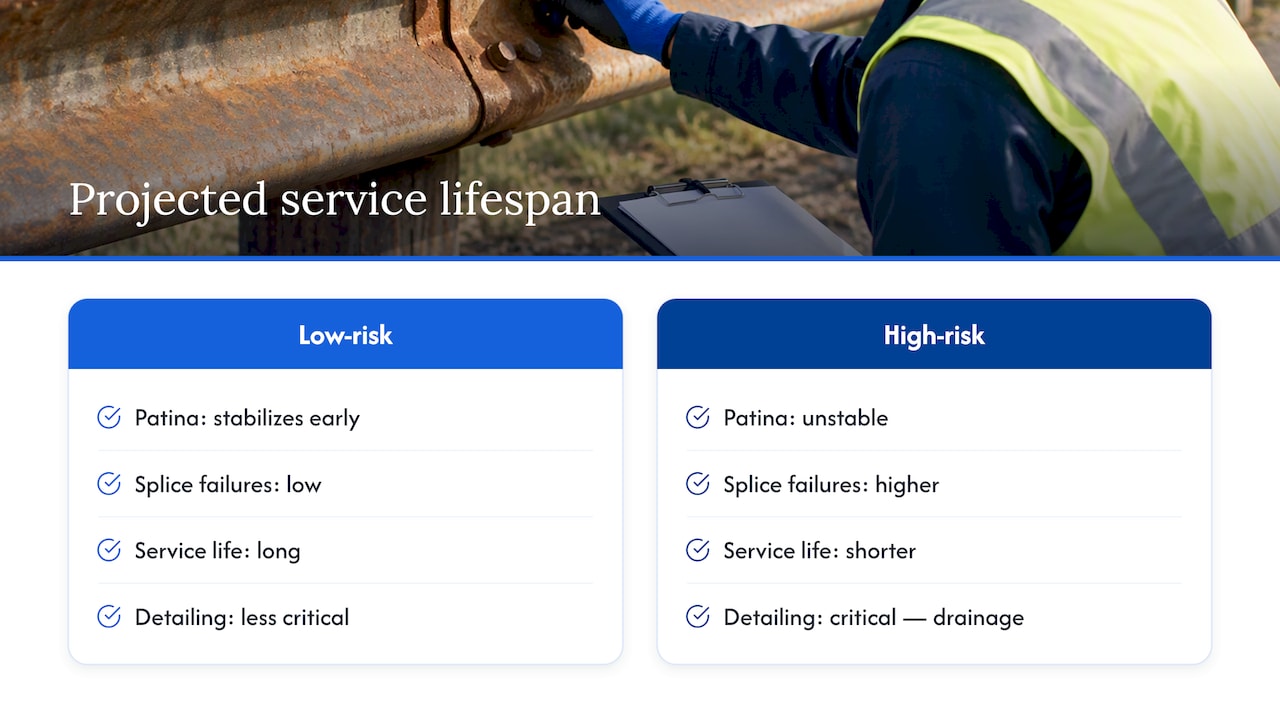
Service life for weathering steel guardrail varies widely based on exposure, and that variation is the central risk a safety manager has to manage. In dry, low-chloride environments with annual rainfall below the range Caltrans flagged as a concern, uncoated weathering steel guardrail performs well over extended service periods, developing a stable patina early and losing material slowly after that.
In coastal zones, high-rainfall corridors, or roadways with heavy deicing salt use, service life drops substantially. The same Caltrans research that identified lap splices as a corrosion hotspot found that field surveys in some high-rainfall and coastal sites showed higher lap-connection failure rates than drier inland installations. FHWA’s research on corrosion-resistant steels likewise ties shortened service life to high time-of-wetness conditions, where the patina never fully stabilizes.
Detailing choices affect lifespan as much as geography does. Installations with good drainage, scuppers that flush salt away from splices, and crevice-avoidant hardware tend to outlast otherwise identical installations with poor detailing in the same climate. A documented inspection program extends effective service life further, since early detection of section loss at splices allows targeted repair instead of full-run replacement. Buyers should treat projected lifespan as a function of environment and maintenance commitment together, not as a fixed number attached to the material grade alone.
A practical recommendation for safety managers
Weathering steel earns its reputation in dry, low-chloride sites where aesthetics and life-cycle cost both favor it. Everywhere else, pair it with a real inspection program or choose coated or higher-alloy steel instead.
— Hu
How to request a quote for engineered guardrail support
We provide guardrail hardware and related mounting infrastructure, so a single RFQ can cover both the barrier system and any adjacent support structures a site needs.
For guardrail-specific sourcing, our guardrails product line covers standard and custom configurations, while projects that also need adjustable anchoring can review the GQ-A Series Fixed-Adjustable Mounting System alongside the rail order.
To speed quoting, include in your RFQ:
- Site exposure details: rainfall, coastal proximity, deicing salt practice.
- Desired finish and whether staining or coating is required.
- Splice detail drawings and expected impact load or crash rating.
- Stock length needs versus custom fabrication requirements.
Reach out through our product catalog to start that conversation.
FAQ
What are the proper components of a guardrail system?
A complete guardrail system includes the W-beam rail, posts, offset blocks, splice hardware, and end terminals rated for the design’s expected impact severity. Adapters, pedestrian gates, and transition pieces are added where the site geometry requires them.
Is weathering steel the same as corten steel?
Corten is a trademarked weathering steel product, and the term is often used generically for any steel meeting ASTM A588 or A606 weathering steel specifications. The underlying material behavior, forming a protective rust patina, is the same regardless of brand name.
How much does a 12 ft piece of guardrail weigh?
Weight depends on gauge and profile, since rail thickness varies by manufacturer and project specification. A supplier’s certified mill documentation for the specific gauge ordered is the reliable source for exact weight figures.
What are the AASHTO guardrail standards?
AASHTO’s Manual for Assessing Safety Hardware governs crash performance testing for guardrail systems, while AASHTO M180 sets material and coating requirements. Procurement documents should cite both and confirm that a vendor’s crash test configuration matches the hardware actually being purchased.
Sources
Guardrail procurement rests on a small set of documents that every bid should reference explicitly. AASHTO’s Manual for Assessing Safety Hardware governs crash performance testing, while AASHTO M180 sets the material and coating requirements that most state DOTs cite in their specifications. FHWA advisories layer on top of these, particularly where uncoated weathering steel is involved.
When reviewing a vendor’s crash test documentation, check that the tested configuration, including post spacing, rail height, and splice detail, matches what’s actually being purchased. A crash rating earned on a different post spacing or blockout design doesn’t transfer automatically.
Procurement documents should require:
- Review of Weathering Steel Guardrail for California Highways (Caltrans research summary)
- Determining a Field Inspection Technique for Guardrail Beam Integrity (Roadside Pooled Fund final report)