
Battery energy storage systems (BESS) are a practical, well-tested way to enable higher-power EV charging without triggering a costly grid upgrade, provided the system is sized against real demand data and paired with smart charge controls. The payoff shows up as lower demand charges, faster deployment timelines, and enough resilience to keep chargers running through outages. The sizing math and the safety rules that govern where you can install one, covered below, determine whether that payoff actually materializes.
TL;DR:
- Battery storage systems should be correctly sized based on the site’s peak demand during its busiest hour to avoid inefficiencies from undersizing or oversizing.
- Proper coordination with the grid requires layered controls, including real-time energy management and demand response, rather than relying solely on time-of-use rates.
- UL 9540A testing is essential for non-residential systems exceeding 50 kWh to ensure safety and adherence to fire separation requirements.
- Capital costs are primarily driven by battery cells and enclosures, but demand-charge reduction and energy arbitrage can significantly offset expenses.
- Mobile battery stations are suitable for temporary sites or rural corridors, while containerized units fit permanent, high-traffic charging hubs with long-term demand stability.
Table of Contents
- What Is Battery Storage for EV Charging?
- What Are the Financial Benefits of Battery Storage?
- How Do You Size a Battery for EV Charging?
- How Does Battery Storage Coordinate With the Grid?
- What Safety Standards Apply to EV Charging Battery Storage?
- What Does Battery Storage for EV Charging Cost?
- Which Deployment Form Fits Your Site?
- How Guoqiang’s Product Lines Map to These Use Cases
- What Should Procurement Teams Do Next?
- Explore Guoqiang’s Modular and Mobile Storage Options
- Sources
- FAQ
What Is Battery Storage for EV Charging?
A battery energy storage system is a bank of rechargeable cells, paired with inverters and controls, that sits between the utility grid and the charging equipment. It stores electricity during low-demand periods and releases it in short, high-power bursts when vehicles plug in. That buffering function is the entire reason BESS matters for EV charging: chargers demand power in spikes, while the grid connection at most sites was built to deliver a steady trickle.
Two units drive every conversation about sizing, and confusing them is the single most common procurement mistake:
- kW (kilowatts) measures power. It’s the rate of energy delivery. A 350 kW charger needs 350 kW available the instant a car plugs in.
- kWh (kilowatt-hours) measures energy. It’s the total amount stored or consumed over time. A 200 kWh battery can support that same charger for a while before it needs to recharge itself from the grid.
Here’s the practical version. A rural charging plaza with two 150 kW DC fast chargers but only a 100 kW grid connection can’t run both stalls at full power from the grid alone. Add a 300 kWh battery, and the site draws a steady 100 kW from the grid around the clock, banks the surplus, and discharges it in bursts of 300 kW or more whenever cars arrive. The battery isn’t generating power. It’s shifting when stored energy is available, which is precisely what lets a grid-constrained site support fast charging it otherwise couldn’t.
That gap between grid capacity and charging capacity is why the phrase “battery storage for EV charging” specifically refers to buffered, grid-tied systems rather than the battery inside the vehicle itself. Understanding that distinction early saves confusion later when vendors talk about “power vs. energy” specs.
What Are the Financial Benefits of Battery Storage?
Demand charges are usually the biggest line item utilities used to punish spiky loads, and EV charging is about as spiky as commercial electricity use gets. A single fast-charging session can spike a site’s peak demand for the entire billing month, and that peak sets the demand charge no matter how briefly it lasted. Peak shaving with a battery smooths that spike, discharging during the charge event and recharging slowly afterward, which can meaningfully cut the monthly demand-charge line.
The bigger financial lever is often avoided capital spending. When a site’s charging load exceeds what the existing grid connection or nearby substation can deliver, the traditional fix is a utility infrastructure upgrade, which can mean years of permitting and construction plus a large capital outlay. A battery-buffered alternative can sidestep that timeline entirely in the right site conditions.
Other returns worth building into a business case:
- Resilience during outages. A charged BESS keeps DC fast charging available when grid power drops, which matters for fleet depots and highway corridor sites that can’t afford downtime.
- More simultaneous sessions. Buffered power lets more stalls run at full rate at once, instead of throttling output as more vehicles plug in.
- PV and time-of-use arbitrage. Pairing storage with onsite solar lets a site charge the battery from cheap or free daytime generation, then discharge during expensive peak-rate hours.
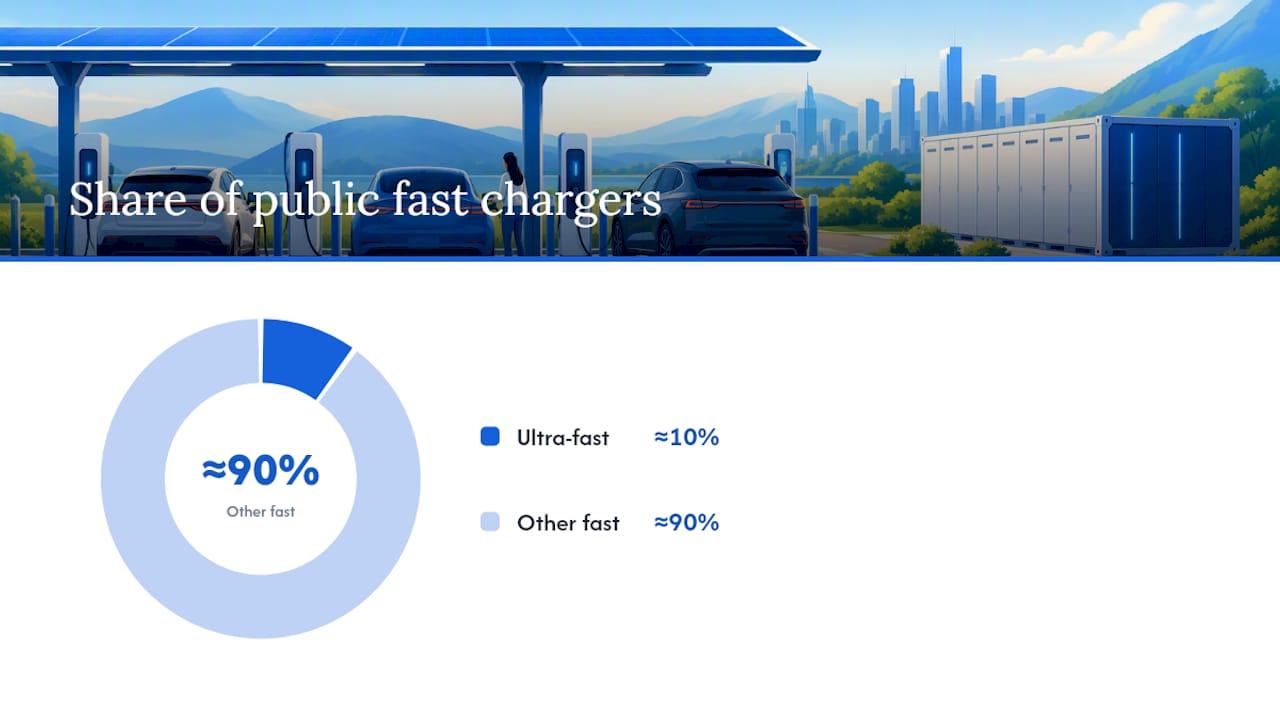
Statistic to watch: ultra-fast chargers rated 150 kW and above grew by about 50% in 2024 and now account for nearly 10% of public fast chargers, according to the IEA’s Global EV Outlook 2025. That’s exactly the charger class most likely to run into grid capacity limits, which is why storage-buffered sites are becoming standard procurement conversation, not a niche option.
How Do You Size a Battery for EV Charging?
Sizing a BESS wrong in either direction is expensive. Undersize it, and chargers throttle during busy periods, frustrating drivers and undercutting the resilience case entirely. Oversize it, and you’ve sunk capital into capacity that sits idle. NREL’s right-sizing framework, developed through case study work with the Joint Office, gives procurement teams a repeatable method built around two concepts.
First Hour estimates the energy a site needs to deliver in its single busiest hour. That’s the number that determines how much usable battery capacity you need on hand at minimum, since the battery has to cover that hour’s demand without fully depleting.
Design Day goes further; it models a full day at roughly the 99th percentile of expected demand, not an average day and not a worst-case outlier. NREL frames this as the realistic upper bound worth designing for, since building for the absolute peak day wastes capital on capacity you’ll rarely use.
A practical right-sizing sequence looks like this:
- Pull twelve months of session data if the site is operational, or use comparable-site benchmarks if it’s new: arrival patterns, session duration, energy delivered per port.
- Calculate First Hour energy demand by summing expected simultaneous charging load during the busiest hour observed or forecast.
- Model the Design Day profile across a full 24 hours, identifying the 99th percentile demand day rather than an outlier event.
- Check grid recharge capacity against that Design Day profile. Confirm the grid connection can deliver enough average power to refill the battery across the full day, not just during the peak.
- Size the battery to cover First Hour peaks while the grid recharges the balance. This is usually a fraction of full Design Day energy, not the whole day’s total.
In NREL’s sample rural case, a right-sized battery-buffered system cut capital costs by roughly 65% versus building a new substation and shaved two to five years off the construction timeline. That gap is why sizing discipline pays for itself before a single charger goes live. Build the Design Day assumptions directly into your RFP, including vehicle arrival patterns and per-port energy figures, so vendor bids are comparable rather than built on guesswork.
How Does Battery Storage Coordinate With the Grid?
A battery doesn’t eliminate the need for a grid connection. It reduces how big that connection needs to be. NREL’s own case work makes the point directly: the grid still has to supply enough average power to fully recharge the battery across a Design Day cycle, or the buffer eventually runs dry during a busy stretch.
Time-of-use rate structures alone aren’t a reliable coordination strategy, either. If every site on a distribution feeder is programmed to charge whenever off-peak rates kick in, you get what NREL researchers call “herding behavior”: a wave of simultaneous charging that overloads local distribution equipment right at the moment rates drop. NREL’s 2024 survey of smart charge management flags this as a growing risk as more sites adopt naive TOU scheduling.
Real coordination requires layered controls:
- Site-level energy management systems (EMS) that modulate charging and battery discharge in real time, not on a fixed schedule.
- Virtual power plant (VPP) aggregation, where a fleet of distributed batteries and managed EV loads gets coordinated as a single dispatchable resource for the grid operator.
- Demand-response enrollment, letting the utility call on stored capacity during system-wide stress events in exchange for a rate credit or payment.
Managed EV charging itself is increasingly modeled as a capacity resource in utility planning, similar to how a fixed battery gets treated, according to Department of Energy modeling work using the ReEDS framework. That reframes a site’s storage and its smart-charging software as two halves of the same asset.
Pro Tip: Ask your EMS vendor for real-time load modulation, not just scheduled TOU switching. The difference shows up the first time your feeder gets stressed by three other sites charging on the same off-peak schedule.
What Safety Standards Apply to EV Charging Battery Storage?
Chemistry choice comes first. Lithium iron phosphate (LFP) dominates stationary storage for EV charging sites because it trades some energy density for a materially lower thermal runaway risk and a longer cycle life, both of which matter more in a fixed installation than they would in a vehicle. Nickel manganese cobalt (NMC) chemistries pack more energy into less space but usually cost more to insure and protect. For most containerized or e-house deployments, LFP’s safety margin outweighs the density trade-off.
Safety testing is where procurement teams can’t cut corners. UL 9540A is the consensus test method for evaluating thermal runaway propagation in a battery system, and it’s the mechanism that determines how big a battery you’re allowed to install without extra separation distance. NFPA 855 leans directly on those UL 9540A test results to set fire code separation distances, defining a remote outdoor location as more than 100 feet from exposures unless testing proves a tighter footprint is safe.
The capacity thresholds matter for every non-residential project. ANSI/CAN/UL 9540:2023 sets a 50 kWh cap for non-residential installations that have not completed UL 9540A testing, versus 20 kWh for residential systems. Crossing that threshold without certification requires downsizing the system or entering a longer permitting process.
Statistic to watch: that 50 kWh non-residential ceiling is easy to blow past with a single fast-charging buffer battery, which means most EV charging BESS installations need UL 9540A testing as a baseline requirement, not an optional upgrade.
Build this checklist into every RFP:
- Confirm the vendor’s system has completed UL 9540A testing under the current fifth edition test method.
- Get documented separation distances or a fire protection engineering letter for your specific site layout.
- Verify local AHJ (authority having jurisdiction) has adopted NFPA 855 and confirm which edition.
- Ask whether certification changes your allowable installed capacity versus the 50 kWh non-residential default.
What Does Battery Storage for EV Charging Cost?
Capital cost breaks into three buckets: the battery cells and racking, power conversion equipment (inverters and transformers), and the enclosure plus civil works to get it installed and connected. Battery cells are usually the single largest line item, though that share keeps shrinking as cell prices continue their long-term decline. Recurring costs run smaller but steadier: thermal management, monitoring software subscriptions, periodic cell balancing, and eventual augmentation as capacity degrades.
Building the savings side of the business case means modeling three separate revenue and cost-avoidance streams, and vendors should be able to speak to all three with site-specific numbers:
- Demand-charge reduction, calculated against your actual utility rate schedule, not a generic estimate.
- Energy arbitrage, charging during low-rate hours and discharging during expensive peak windows, which pencils out best on rate schedules with a wide off-peak/on-peak spread.
- Avoided or deferred infrastructure cost, comparing the battery-buffered system’s price against quoted utility upgrade costs and their construction timeline.
- Resilience value, harder to quantify but real for any site where downtime carries a reputational or contractual cost.
Push vendors hard on three procurement terms before signing anything: warranty duration and degradation guarantees (most quote capacity retention at a specific year, commonly 10 years), end-of-life and second-use handling (does the vendor take the system back, and does it have a documented recycling path), and performance guarantees tied to actual discharge capability, not just nameplate rating.
Which Deployment Form Fits Your Site?
Not every site needs the same physical footprint, and the deployment form usually gets decided by how permanent the installation is and how fast it needs to go live.
Containerized BESS and e-houses suit permanent, high-traffic sites: highway corridor plazas, fleet depots, and retail charging hubs where the storage is expected to run for a decade or more. These arrive pre-integrated with thermal management and controls, which cuts commissioning time versus a stick-built enclosure, and they scale by adding units side by side as demand grows.
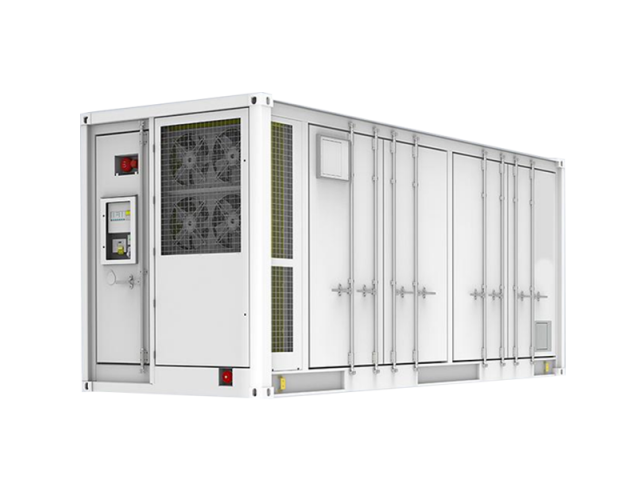
Mobile PV-BESS power stations solve a different problem entirely: temporary events, rural corridors where grid build-out is slow, or pilot programs where a site’s long-term demand is still unproven. Pairing solar generation with a mobile battery unit means a site can operate with minimal or even zero permanent grid connection, which matters where utility interconnection queues run months or years long.
Integration differences worth flagging to your civil team early:
- Containerized units need a prepared pad, cooling hookups, and a fixed electrical interconnection.
- Mobile units need vehicle or trailer access but skip most civil works entirely.
- Both forms benefit from modular scaling, adding capacity in discrete blocks rather than a single oversized build.
Bidirectional vehicle-to-grid charging is also emerging as a complement to fixed storage, letting fleet vehicles themselves act as distributed mobile storage during off-hours, though that technology is still maturing for most commercial deployments.
How Guoqiang’s Product Lines Map to These Use Cases
That manufacturing base extends into flexible energy storage hardware built for the same demanding infrastructure standards.
For permanent, high-capacity installations, the ODM/OEM Energy Storage Container line supports custom specification, which matters when your Design Day sizing calls for a non-standard capacity or footprint. For rural corridors or pilot deployments, the Mobile PV-BESS Power Station pairs solar generation with battery buffering in a single deployable unit, matching the mobile use case covered above.
What Should Procurement Teams Do Next?
Start by pulling twelve months of load data, or comparable-site benchmarks, and bring your utility account manager into the conversation before you talk to storage vendors. Loop in an EMS vendor early too. If your site’s long-term demand is unproven, pilot a mobile unit before committing to a permanent container. Treat any vendor who can’t produce UL 9540A test documentation or a clear degradation warranty as a red flag requiring deeper technical review before contract signature.
— Hu
Explore Guoqiang’s Modular and Mobile Storage Options
If your project team is weighing a containerized system against a mobile deployment, that decision usually comes down to how certain you are about long-term site demand versus how fast you need power on the ground. Product lines cover both ends of that decision. The ODM/OEM Energy Storage Container supports custom capacity and footprint specs for permanent sites, while the Mobile PV-BESS Power Station gets rural corridors, pilot programs, and temporary events running without waiting on a grid interconnection queue.
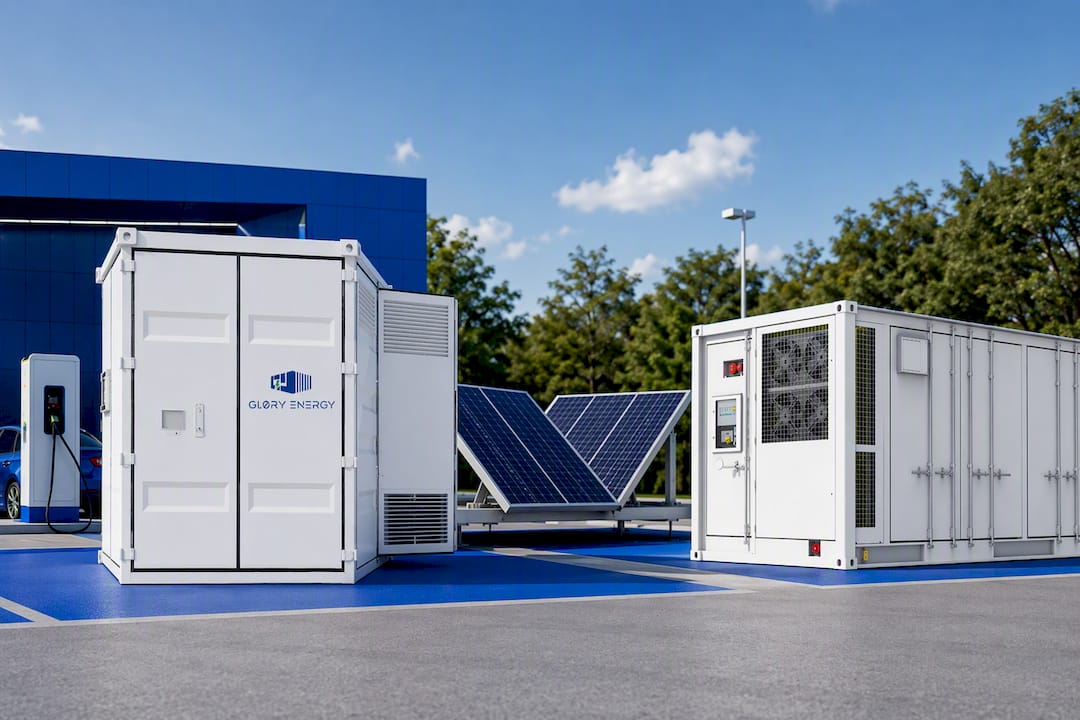
For infrastructure teams building an RFP around unusual voltage, capacity, or enclosure requirements, Guoqiang’s OEM and ODM capabilities cover bespoke container specification from the ground up, backed by the company’s in-house manufacturing and quality control processes. This product class fits sites where grid-constrained charging, resilience requirements, or corridor deployment timelines make a buffered battery system the practical choice, not every site needs one, but where the Design Day math points to a gap, modular storage closes it faster than a utility upgrade typically can. Browse the full product catalog or reach out through the site to scope a feasibility assessment for your next charging deployment.
Sources
- Global EV Outlook 2025 — Electric vehicle charging (IEA)
- Grid-Constrained Electric Vehicle Fast Charging Sites: Battery-Buffered Options (NREL / Joint Office case study)
- Understanding UL 9540A and NFPA 855 (UL)
- ANSI/CAN/UL 9540:2023 — Energy Storage Systems and Equipment (ANSI/UL)
FAQ
Why Is It Bad to Charge an EV Battery to 100%?
Charging a lithium-ion EV battery to a full 100% and holding it there accelerates capacity degradation over time compared to limiting the charge level for daily use. This applies to the vehicle’s own battery, not the stationary BESS at a charging site, though both chemistries share similar degradation mechanics.
Is There a Portable Battery to Charge an EV?
Yes. Mobile PV-BESS power stations combine solar generation with battery storage in a deployable unit, letting a site charge vehicles without a permanent grid connection. These suit rural corridors, temporary events, and pilot deployments where building out fixed infrastructure isn’t yet justified.
What Drains an EV Battery the Most?
Fast charging sessions, extreme temperatures, and repeated deep discharges put the most cumulative stress on an EV battery’s chemistry. On the charging infrastructure side, uncoordinated simultaneous fast-charging sessions create the equivalent stress on a site’s BESS, which is why smart charge management matters as much as the hardware itself.
What Happens to an EV Battery After Eight Years?
Most EV batteries retain a majority of their original capacity after eight years of typical use, though the exact figure varies by chemistry, climate, and charging habits. Many retired EV batteries move into second-use stationary storage applications, including EV charging site buffers, before final recycling.
How Big Should a Battery Storage System Be for an EV Charging Site?
Size is determined by running a First Hour calculation against your busiest expected hour, then validating against a full Design Day profile at roughly the 99th percentile of demand. The NREL right-sizing framework walks through both calculations using real session data or comparable-site benchmarks.