
The three standards every battery energy storage project team must plan for today are NFPA 855, UL 9540A for fire testing, and NEC/NFPA 70 for electrical design. Confirm which edition of each your authority having jurisdiction has adopted, decide early whether installation-level UL 9540A testing applies to your design, and start your FAT/SAT documentation and emergency response plan before you file for a permit, not after.
TL;DR:
- Projects must confirm which editions of NFPA 855, UL 9540A, and NEC/NFPA 70 their jurisdiction has adopted before planning permits and testing.
- Large-scale fire testing under UL 9540A influences separation distances and sprinkler criteria, with stricter testing required once design exceeds prescriptive NFPA 855 limits.
- Early coordination with fire marshals and AHJs during siting, permitting, and approval phases reduces delays and catches conflicts before final design is locked.
- Maintaining layered safety controls, including proper system segmentation, thermal management, and suppression, is key to preventing thermal runaway propagation.
- Documentation such as FAT/SAT records, UL 9540A test reports, and comprehensive emergency response plans should be drafted alongside engineering for efficient permitting and safe operation.
Table of Contents
- Codes and standards overview: what each document controls
- Fire and thermal runaway: code-driven mitigation requirements
- Testing, validation and certification: interpreting UL 9540A
- Siting, permitting and AHJ engagement: the typical approval workflow
- Electrical and worker safety: NEC and OSHA expectations
- Risk management and engineering controls: defense-in-depth for BESS
- Emergency response planning and first-responder coordination
- Guoqiang proof points relevant to standards-compliant BESS deployments
- Material handling and transportation safety standards
- Installation best practices to meet safety standards
- Regular maintenance and inspection protocols for safety compliance
- Author perspective: a concise priority checklist for delivery teams
- How Guoqiang’s Mobile PV-BESS Power Station supports standards-aware deployments
- FAQ
- Sources
Codes and standards overview: what each document controls
Each standard governs a different layer of a battery energy storage system, and permitting moves faster when a project team knows which document answers which question.
- NFPA 855 sets installation requirements: spacing, fire suppression, ventilation, and siting for stationary storage.
- UL 9540 and UL 9540A certify the system and test how it behaves during thermal runaway propagation.
- NEC/NFPA 70 governs wiring, grounding, disconnects, and interconnection safety.
- IEC 62933 provides an international framework for performance and safety testing outside U.S. jurisdictions.
- UN 38.3 governs transport testing for the cells and modules before they ever reach a site.
Local fire and building codes typically reference NFPA 855 by edition year, so the version your jurisdiction has adopted, not the newest one published, controls your submittal. A typical AHJ package includes the UL 9540 certificate, a UL 9540A test report or an engineering analysis explaining why one is not required, site and equipment layout drawings, and an emergency response plan.
Fire and thermal runaway: code-driven mitigation requirements
Thermal runaway starts in a single cell and can propagate to neighboring cells, then modules, then racks, releasing flammable gas and heat faster than passive cooling can manage. Code requirements exist specifically to interrupt that chain before it reaches the next unit.
- Physical separation and barriers between units limit how fast heat and gas move from one enclosure to the next.
- Pressure relief venting directs flammable gas away from occupied spaces and ignition sources.
- Detection systems must identify off-gassing or thermal events early enough for automated or manual suppression to respond.
Large-scale fire testing under UL 9540A measures temperature, heat flux, and venting behavior, and those results are a key input for AHJs to determine separation distances and sprinkler criteria for indoor installations. UL Solutions notes that this data is now a primary input for permitting decisions rather than a supplementary document.
Testing, validation and certification: interpreting UL 9540A
Not every project needs installation-level UL 9540A testing. A system that stays within NFPA 855’s prescriptive spacing and energy limits may rely on unit-level certification alone, but once a design exceeds those limits, testing providers and UL note that AHJs frequently require full UL 9540A results to validate the design before approval, according to Intertek’s review of the 2026 update.
The shift from Edition 5 to Edition 6 broadens installation-level testing and introduces more demanding large-scale fire scenarios, with the new edition planned to take effect January 1, 2027, per UL Solutions. Project teams should plan test timelines around that transition now.
- Package FAT and SAT certificates alongside the UL 9540A report, not as separate submittals.
- Include the NRTL listing and a summary table mapping test conditions to your actual site layout.
- Flag any deviation between tested configuration and installed configuration before the AHJ finds it.
Siting, permitting and AHJ engagement: the typical approval workflow
Permitting generally follows three phases, and early coordination with your authority having jurisdiction shortens all three.
- Application and plan review: submit site plans, equipment certifications, UL 9540A results or justification for their absence, and an emergency response plan.
- Approval and conditions: the AHJ may require design changes, additional setback, or revisions to the ER plan before issuing a permit, a pattern the California Energy Commission’s BESS guidance describes explicitly for its Opt-In Certification Program.
- Inspection and commissioning: final inspection confirms the installed system matches the approved design, including responder access and signage.
Siting concerns center on proximity to occupied structures, responder access routes, stormwater and emissions review, and a documented decommissioning plan. Scheduling a pre-application meeting with the fire marshal before drawings are finalized catches conflicts while they are still cheap to fix.
Electrical and worker safety: NEC and OSHA expectations
NEC/NFPA 70 articles covering disconnects, grounding, and interconnection with anti-islanding protection apply directly to BESS wiring and must be reflected in as-built drawings. OSHA does not maintain a single BESS-specific rule, instead enforcing lithium battery storage hazards through the General Duty Clause and standards including 1910 Subpart S and 1926.441 for battery charging on construction sites, according to an OSHA standard interpretation.
- Inspectors evaluate your emergency action plan, manufacturer instructions, and training records during a review.
- Lockout/tagout procedures and PPE requirements should be documented and retained on site, not just referenced.
- Maintenance logs and training certificates are the records OSHA inspectors ask for first.
Risk management and engineering controls: defense-in-depth for BESS
No single safeguard stops thermal runaway, so codes and reviewers expect layered protection: cell chemistry selection, a battery management system that catches early anomalies, thermal isolation between modules, continuous monitoring, and suppression as a last resort. Design for graceful degradation matters as much as prevention: segmentation that isolates a faulted rack, remote shutdown capability, and a plan for handling stranded energy after an event.
Pro Tip: Ask suppliers for their DFR and FMEA documentation before you ask for a price quote; a missing failure-mode analysis is a bigger risk flag than a missing data sheet.
- Request commissioning checklists that confirm BMS thresholds match the as-tested configuration.
- Verify supplier quality control extends to cell-level sourcing, not only final assembly.
- A 2024-2025 peer-reviewed review of BESS incidents found that multi-layered protection from cell to system, backed by rigorous commissioning, is what separates contained events from propagating failures.
Emergency response planning and first-responder coordination
An emergency response plan that satisfies most AHJs covers more than an evacuation diagram.
- Site information package: equipment layout, hazard zones, shutoff locations, and contact information for local fire services.
- Joint training and exercises: walk the site with responders before commissioning, not after an incident.
- Remote telemetry access: share monitoring data with responders so they know system state before arriving.
Responders need explicit warning about vent-gas ignition potential and defined evacuation distances, since off-gassing can ignite after the initial event appears contained. The DOE’s safety strategy frames incident preparedness as one of three pillars alongside validation and codes, not an afterthought to design.
Guoqiang proof points relevant to standards-compliant BESS deployments
Our manufacturing background centers on high-strength steel infrastructure: highway guardrails, photovoltaic mounting structures, and flexible energy storage containers, built through in-house production with strict quality control. We have contributed to more than 3,000 photovoltaic projects worldwide, giving us experience in containerized and engineered steel systems that support large-scale deployments. Product selection still requires project-specific UL 9540A testing and AHJ approval; our role is supplying engineered hardware, not certifying your installation.
Material handling and transportation safety standards
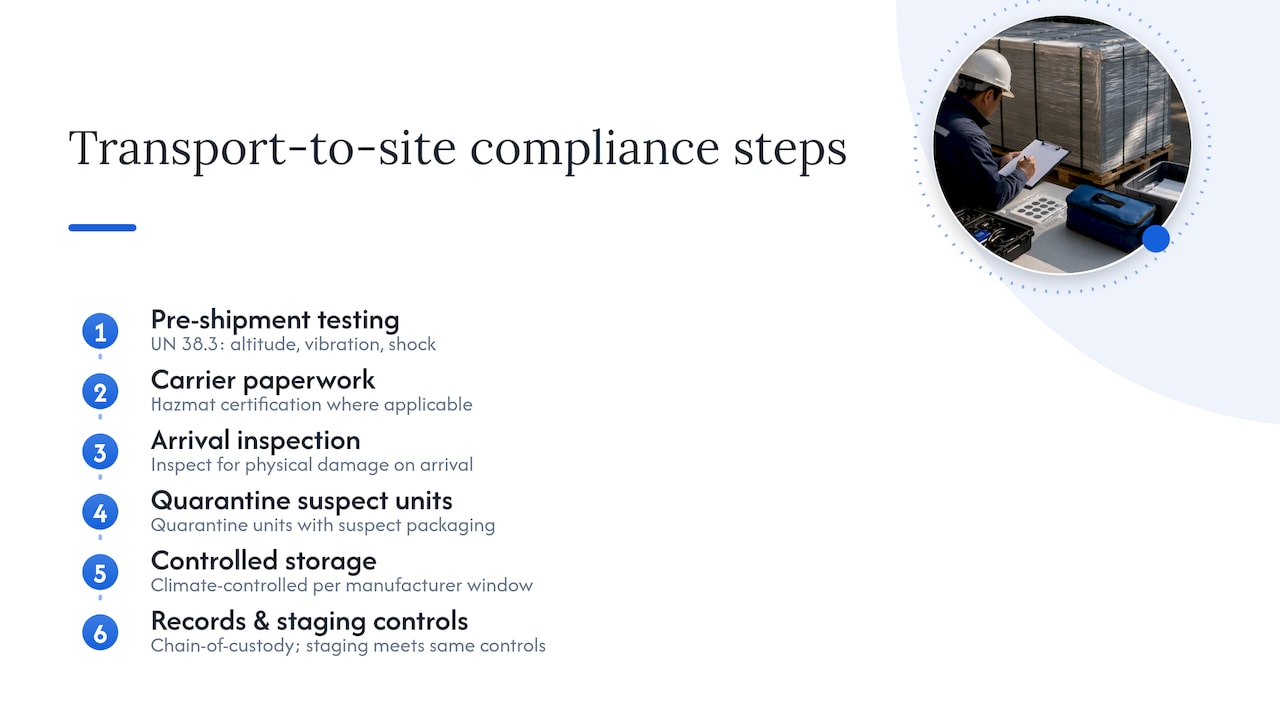
Cells and modules face mechanical stress, vibration, and pressure changes long before they reach a site, which is why UN 38.3 testing applies before shipment. According to transport-focused BESS guidance, these tests verify a battery’s ability to withstand altitude, vibration, shock, and short-circuit conditions during transport, and compliance documentation should travel with the shipment, not get requested after delivery.
Receiving teams need a documented handling protocol: inspection for physical damage on arrival, a quarantine process for any unit with suspect packaging, and climate-controlled storage that matches the manufacturer’s temperature and humidity window. Forklift and crane operators moving modules should follow weight-rated lifting points specified by the manufacturer rather than improvised rigging, since battery enclosures are not always built to standard pallet lifting geometry.
Documentation to retain includes the UN 38.3 test summary, the carrier’s hazardous materials certification where applicable, and a chain-of-custody record showing storage conditions from factory to site. If modules sit in a staging yard before installation, that yard should meet the same separation and access requirements that apply to the permanent installation, since a damaged or improperly stored unit creates risk before it is ever energized.
Loading dock procedures matter too: unloading areas near occupied buildings should maintain clearance consistent with your eventual installation setbacks, and any module showing signs of impact damage during transit should be isolated and inspected by the supplier before it goes anywhere near commissioning.
Installation best practices to meet safety standards
Installation quality determines whether a system performs the way its UL 9540A report predicted it would. A design that passed testing on paper can still fail in the field if torque specs, cable routing, or enclosure sealing deviate from the tested configuration.
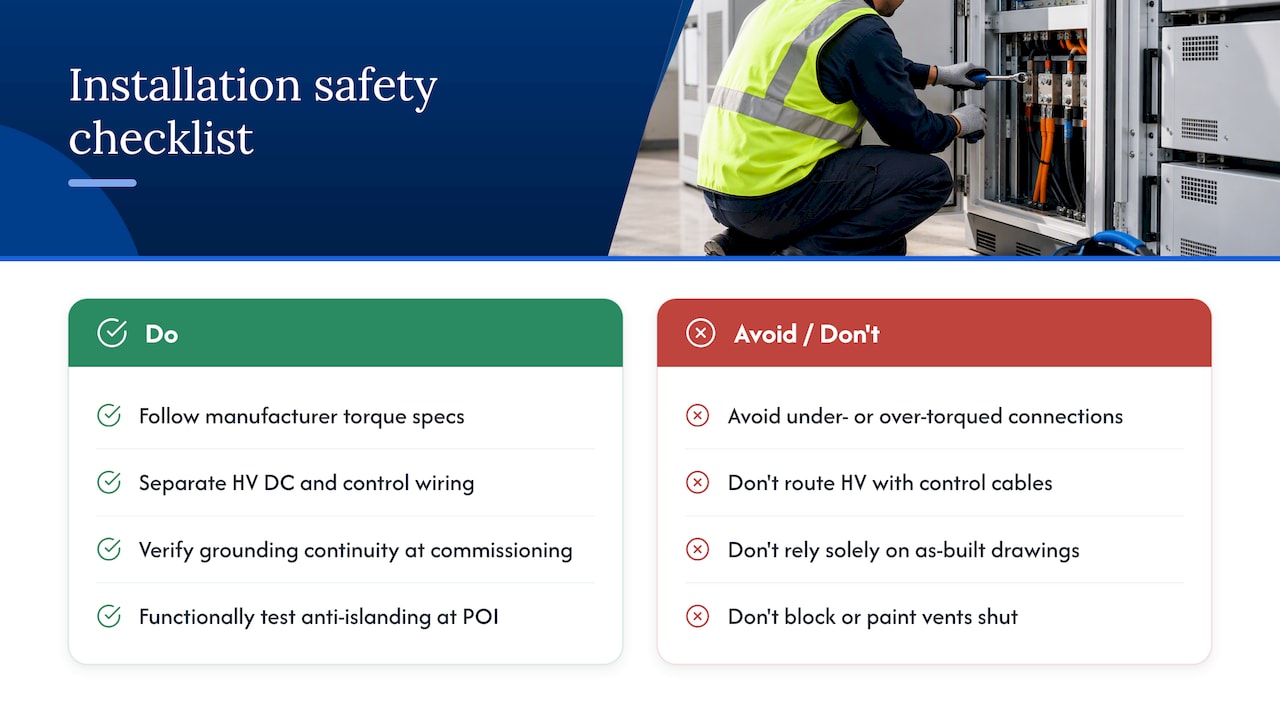
Crews should follow manufacturer-specified torque values on all electrical connections, since under-torqued connections create resistance heating that mimics an early thermal event. Cable routing should maintain separation between high-voltage DC runs and control wiring to avoid interference with BMS monitoring signals. Enclosure doors and vents need to seal and open exactly as tested, since a vent that is painted shut or blocked by site grading defeats the pressure relief design that UL 9540A validated.
Grounding and bonding should be verified with a continuity test at commissioning, not assumed from drawings. Anti-islanding protection required under NEC/NFPA 70 needs functional testing at the point of interconnection, confirming the system actually disconnects under the test conditions utilities expect.
Site grading and drainage around outdoor installations should direct water away from enclosures, and access roads need to support the weight of fire apparatus specified in your emergency response plan, not just delivery trucks. Signage identifying hazard zones, shutoff locations, and emergency contacts should go up during installation, before the final inspection, so inspectors see the finished condition rather than a promise.
Contractor access control matters during this phase too. A system like EntryWatch gives site managers an auditable log of who was on site during installation and a ready emergency roll call list, which supports the contractor induction and access records many AHJs now ask to see alongside the physical inspection.
Regular maintenance and inspection protocols for safety compliance
Certification at commissioning is a snapshot, not a guarantee, so ongoing inspection protocols matter as much as the initial permit. Most installations need a documented maintenance schedule covering BMS calibration checks, thermal imaging of connections, and suppression system functional tests, each logged with dates and findings.
Inspection frequency should match manufacturer guidance and any conditions attached to your original permit, since some AHJs require periodic reporting as a condition of continued operation. Battery management system thresholds should be reviewed against any firmware updates, since a software change that alters alarm setpoints without site verification can quietly erode the safety margin the original testing established.
Visual inspections should check for corrosion, loose connections, blocked vents, and any damage to fire barriers or spacing that may have shifted during other site work. Suppression and detection systems need functional testing on the schedule the manufacturer specifies, not just a visual check that the hardware is present.
Maintenance records, training logs, and inspection reports should be retained in a format ready for AHJ or OSHA review, since these are typically the first documents requested during an enforcement visit or periodic compliance check. Any deviation found during inspection, whether a loose connection or a vent partially obstructed by vegetation growth, should be corrected and logged before it becomes the finding in someone else’s incident report.
Author perspective: a concise priority checklist for delivery teams
If I had to narrow this down to three actions, they would be: confirm which NFPA 855 and UL 9540A editions your AHJ has actually adopted, decide your installation-level testing strategy before design freeze, and draft your FAT/SAT and emergency response documentation in parallel with engineering, not after it. Involve your fire marshal, electrical inspector, and testing lab early, and loop in local fire services before commissioning, not during an incident.
— Hu
How Guoqiang’s Mobile PV-BESS Power Station supports standards-aware deployments
We built the Mobile PV-BESS Power Station as a containerized, engineered system suited to projects that need to move quickly without sacrificing the documentation a permitting process demands. Containerization supports the segmentation and spacing strategies that NFPA 855 compliance depends on, and the manufacturing process generates the FAT and SAT records needed for AHJ submittal.

- Engineered steel container construction suited to outdoor siting and defined separation distances.
- Integrated monitoring supports the telemetry data responders and AHJs increasingly expect to see.
- Manufacturing-stage FAT/SAT documentation available alongside datasheets for your permit package.
| What you need | How this product supports it |
|---|---|
| Containerized spacing strategy | Steel container design built for outdoor separation |
| FAT/SAT records for submittal | Documentation generated during manufacturing |
| Mobility for phased projects | Mobile platform suited to temporary or phased deployments |
Pro Tip: Request the datasheet and FAT/SAT package before your design freeze, not during permit review, so your engineering team can cross-check it against your UL 9540A strategy early.
Project-specific testing and AHJ approval remain the responsibility of your project team no matter which hardware you select. Explore the full product range or review our PV mounting and energy storage container lines for datasheets and compliance documentation to start your evaluation.
FAQ
How safe are BESS systems?
Battery energy storage systems designed to current codes and tested under UL 9540A show measurably reduced propagation risk compared to untested designs, though no system eliminates thermal runaway risk entirely. Layered protection, from cell chemistry through containment and suppression, is the model regulators and reviewers now expect, according to the DOE’s safety strategy.
What are the main battery safety standards?
The core standards are NFPA 855 for installation requirements, UL 9540 and UL 9540A for product and propagation testing, and NEC/NFPA 70 for electrical safety, with IEC 62933 and UN 38.3 covering international and transport requirements respectively. Jurisdictions adopt specific editions of each, so the applicable version depends on local code adoption.
Is NFPA 855 mandatory?
NFPA 855 itself is a standard, and it becomes mandatory only when a jurisdiction’s fire or building code formally adopts it by reference, which most U.S. jurisdictions now do. The 2026 edition is the current reference version, though your local AHJ determines which edition actually applies to your project.
What are the OSHA requirements for lithium battery storage?
OSHA does not maintain a single standard dedicated to lithium battery storage and instead enforces hazards through the General Duty Clause along with standards such as 1910 Subpart S and 1926.441 for battery charging in construction settings. Inspectors typically review emergency action plans, training records, and adherence to manufacturer instructions, per OSHA’s standard interpretation.
Sources
- Key revisions in NFPA 855 (2026) — CSA Group
- Understanding UL 9540A, NFPA 855 — UL Solutions
- Energy Department: Safety strategy for energy storage (2024)
- OSHA interpretation on battery standards enforcement
- California Energy Commission: BESS safety fact sheet (Part 2)