
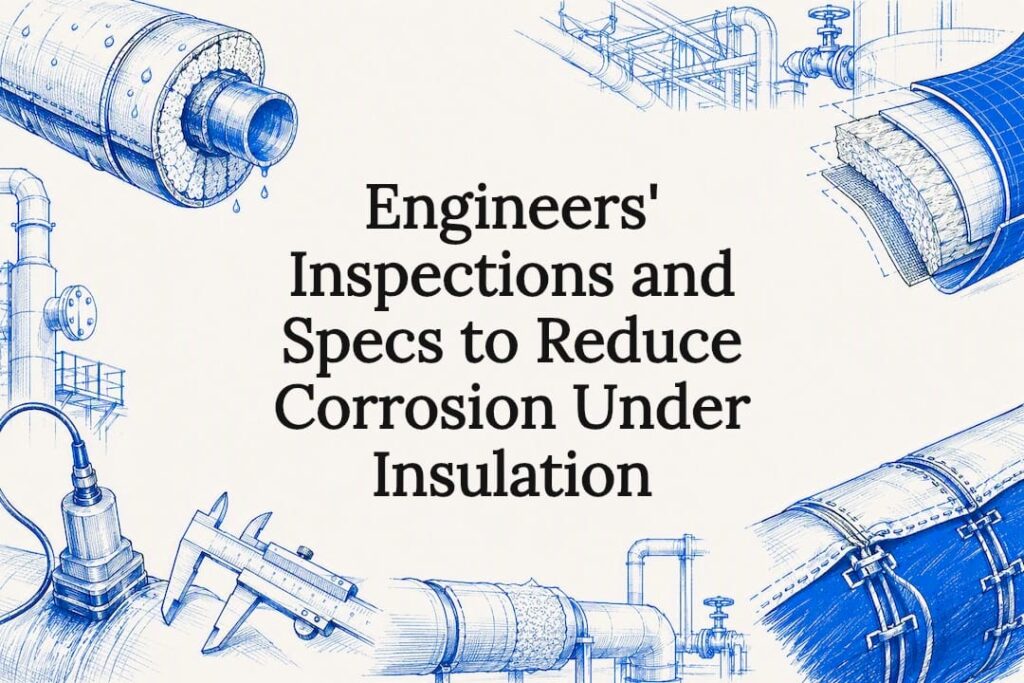
Corrosion under insulation (CUI) is external corrosion that forms on insulated metal when moisture reaches the metal-insulation interface, and it ranks among the costliest integrity threats in process plants. Carbon steel operating between 32°F and 300°F and austenitic stainless steel above roughly 140°F face the highest risk, especially at nozzles, supports, and jacket penetrations. If you manage an insulated asset, inspect those high-risk locations first and confirm jacketing and sealant integrity before anything else.
TL;DR:
- Insulation materials with high leachable chlorides or sulfates, combined with temperature cycling, significantly raise the risk of localized and stress corrosion cracking, especially on stainless steel.
- Inspection intervals should be tailored to asset risk, with high-risk objects inspected every 1 to 3 years and lower-risk items potentially extending beyond five years, depending on jacket and temperature conditions.
- Visual jacket inspections identify many early warning signs, but multi-method non-destructive testing is necessary for detection of internal corrosion, especially ECSCC, which often shows minimal metal loss.
- Corrosion under insulation can increase maintenance costs up to 20 times compared to uninsulated surfaces, mainly due to inspection, removal, and repair expenses over the asset life.
- Implementing prevention measures during design, such as non-wicking insulation and durable coatings like thermal spray aluminum, can significantly reduce CUI occurrence and lifecycle costs.
Table of Contents
- What Causes Corrosion Under Insulation?
- Which Materials and Temperatures Are Most at Risk?
- How Do You Detect Corrosion Under Insulation?
- Coatings, Insulation, and Jacketing That Cut CUI Risk
- How Often Should You Inspect for CUI?
- Which Standards Govern CUI Inspection and Specification?
- What Does Corrosion Under Insulation Actually Cost?
- Publisher Notes on Product and Engineering Context
- How CUI Failures Actually Progress
- Does Insulation Type Change How Hard CUI Is to Find?
- How Do Environmental Conditions Influence CUI Severity?
- What’s New in Real-Time CUI Monitoring?
- Best Practices After Inspection: Drying and Resealing
- The Checklist Every Maintenance Team Skips
- Specify for the Full Asset Life, Not Just Commissioning
- Sources
- FAQ
What Causes Corrosion Under Insulation?
CUI starts with water. Rain, wash-down, deluge testing, or plain humidity work through gaps in the weather jacket, and once inside the insulation system, that moisture has almost nowhere to go. It sits against the pipe or vessel wall, sheltered from sun and airflow, and the insulation that keeps heat in also keeps water from evaporating back out.
Temperature cycling turns that trapped moisture into a corrosion engine. A line that runs hot during operation and cools during shutdowns or intermittent service creates repeated wet-dry cycles at the metal surface. Each cycle concentrates dissolved salts against the steel, and each concentration step raises local corrosivity. This is why CUI often shows up worst on equipment that cycles rather than equipment that runs at one steady temperature.
Insulation itself can make the problem worse. Some insulation materials contain leachable chlorides and sulfates that wash out when wet and deposit directly onto the metal surface. Chlorides are particularly damaging on stainless steel, where they drive external chloride stress corrosion cracking (ECSCC), a failure mode distinct from the general wall-thinning you see on carbon steel.
That distinction matters for how you interpret inspection results. Carbon steel under insulation typically loses metal in a fairly predictable, gradual pattern, so thickness surveys catch it early. Stainless steel behaves differently: ECSCC can initiate as a fine surface crack with almost no measurable metal loss, then propagate through the wall in a comparatively short window. A few additional mechanisms deserve attention when you’re diagnosing root cause:
- Wet-dry cycling concentrates chlorides and sulfates at the metal surface with every evaporation cycle, raising local ion concentration far above the insulation’s average leachable content.
- Crevice conditions at insulation seams, supports, and clips create low-oxygen pockets where localized corrosion cells form and self-sustain.
- Microbial activity, including sulphate-reducing bacteria in groundwater-contaminated insulation, can cause severe localized perforation that standard leachable-ion testing won’t flag.
- **Coating breakdown at pipe supports and penetrations gives water a direct path to bare steel, which is why these points fail first in almost every inspection program.
Recognizing which mechanism is active on a given asset changes your inspection method, your repair scope, and how urgently you need to act.
Which Materials and Temperatures Are Most at Risk?
Temperature range determines susceptibility more than almost any other variable, and it differs sharply by alloy. Carbon and low-alloy steels face their highest CUI risk between 32°F and 300°F, a range wide enough to cover most process piping, storage tanks, and heat exchangers that don’t run consistently hot. Below freezing, water tends to stay frozen rather than cycling; above 300°F, most moisture evaporates before it can sustain a corrosion cell, at least under steady-state operation. The real trouble comes from equipment that spends time inside that window during startup, shutdown, or intermittent service, even if normal operating temperature sits outside it.
Austenitic stainless steel plays by different rules. It’s largely immune to general CUI thinning but becomes vulnerable to ECSCC at roughly 140°F and above, particularly when chlorides are present in the insulation or in contaminated water ingress. Because ECSCC attacks with minimal general metal loss, it can progress toward failure while a routine ultrasonic survey shows the wall looking essentially fine. Inspection programs that treat stainless the same way they treat carbon steel routinely miss this failure mode until a leak forces the issue.
Duplex stainless steels sit in a more favorable position. Their two-phase microstructure gives them meaningfully better chloride stress corrosion cracking resistance than standard 300-series grades, which is why duplex shows up increasingly in coastal and marine-adjacent installations where airborne chlorides are a constant. That resistance isn’t unlimited, though, and duplex still needs the same jacket integrity discipline as any other alloy.
Insulation choice compounds or reduces these risks depending on the material:
- Calcium silicate and mineral wool can leach measurable chloride and sulfate content if manufactured or stored improperly, feeding the corrosion cell directly.
- Cellular glass is essentially closed-cell and non-wicking, so it resists moisture retention even when the jacket is compromised.
- Closed-cell polyurethane and polyisocyanurate foam perform well against moisture uptake but have firm upper temperature limits that rule them out for hot service.
- Perlite and fiberglass vary widely by manufacturer and binder chemistry, so leachable-ion testing matters more here than with cellular glass.
Materials selection and temperature service should drive your inspection frequency and NDT method choice, not just asset age or a generic turnaround schedule.
How Do You Detect Corrosion Under Insulation?
Detecting CUI is inherently harder than detecting external corrosion because the insulation and jacket hide the problem by design. No single method covers every failure mode, which is why effective programs stack multiple techniques rather than relying on one.
Start with what you can see. Visual inspection of the weather jacket catches a surprising share of at-risk locations before any instrument gets involved. Look for damaged or missing cladding, rust staining running down the jacket, failed caulking at seams and penetrations, and standing water or drip marks at low points. Supports, nozzle penetrations, and vertical-to-horizontal transitions deserve extra attention because gravity concentrates water exactly there.
Once you’ve flagged a location, here’s how the main NDT methods stack up:
- Ultrasonic thickness (UT) gauging measures wall thickness directly and gives you a quantitative trend over time, but it requires either insulation removal or an inspection port, and it only measures the single spot you place the probe on.
- Radiography (profile radiography) shows the pipe wall profile through the insulation without removing it, making it effective for spotting general thinning, but it needs two-sided access and radiation safety controls that limit where and when you can run it.
- Pulsed eddy current (PEC) scans through insulation and cladding without removal, covering large areas quickly, but it reports average wall loss rather than pinpoint readings, so small localized pits can go undetected.
- Guided wave testing screens long pipe runs from a single access point, useful for buried or hard-to-reach sections, but sensitivity drops with distance and at complex geometry like tees and flanges.
Each method trades off cost, access, and sensitivity differently, and none of them reliably catches ECSCC on stainless steel, which often needs targeted removal and surface examination or specific crack-detection techniques once chloride exposure is suspected.
Insulation removal remains the only way to confirm what’s actually happening at the metal surface, and it’s unavoidable when visual signs are severe, when PEC or radiography flags an anomaly that needs quantification, or when the asset has never been opened for inspection. Inspection ports and plugs reduce the cost of routine checks by giving you a repeatable access point without removing full insulation runs, but they only work if they’re resealed correctly. A poorly reinstalled inspection port is a documented source of repeat CUI, sometimes worse than the original condition because the plug creates a new moisture entry path.
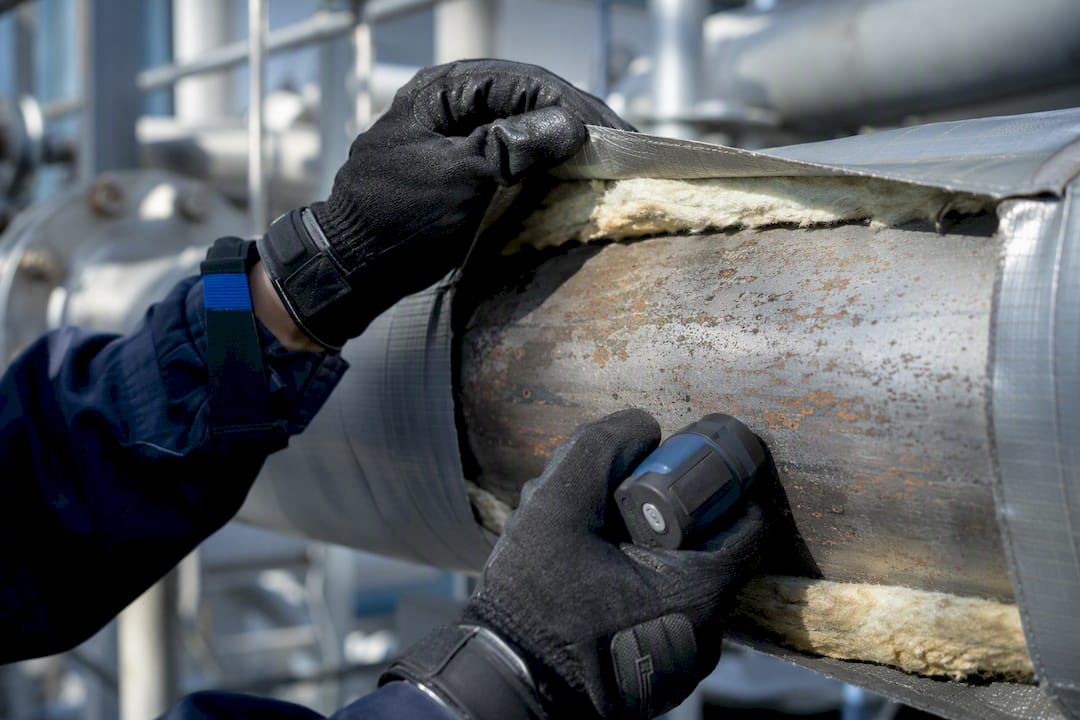
Pro Tip: Photograph every insulation removal location before resealing, and log the jacket seam orientation. When the same spot comes up for reinspection in three or five years, that photo tells you immediately whether the repair held or the water found a new way in.
Coatings, Insulation, and Jacketing That Cut CUI Risk
The most effective CUI control happens at the specification stage, before insulation ever goes on the pipe. Designing out the moisture pathway costs less over an asset’s life than inspecting and repairing around it indefinitely.
Thermal spray aluminum (TSA) is the coating of choice for the most demanding CUI environments. Properly applied TSA can deliver service life beyond 25 years while providing sacrificial galvanic protection even where the coating gets scratched or damaged, unlike organic coatings that only protect where the film stays intact. TSA’s tradeoff is application cost and the surface preparation it demands, which is why it tends to show up on high-consequence assets and newer construction rather than as a blanket retrofit.
Organic coatings remain the workhorse for less severe service. Epoxy-phenolic systems handle moderate temperatures well and cost less to apply than TSA, while polysiloxane coatings offer strong UV and weathering resistance for exposed sections. Both have firm temperature ceilings, so check the manufacturer’s data sheet against your actual operating and cycling temperature, not just the nameplate rating.
Insulation selection deserves the same rigor as coating selection:
- Cellular glass resists moisture absorption almost entirely, making it a strong default for wet or humid service despite a higher material cost.
- Closed-cell foam performs well in moderate temperature service and resists wicking, but check its upper limit against your process conditions.
- Hydrophobic-treated mineral wool reduces water uptake compared to standard wool while keeping the lower material cost.
- Non-contact or standoff systems that create a small air gap between insulation and pipe wall have been shown to meaningfully reduce CUI rates by letting trapped moisture evaporate rather than sit against the metal.
Jacketing details finish the job. The weather jacket and vapor barrier function as the first line of defense and, in practice, the only economical point of maintenance once insulation is installed. Overlapping seams should shed water downward, never trap it. Caulking at penetrations, flashings at vertical transitions, and properly pitched drip points all matter more than the insulation grade itself if the jacket fails.
Pro Tip: When specifying insulation for a new project, ask your coating and insulation vendors for compatibility data together, not separately. Some insulation binders react poorly with certain primer chemistries, and that incompatibility only shows up years later as blistering you’ll misdiagnose as a coating defect.
How Often Should You Inspect for CUI?
Risk-based inspection (RBI) turns a fixed turnaround schedule into a prioritized one, and for CUI specifically it works by scoring likelihood of damage against consequence of failure. Likelihood factors in insulation type, operating temperature range, geographic exposure, jacket condition, and time since last inspection. Consequence factors in fluid hazard, pipe size, and what’s nearby if a leak occurs. API RP 583 is the central reference plant owners use to structure this scoring and to define inspection scope and methods for CUI specifically.
A practical inspection cadence follows from that scoring, though every plant should adjust to its own risk tolerance and regulatory environment:
- High-risk assets (carbon steel in the 32°F–300°F band, or stainless above 140°F, with poor jacket condition or known chloride exposure) generally warrant inspection every one to three years.
- Moderate-risk assets with intact jacketing and moderate temperature cycling can often move to a three to five year interval.
- Lower-risk assets, meaning steady-state temperatures outside the susceptible windows with well-maintained jacketing, may extend past five years if trending data supports it.
RBI has real limits, though. On assets where a failure would be catastrophic, whether due to toxicity, pressure, or proximity to people, RBI alone can understate necessary caution; pair the risk score with conservative design margins and better coatings rather than trusting the interval alone.
Whatever cadence you land on, trend the data. A single thickness reading tells you where an asset stands today; a corrosion map built from repeated readings at the same locations tells you the rate, which is what actually predicts remaining life. And when insulation goes back on after any inspection, verify the reseal: check seam overlap, caulking, and jacket fasteners before signing off, since a rushed reclose after a good inspection undoes the benefit of having inspected at all.
Which Standards Govern CUI Inspection and Specification?
API RP 583 is the document to keep on hand for anything CUI-related. It covers design considerations that reduce susceptibility, inspection methods and intervals, mitigation options, and how to fold CUI into a broader RBI program. If you’re writing an inspection specification or arguing for budget to address a known CUI issue, RP 583 is the reference that gives your position technical weight.
ASTM standards matter most on the insulation procurement side. ASTM C795 governs testing insulation materials intended for use on austenitic stainless steel, specifically checking for leachable chloride, fluoride, silicate, and sodium ion content that could initiate ECSCC. Specifying insulation to C795 compliance at the procurement stage is one of the cheaper preventive steps available, since it’s a paperwork requirement rather than a design change.
Beyond these two, a few other references round out a complete program:
- NACE/AMPP guidance on coating selection and application complements API RP 583’s inspection focus with surface preparation and coating performance detail.
- ISO standards on thermal insulation provide material property test methods that some specifications reference alongside ASTM.
- Site and regional regulations can add requirements beyond these baseline standards, particularly around asbestos-era insulation removal or specific environmental permits, so confirm local requirements before finalizing a scope.
Build your specification around API RP 583 and ASTM C795 first, then layer in whatever regional requirements apply to your facility.
What Does Corrosion Under Insulation Actually Cost?
CUI is not a minor line item. Industry data from ExxonMobil and related sources indicate CUI accounts for roughly 40% to 60% of piping maintenance expenditures in the oil and gas sector, and corrosion rates under insulation can run up to 20 times higher than equivalent uninsulated exposure. That gap exists precisely because insulation hides the problem while creating the exact wet, cyclic conditions corrosion needs.
Corrosion rates beneath insulation can reach up to 20 times those seen on equivalent uninsulated surfaces, largely because trapped moisture and thermal cycling create conditions open air simply doesn’t produce.
The cost breakdown behind that percentage typically includes:
- Inspection labor and scaffolding, often the single largest recurring cost since insulation removal and reinstallation around access points adds up over a plant’s life.
- Insulation removal and reinstallation, which multiplies fast when a facility discovers CUI broadly rather than catching it early at isolated points.
- Pipe and vessel repairs, ranging from spot patches to full section replacement depending on how far corrosion progressed before detection.
- Unplanned outages, the most expensive category by far when a leak forces an emergency shutdown instead of a scheduled repair.
Lifecycle math tends to favor upfront investment. A facility that specifies TSA or non-wicking insulation at construction spends more capital initially but avoids the repeating cycle of frequent inspection, insulation removal, and organic recoat that a cheaper initial spec locks in for decades. Designing out the problem rather than inspecting around it consistently comes out ahead once you run the numbers over a 20 or 30 year asset life.
Publisher Notes on Product and Engineering Context
Jiangsu Guoqiang Holding Group has manufactured high-strength steel infrastructure products since 1998, holding over 40% domestic market share in traffic safety products and over 20% in photovoltaic solutions in China, with contributions to more than 3,000 photovoltaic projects worldwide.
For engineering teams managing CUI-sensitive projects, a few product categories intersect directly with insulation and coating decisions:
- Energy storage containers and E-House enclosures involve insulated steel envelopes where jacket integrity and coating selection matter just as much as they do on process piping.
- Annular pipe products used in data center cooling applications carry the same moisture-management considerations as process piping when insulated for thermal control.
- Mounting systems and structural brackets supporting insulated equipment need corrosion-resistant coatings at every fastener and support point, since supports are consistently among the first failure locations in any CUI survey.
Teams specifying insulated systems for a new build or retrofit can request engineering consultation and project-specific datasheets directly through Gq-international’s project inquiry channels.
How CUI Failures Actually Progress
CUI rarely jumps straight from sound metal to a through-wall leak. It moves through recognizable stages, and knowing which stage an asset is at changes both urgency and repair scope.
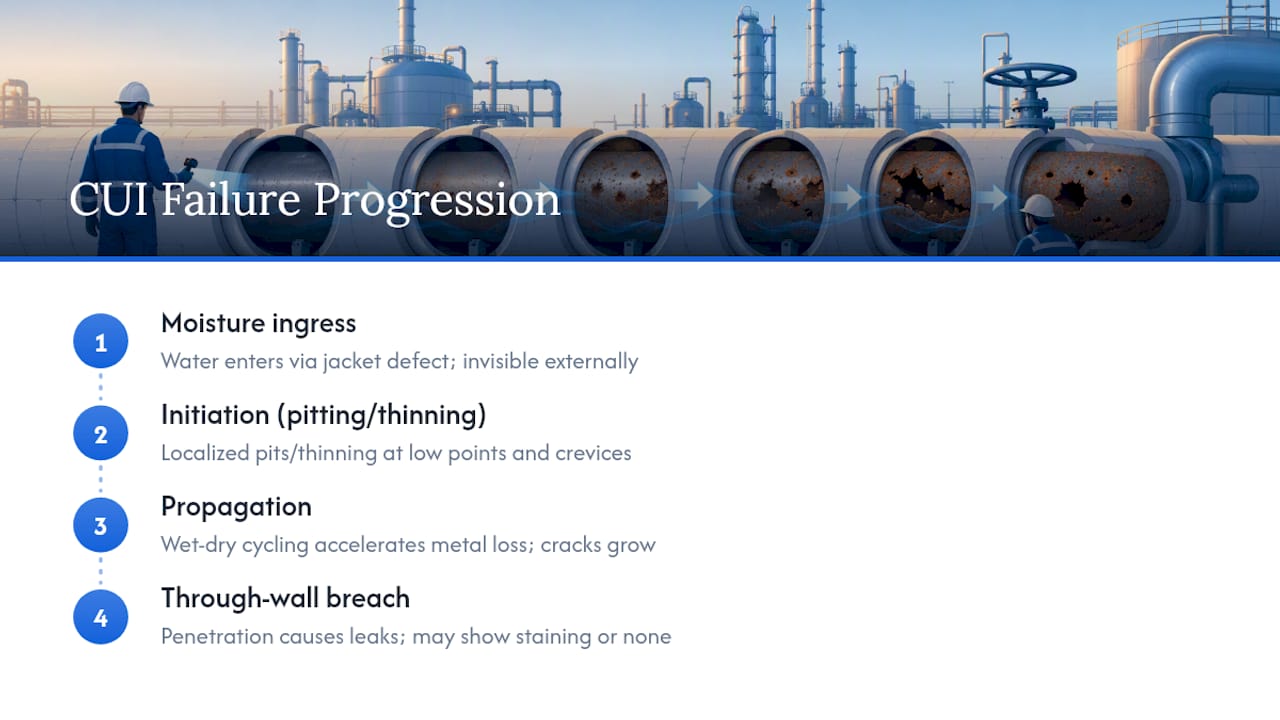
Stage one is moisture ingress with no visible external sign. Water has entered through a jacket defect but hasn’t yet caused measurable corrosion. This stage is invisible without insulation removal or moisture-sensitive NDT, which is why routine visual jacket inspection matters so much upstream of it.
Stage two is initiation: pitting or general thinning begins at the metal surface, often localized at low points or crevices where water pools. On carbon steel this shows as scattered shallow pits; on stainless steel exposed to chlorides, this is where ECSCC cracks can begin initiating at the surface.
Stage three is propagation. Wet-dry cycling accelerates metal loss on carbon steel into a measurable, trending thickness reduction. On stainless, ECSCC cracks grow through the wall thickness, often faster than general corrosion would suggest, because crack growth doesn’t require broad material loss to reach critical depth.
Stage four is breach: through-wall penetration resulting in a leak, sometimes preceded by visible staining or weeping through the jacket seam, sometimes with no external warning at all if the crack path stays contained until final rupture. Catching an asset at stage one or two through routine inspection is dramatically cheaper than discovering it at stage four during an unplanned outage.
Does Insulation Type Change How Hard CUI Is to Find?
Insulation material affects both how fast CUI develops and how hard it is to detect, and the two effects don’t always point the same direction. Cellular glass resists moisture retention well, which slows corrosion initiation, but its rigid, closed-cell structure can also mask early jacket leaks longer because water doesn’t visibly wick or stain the surface the way it does with absorbent materials.
Mineral wool and fiberglass wick moisture readily, which sounds like a purely negative trait, but it also means water damage shows up faster as visible staining and wet insulation, giving inspectors an earlier warning sign. The tradeoff is that these materials often carry higher leachable chloride and sulfate content depending on manufacturing quality, so once moisture is present, the corrosion mechanism has more fuel to work with.
Diagnostic challenges compound with insulation thickness and density. Thicker insulation improves thermal performance but reduces the sensitivity of pulsed eddy current and radiography, since both methods lose resolution as the standoff distance from probe to metal increases. Dense, tightly packed insulation also makes full removal more labor-intensive, which pushes some inspection programs toward spot removal at high-risk points instead of comprehensive surveys, a compromise that works only if those spot locations are chosen well using the visual and mechanism-based risk factors described earlier.
How Do Environmental Conditions Influence CUI Severity?
Location changes everything about CUI risk, and coastal or marine-adjacent facilities face a materially harder problem than inland plants. Airborne salt spray deposits chloride directly onto jacket surfaces and, once a jacket defect exists, carries that chloride straight to the insulation and metal surface. This is precisely the exposure that pushes stainless steel toward ECSCC at lower threshold concentrations than a chloride-free environment would produce.
Industrial atmospheres carrying sulfur compounds, common near refineries, power plants, and chemical processing, contribute leachable sulfates that behave similarly to chlorides in accelerating localized corrosion cells. Facilities in these atmospheres often see faster CUI progression at the same temperature and insulation spec as an otherwise identical inland plant, simply because the ambient contaminant load feeding the corrosion cell is higher.
Humidity and rainfall frequency matter independent of contaminant load. A facility with frequent rain and high ambient humidity keeps insulation systems wetter more of the year, extending the wet phase of every wet-dry cycle and giving corrosion more active time per year than a dry climate with the same jacket condition. Facilities near cooling towers or water treatment operations face an added variable: process water mist can settle onto insulated equipment even when the equipment itself has no water exposure by design.
None of these environmental factors are things you can engineer away entirely, but they should directly inform inspection frequency. A coastal facility with sulfate-laden humid air justifies materially tighter inspection intervals than the same equipment inland, even with identical insulation and coating specifications.
What’s New in Real-Time CUI Monitoring?
Fixed-point corrosion sensors represent the biggest shift in CUI detection over the past decade. These devices mount permanently at high-risk locations, typically under the insulation at supports or low points, and report wall thickness or corrosion rate data continuously rather than waiting for a scheduled inspection to catch damage that’s already progressed.
Wireless ultrasonic sensors now allow continuous thickness monitoring at fixed points without insulation removal for each reading. Once installed during a planned outage or new construction, they transmit data on a set interval, letting engineers watch a thinning trend develop in near real time instead of comparing two isolated readings years apart. This matters enormously for ECSCC-susceptible stainless assets, where waiting years between manual inspections can mean missing the entire crack propagation window.
Fiber optic and moisture-sensing cables represent an earlier-stage detection layer, placed to sense moisture presence at the metal-insulation interface before corrosion even begins. Because moisture content correlates strongly with CUI onset, a moisture alarm gives maintenance teams a chance to dry out and reseal a section before metal loss starts, rather than discovering the problem after thinning is already measurable.
These technologies cost more upfront than periodic manual inspection and won’t replace it entirely, but they make the most sense on high-consequence, hard-to-access assets where continuous data justifies the investment, buried piping, elevated structures, and anything where an unplanned shutdown for inspection access is prohibitively expensive.
Best Practices After Inspection: Drying and Resealing
What happens after you find CUI matters as much as finding it. A rushed reclose is one of the most common ways facilities create repeat corrosion at the exact location they just repaired.
Once insulation comes off and any corrosion repair is complete, the metal surface needs to be fully dry before new insulation goes back on. Trapped residual moisture under freshly reinstalled insulation restarts the wet-dry cycle immediately, sometimes producing faster corrosion than the original defect because the surface is now bare of any protective mill scale or aged coating.
Damaged insulation should be replaced rather than reused wherever it shows signs of saturation, since wet insulation that dries out doesn’t necessarily flush out the leachable ions it picked up during exposure. New insulation installed at the repair point should match or exceed the moisture-resistance properties of the surrounding system, not just the cheapest available match.
Resealing the jacket is where most repeat failures originate. Overlap seams need to shed water downward, caulking needs to fully seal penetrations and terminations, and any inspection port used during the survey needs its plug reinstalled with the same care as the original installation, not treated as a quick afterthought once the inspector has moved on. Document the repair location, insulation type, and reseal date so the next inspection cycle can specifically check whether that repair held.
The Checklist Every Maintenance Team Skips
Most CUI failures trace back to the same handful of avoidable mistakes: treating jacket inspection as optional between turnarounds, applying the same inspection method to carbon steel and stainless without adjusting for ECSCC risk, reinstalling insulation without verifying the metal is fully dry, choosing insulation on thermal performance alone without checking leachable ion content, skipping inspection at supports and penetrations because they’re harder to access, and closing out inspection ports without documenting whether the reseal actually held.
A workable priority list starts with jacket integrity. Walk the insulated inventory annually looking for cladding damage, staining, and failed sealant, and flag anything at supports, low points, and vertical transitions for follow-up. Rank flagged locations by temperature service and alloy, since carbon steel in the 32°F–300°F window and stainless above 140°F carry the highest urgency. Then match NDT method to the failure mode you actually suspect, not the method that’s easiest to schedule.
Pro Tip: If a stainless line has never had a targeted ECSCC inspection, don’t assume a clean UT survey means it’s fine. Ask specifically for crack-oriented inspection at insulation supports before signing off on remaining life.
— Hu
Specify for the Full Asset Life, Not Just Commissioning
Managing corrosion under insulation risk starts at the design table, and Gq-international works with project teams that need steel infrastructure built for the moisture, temperature cycling, and coastal exposure conditions that drive CUI in the first place. Whether you’re specifying energy storage containers with insulated steel envelopes or an E-House enclosure that needs to hold up in a humid industrial site, the structural steel choices you make now determine how much corrosion management your maintenance team inherits later.

A manufacturing background provides an advantage for project teams weighing insulation and jacketing decisions against structural specs: in-house production means mounting systems, brackets, and enclosure steel come from a single quality-controlled source rather than a patchwork of vendors with inconsistent coating standards. For solar and renewable installations, that consistency extends to OEM and ODM mounting solutions engineered for the site conditions the project actually faces, not a generic catalog spec.
If your project involves insulated piping, cooling infrastructure, or enclosure steel exposed to the temperature and moisture conditions that drive CUI, request a project-specific datasheet or engineering consultation through Gq-international’s product catalog to start the specification conversation now.
Sources
For deeper technical grounding beyond this guide, consult API RP 583 directly for inspection and design specifications, and the MDPI review of CUI in oil and gas for a comprehensive mechanism and economics summary. Insulation Outlook magazine and Inspectioneering’s CUI topic pages offer practical, field-oriented guidance that complements the formal standards.
- Corrosion Under Insulation: Prevention Measures – Insulation Outlook Magazine
- Corrosion under insulation (CUI) detection guide – Atlantis NDT
- A Review of Corrosion under Insulation: A Critical Issue in the Oil and Gas Industry (PDF)
- API RP 583 Corrosion Under Insulation and Fireproofing (recommended practice summary)
FAQ
What Are the Three Main Causes of Corrosion Under Insulation?
Moisture ingress through a damaged weather jacket, temperature cycling that drives repeated wet-dry cycles, and leachable chlorides or sulfates from the insulation itself are the three primary drivers. Together they create the electrochemical conditions needed to sustain corrosion at the metal surface.
What Are the Four Types of Corrosion Damage Seen Under Insulation?
The main patterns are general (uniform) metal loss, localized pitting, external chloride stress corrosion cracking (ECSCC) on stainless steel, and microbially influenced corrosion from bacteria like sulphate-reducing bacteria in contaminated groundwater. Each requires a different detection approach, since thickness gauging alone can miss ECSCC and microbial attack.
What Are the Common Problems With Insulation That Lead to CUI?
Damaged or poorly sealed weather jackets, insulation materials with high leachable chloride or sulfate content, and insulation that retains moisture instead of shedding it are the most common contributors. Non-wicking materials like cellular glass and properly maintained jacket seams address most of these problems directly.
How Often Should Insulated Equipment Be Inspected for CUI?
High-risk assets, meaning carbon steel in the 32°F–300°F range or stainless above 140°F with compromised jacketing, generally need regular inspection at intervals determined by risk assessment. Lower-risk assets with intact jacketing and steady-state temperatures outside those windows can often have longer inspection intervals, based on a risk-based inspection program structured around API RP 583.
Can Corrosion Under Insulation Be Prevented Entirely?
No single measure eliminates CUI risk completely, but combining non-wicking insulation, TSA or epoxy-phenolic coatings, ASTM C795 compliant materials, and disciplined jacket maintenance reduces risk substantially. Design-out strategies applied at the specification stage consistently outperform reactive inspection and repair over an asset’s full life.