Choose protection by exposure class, not by habit: for most highway and bridge guardrails, hot-dip galvanizing remains the baseline solution. In marine, salt-spray, or heavy de-icing environments, that baseline needs reinforcement, thicker zinc coatings, supplementary paint systems, or alternate alloys. Before you specify galvanizing on high-strength steel, get written confirmation that the alloy has been tested for thermal compatibility.
TL;DR:
- Hot-dip galvanizing remains the standard protection for most highway guardrails, delivering 50 to 100 years before first maintenance, depending on exposure class.
- Coastal and heavily salted environments require thicker zinc coatings, supplementary paint, or alternative alloys due to increased corrosion risks.
- Designing guardrails with proper drainage, sealed joints, matched fastener coatings, and modular lengths reduces localized corrosion significantly.
- Procurement should specify coating thickness by exposure class, require steel heat treatment confirmation for high-strength alloys, and include strict quality certification requirements.
- Longer-term costs favor durable systems like galvanizing, with inspection frequencies tailored to environmental severity, ensuring lifecycle performance.
Table of Contents
- What Causes Corrosion in Steel Guardrails and How Do You Classify Exposure?
- How Do Galvanizing, Weathering Steel, and Coatings Compare?
- What Design Details Prevent Localized Corrosion?
- What Belongs in a Guardrail Corrosion-Protection Specification?
- How Should You Plan Lifecycle Cost and Maintenance?
- How Guoqiang’s Guardrail and Mounting Systems Fit Corrosion Specifications
- What Procurement Teams Consistently Get Wrong
- Request Datasheets and MTRs for Your Guardrail Procurement
- Sources
- FAQ
What Causes Corrosion in Steel Guardrails and How Do You Classify Exposure?
Corrosion starts with a simple reaction: steel, moisture, and oxygen combine to form iron oxide, and the process accelerates whenever an electrolyte is present to carry current between anodic and cathodic sites on the metal surface. Chlorides from de-icing salt or sea spray dramatically speed this up. So does sulfur dioxide near industrial corridors, high ambient humidity, and repeated freeze-thaw cycling that pumps water into microcracks and coating defects.
Three corrosion patterns show up repeatedly on guardrail hardware:
- Pitting corrosion concentrates attack at coating breaks or scratches, common at bolt holes and impact points.
- Crevice corrosion develops in tight gaps, lapped joints, and the interior of hollow rail sections where oxygen is limited and chloride concentrates.
- Galvanic corrosion occurs when dissimilar metals contact, such as an uncoated fastener against a galvanized rail, creating a sacrificial cell that eats away the more active metal.
Procurement teams need a shared vocabulary for site severity. The ISO 9223 exposure-class system, referenced in FHWA’s service-life design guidance, ranges from C1 (dry, indoor-like conditions) through C5 and C5M (coastal and heavy industrial atmospheres with constant salt or chemical loading). A guardrail on a dry interior highway sits in C2 or C3. The same rail on a coastal bridge deck exposed to salt spray and de-icing runoff belongs in C4 or C5M. Exposure class should drive both the coating thickness you specify and how often you schedule inspections.
How Do Galvanizing, Weathering Steel, and Coatings Compare?
Hot-dip galvanizing (HDG) works by forming a metallurgically bonded series of zinc-iron intermetallic layers on the steel surface. That bond gives two layers of defense: a physical barrier against moisture and oxygen, plus cathodic protection, meaning the zinc corrodes preferentially and protects exposed steel even where the coating is nicked. Depending on coating thickness and atmosphere, HDG structures commonly deliver 50 to 100 years to first maintenance in typical highway environments, which is why it remains the default choice on most guardrail contracts.
Weathering steel takes a different route. It relies on alloying elements (copper, chromium, nickel) to form a tight, adherent rust patina that slows further oxidation once it stabilizes. That patina needs alternating wet and dry cycles to form properly, which makes weathering steel a poor fit for constantly wet, coastal, or heavily salted sites where the patina never fully dries and corrosion just keeps progressing.
Coil-applied or powder-coated finishes offer a third path. Comparative outdoor exposure testing has found that coil zinc or zinc-aluminum coated rails can match piece-galvanized performance over five years, though the same research flagged aesthetic and durability shortcomings in powder-coated alternatives. Treat coating equivalence claims as something to verify through exposure data, not something to assume.
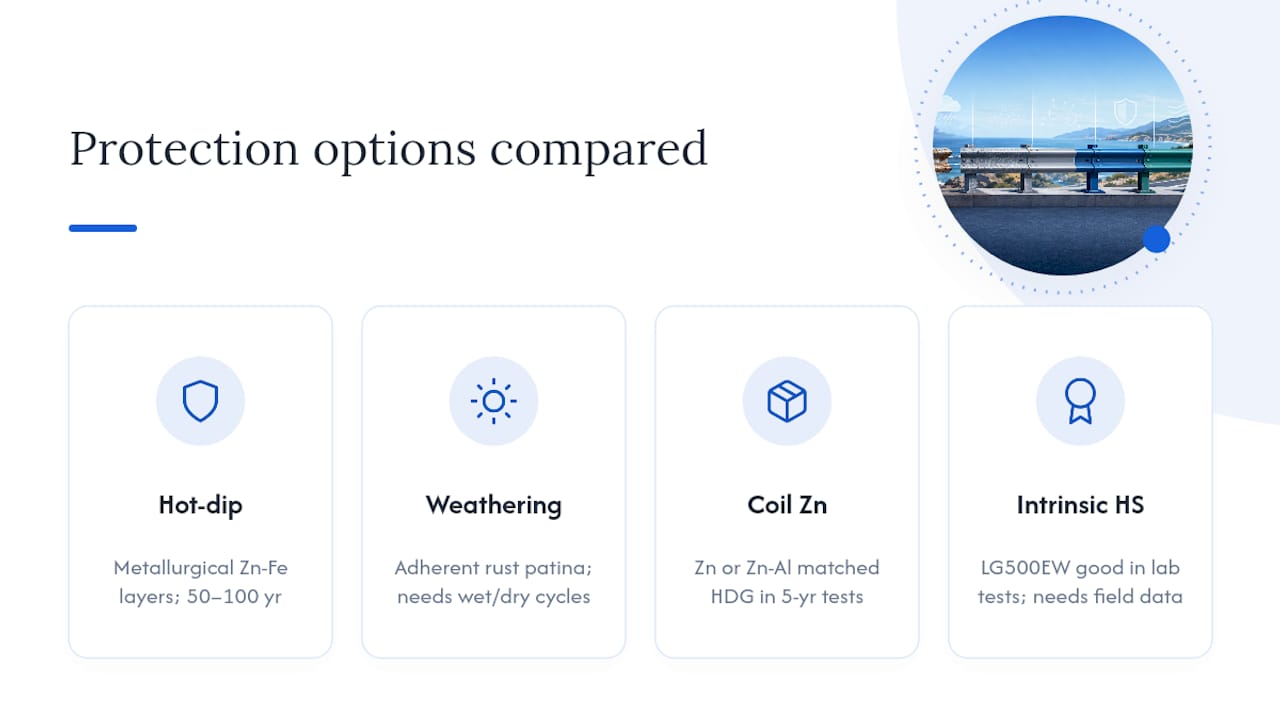
A newer category worth watching: coating-free, high-strength steels engineered for intrinsic corrosion resistance. The LG500EW alloy showed superior accelerated-test corrosion resistance compared to conventional low-alloy steel in industrial marine simulations, forming a protective rust layer without any applied coating. That is a genuinely interesting development for lifecycle carbon, since fusion nano-coating processes have also been shown to cut emissions relative to traditional galvanizing. But an accelerated lab test is not fifteen years of coastal service, and procurement teams should ask for long-term field exposure data before committing to volume orders.
Pro Tip: Never assume a high-strength steel can go straight into the galvanizing kettle. Some heat-treated, high-yield alloys are susceptible to hydrogen embrittlement or strength loss during the galvanizing process, and the risk rises for steels above roughly 460 MPa yield strength.
What Design Details Prevent Localized Corrosion?
Detailing decisions made at the drawing-board stage often matter more than the coating spec itself. Four rules belong in every guardrail fabrication package:
- Design drainage into every hollow member. Specify drain holes at low points on posts and rail sections; standing water inside a tube is a slow, invisible corrosion cell that no coating fully stops.
- Avoid crevice-forming joints. Where lapped or bolted connections are unavoidable, seal them or specify continuous welds instead, and coat surfaces before final assembly wherever the design allows.
- Match fastener coatings to the base metal. Pair HDG rails with HDG fasteners to avoid galvanic mismatches; mechanical galvanizing is a viable option for smaller hardware where thermal dipping risks distortion.
- Design for the kettle, not against it. Break long assemblies into modular lengths sized to the galvanizer’s dip-tank dimensions. Oversized components forced into double-dipping often show incomplete coating coverage and higher thermal distortion risk.
For hollow posts specifically, interior surfaces need the same coating attention as exterior faces. Specifiers guidance recommends designing vent and drain holes so interior surfaces receive full HDG coverage, and requiring acceptance inspection to confirm interior coating wherever the geometry allows a camera or borescope check.
What Belongs in a Guardrail Corrosion-Protection Specification?
A specification that does not name a test standard is not enforceable. Reference ASTM A123 or EN ISO 1461 for hot-dip galvanizing quality, ASTM A385 for good galvanizing practice, and your governing AASHTO or FHWA exposure guidance for service-life targets.
Beyond standards citations, your bid documents and purchase orders should require:
- Minimum coating thickness by exposure class, not a single blanket number across the whole contract.
- Mill test reports (MTRs) confirming chemistry and mechanical properties for every heat of steel used.
- Galvanizer certification and a defined sampling and inspection regime for coating thickness and adhesion.
- Written repair procedures for damaged coatings, including touch-up compound specifications and rejection thresholds.
- Storage, stacking, and handling rules that prevent coating damage before installation, plus a defined acceptance-on-arrival check.
By the numbers: hot-dip galvanized coatings on transportation structures commonly deliver 50 to 100 years to first maintenance depending on atmosphere and thickness, a range wide enough that your exposure classification, not the coating alone, determines where in that band your project actually lands.
How Should You Plan Lifecycle Cost and Maintenance?
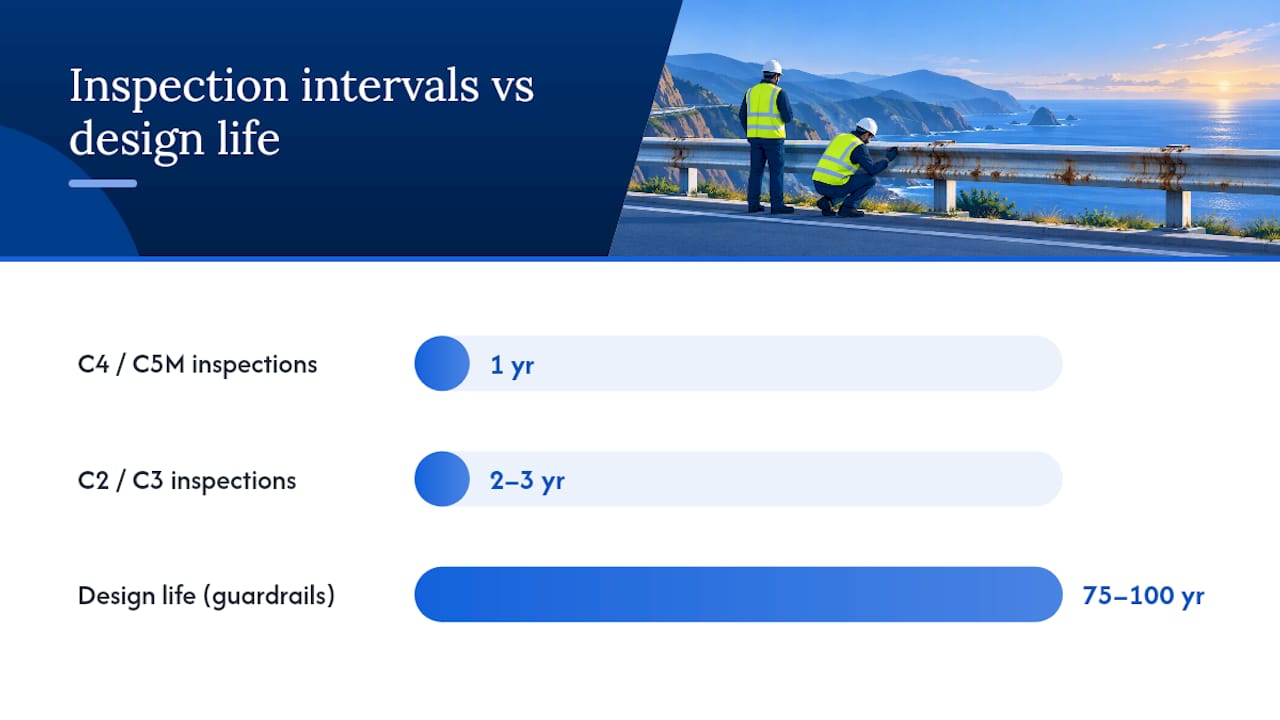
The math on corrosion protection almost always favors paying more upfront. Lifecycle-cost analyses of steel corrosion systems consistently find that durable systems like galvanizing become the cheaper option once you fold in maintenance labor, traffic control during repairs, and downtime over 75 to 100 year design lives.
Translate that into a working maintenance plan:
- Set inspection cadence by exposure class: annual visual checks in C4/C5M environments, every two to three years in milder C2/C3 zones.
- Choose repair strategy by damage extent: touch-up compound for small nicks, localized re-galvanizing for larger sections, full replacement when base metal loss exceeds design tolerances.
- Watch handling damage closely. Comparative reinforcement testing found that bending, UV exposure, and transport damage degrade coating durability well before the coating itself would otherwise fail.
- Build maintenance obligations or performance bonds into the supply contract, so whole-life accountability does not evaporate once the guardrail is installed.
How Guoqiang’s Guardrail and Mounting Systems Fit Corrosion Specifications
Guardrail corrosion prevention succeeds or fails on manufacturing discipline as much as material choice. Gq-international’s guardrail production runs alongside its mounting-system lines, including the GQ-A Series Fixed-Adjustable Mounting System and GQ-F Series Fixed Mounting System, both built to modular dimensions that align with galvanizing kettle constraints rather than forcing oversized single-piece dips.
For procurement teams evaluating a supplier against the checklist above, the practical next step is direct: request coating-thickness data by exposure class, mill test reports for the steel heats involved, and a factory capability statement covering galvanizing partnerships and in-house quality control. Ask, too, how flexible support components like the GQ-FL series flexible support handle joint detailing, since flexible connections carry their own crevice-corrosion considerations distinct from rigid rail sections.
What Procurement Teams Consistently Get Wrong
Most guardrail failures I’ve seen documented trace back to a spec that treated corrosion protection as a checkbox rather than an engineering decision tied to a specific site. Exposure classification is the whole game. Skip it, and you either overpay for protection a dry inland site never needed or underprotect a coastal structure that will need repair inside a decade.
The one place I’d tell every buyer to slow down: high-strength steel and thermal galvanizing. Do not take a supplier’s word that an alloy is compatible. Require metallurgy confirmation and hydrogen embrittlement test data before the first kettle dip, and if that data does not exist yet, specify mechanical galvanizing or an alternate coating system instead.
— Hu
Request Datasheets and MTRs for Your Guardrail Procurement
A certain company manufactures guardrails alongside modular mounting hardware, enabling procurement teams to source both structural rail components and fixed or adjustable mounting systems from a single supplier. That combination matters when your specification demands consistent coating thickness and joint detailing across every connected part, not just the rail itself.
If your project calls for engineered supply beyond standard rail sections, Gq-international’s OEM and ODM mounting solutions cover project-specific engineering work, from modular sizing for galvanizing compatibility to custom fastener specifications. Procurement teams ready to move forward should request coating-thickness data by exposure class, current mill test reports, and a factory capability statement directly through the Guoqiang product catalog, or start with the company overview to identify the right product line for a specific bridge or highway contract.
Sources
- PLOS ONE: fusion nano-coating vs galvanizing (2026)
- Hot-Dip Galvanizing Bridge Design Guide (HDG Bridge Design Guide)
- FHWA Service Life Design Reference Guide
- DOAJ: Development of LG500EW high-strength, high-corrosion-resistant steel (2026)
FAQ
What Is the Best Protection Method for Highway Guardrails?
Hot-dip galvanizing is the default choice for most highway and bridge guardrail exposures, giving decades of low-maintenance service through combined barrier and cathodic protection, per the HDG Bridge Design Guide. Coastal or heavy de-icing sites often need thicker coatings or supplementary measures on top of that baseline.
Can High-Strength Steel Be Hot-Dip Galvanized?
Yes, but not without verification. Some heat-treated, high-yield alloys risk hydrogen embrittlement or strength loss during galvanizing, so specifications should require metallurgy confirmation and embrittlement testing before fabrication begins.
How Often Should Galvanized Guardrails Be Inspected?
Inspection frequency should follow exposure class: annual visual checks in coastal or heavy de-icing zones (C4/C5M), and roughly every two to three years in milder environments. Time-to-first-maintenance for HDG structures commonly runs 50 to 100 years depending on atmosphere and coating thickness.
Does Gq-international Supply Corrosion-Resistant Guardrail Systems?
Gq-international manufactures guardrails alongside modular mounting systems, including the GQ-A and GQ-F series, designed with dimensions that accommodate standard galvanizing processes. Procurement teams can request coating-thickness data, mill test reports, and factory capability statements through the product catalog.
Are Coating-Free High-Strength Steels Ready for Guardrail Procurement?
Alloys like LG500EW show promising accelerated-test corrosion resistance in marine simulations, per DOAJ-published research, but lack the multi-decade field history that hot-dip galvanizing has. Treat them as an emerging option requiring long-term exposure validation before large-scale contracts.