
Pick lithium iron phosphate (LFP) when cost per delivered kWh, cycle life, or thermal margin is your binding constraint, which covers most stationary storage and high-mileage fleet work. Pick nickel manganese cobalt (NMC) when mass and volume dominate the spec sheet, such as premium long-range EVs or aviation. Confirm either choice against the supplier’s actual pack-level cycle warranty, decomposition test data, and energy-per-kilogram figures before you sign a contract.
TL;DR:
- NMC batteries offer higher energy density, reducing pack weight and volume for long-range electric vehicles, but trade off safety margin and thermal stability.
- LFP batteries provide a longer cycle life and safer thermal decomposition behavior, making them ideal for stationary storage and high-cycle applications, especially in cold climates.
- Cost advantages of LFP come from avoiding nickel and cobalt, resulting in about 6% lower per kWh cost and 67% longer cycle life in lifecycle cost calculations.
- The decision between chemistry types should focus on system constraints like weight or cost, with NMC suited for space-sensitive designs and LFP for longevity and safety-focused projects.
- Always verify actual pack warranty data and thermal decomposition test results from suppliers, as datasheets often omit critical real-world performance details.
Table of Contents
- LFP vs NMC Batteries: A Quick Technical Comparison
- What Makes LFP and NMC Chemically Different?
- How Do Energy Density, Cycle Life, and Safety Compare in Practice?
- Which Chemistry Costs Less Over the System’s Life?
- Which Chemistry Fits Which Application?
- What Pack-Level and BMS Tradeoffs Should Engineers Budget For?
- Why Gq-International’s Integration Experience Matters Here
- How Do You Choose Between LFP and NMC for Your Project?
- The Chemistry Debate Is Really a Constraints Debate
- Where Gq-International Fits Into Your Battery Project
- Sources
- FAQ
LFP vs NMC Batteries: A Quick Technical Comparison
The two chemistries split cleanly along a handful of measurable axes. Once you see the numbers side by side, the decision usually makes itself.
- Energy density: LFP cells run roughly 90 to 205 Wh/kg; leading NMC and NCA cells reach 200 to 300+ Wh/kg depending on nickel content.
- Cycle life: LFP commonly delivers a notably longer cycle life to 80% state of health (SoH) compared to NMC under comparable conditions.
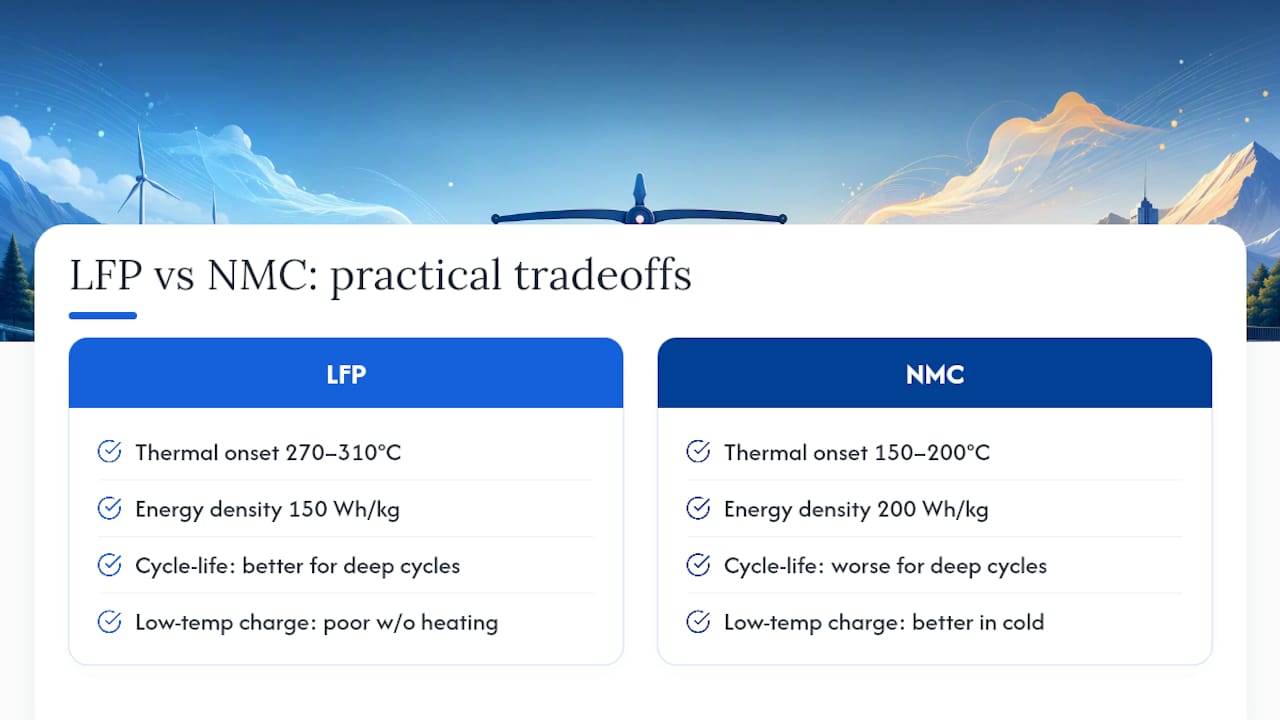
- Thermal decomposition onset: LFP begins decomposing around 270 to 310°C, while NMC starts at a much lower 150 to 200°C.
- Cost and materials: LFP skips nickel and cobalt entirely, cutting exposure to volatile metal markets. NMC’s dependence on both keeps procurement risk higher.
- Best fit: LFP suits stationary storage, buses, and cost driven EVs. NMC suits range-hungry, weight-sensitive designs.
What Makes LFP and NMC Chemically Different?
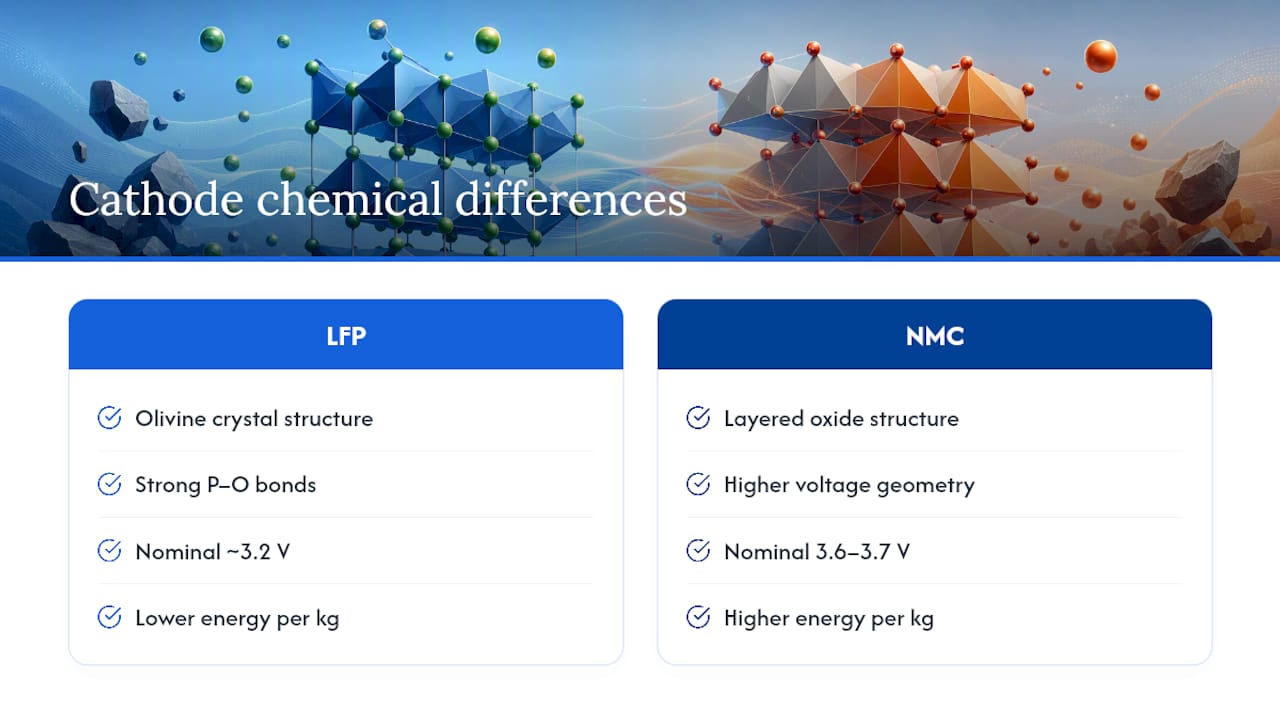
The performance gap starts at the atomic level. LFP uses an olivine crystal structure, where iron and phosphate ions sit locked into a framework held together by strong phosphorus-oxygen bonds. That bond strength is why LFP resists breaking down under heat or overcharge, but it also caps the cell’s nominal voltage at around 3.2 volts and limits how much energy the material can pack per kilogram.
NMC takes a different structural approach entirely, using a layered oxide arrangement that runs at a higher nominal voltage, typically 3.6 to 3.7 volts. That layered geometry allows more lithium to shuttle in and out per cycle, which is the root of NMC’s energy density edge. The catch is that NMC’s nickel fraction determines almost everything about how the cell behaves over time. A cell built on NMC 532 chemistry sacrifices some energy density for stability, while NMC 811 pushes nickel content much higher to squeeze out more capacity. That gain comes at the cost of thermal margin and manufacturing complexity, since higher nickel content increases cation mixing and surface reactivity that degrade the cathode faster under heat or high voltage. Every step up the nickel ladder, from 532 to 622 to 811, trades a little more stability for a little more range.
How Do Energy Density, Cycle Life, and Safety Compare in Practice?
Numbers on a datasheet only matter once you translate them into pack weight, warranty math, and fire risk. Start with energy density: a pack built on 200 Wh/kg NMC cells needs meaningfully less mass and volume than one built on 150 Wh/kg LFP cells to store the same energy, which is the entire reason premium EV makers still lean on nickel-rich chemistry despite its other tradeoffs.
Cycle life tells a different story. That degradation curve is why fleet operators running daily deep cycles increasingly default to LFP.
Thermal behavior is where the gap turns from inconvenient to safety-critical. LFP’s decomposition onset near 270 to 310°C gives engineers a wide buffer before thermal runaway becomes a real risk, versus NMC’s 150 to 200°C onset. Cold weather flips the advantage: NMC generally accepts charge current better at low temperatures, while LFP’s charge acceptance drops off more sharply below freezing unless the pack has active heating.
Which Chemistry Costs Less Over the System’s Life?
LFP wins on raw material exposure because it needs no nickel and no cobalt, the two metals responsible for most of a battery pack’s price volatility. That single fact insulates LFP-based procurement from the price swings that have periodically spiked NMC pack costs.
The Department of Energy found LFP packs running about 6% lower per kWh alongside roughly 67% longer cycle life in a comparative study, a combination that compounds in LFP’s favor once you calculate levelized cost per delivered kWh. A pack that survives twice as many cycles spreads its upfront cost over far more usable energy, which is exactly why LFP now dominates new stationary storage deployments and recently passed 55% of global EV battery deployment. NMC still competes on total cost only in applications where its energy density lets you shrink pack size enough to offset the material premium.
Which Chemistry Fits Which Application?
Matching chemistry to project is mostly a question of what constraint you can’t design around.
- Choose NMC when mass and volume are the binding constraint: premium long-range EVs, performance vehicles, and aviation battery packs where every kilogram costs range or payload.
- Choose LFP when cost per kWh and cycle longevity matter more than weight: stationary storage, high-mileage delivery fleets, and urban buses running multiple deep cycles daily.
- Consider LMFP as a middle path when you need more range than standard LFP delivers but want to avoid nickel and cobalt exposure. LMFP chemistry lifts voltage and energy density while preserving much of LFP’s thermal advantage.
- Plan for cold climates regardless of chemistry. LFP packs deployed in sub-freezing regions typically need active pack heating or charge current limiting to avoid lithium plating.
- Weigh second-life value. LFP’s slower degradation curve and lower fire risk generally make it the more economical candidate for second-life stationary storage after its first automotive service life ends.
What Pack-Level and BMS Tradeoffs Should Engineers Budget For?
LFP’s voltage curve stays remarkably flat across most of its state of charge range, which is great for cell balance but terrible for state-of-charge estimation using voltage alone. That flatness forces battery management systems to rely on coulomb counting, and packs that rarely reach a true full charge need periodic reference-charge cycles to prevent SOC drift.
NMC’s challenge sits at the opposite end of the charge curve. Its sensitivity to upper voltage cutoffs means the BMS has to enforce tighter balancing tolerances and more conservative thermal limits, especially in high-nickel formulations, which adds cost to the pack’s control electronics. Cell format and internal resistance also shift the calculus: prismatic and pouch formats handle peak power delivery differently, and that affects everything from fast-charge tolerance to pack cooling design.
Pro Tip: Never take a cycle-life number at face value. Ask the supplier for the actual DSC decomposition test data and the cycle curve at the temperature your application will actually run at, not the temperature that produced the best number on the spec sheet.
Why Gq-International’s Integration Experience Matters Here
Choosing a chemistry is only half the project. Since 1998, Gq-international has built high-strength steel infrastructure for transportation safety and renewable energy, holding over 40% domestic market share in traffic safety products and over 20% in photovoltaic solutions, with contributions to more than 3,000 photovoltaic projects worldwide. That track record covers the packaging and mounting side of the equation: enclosures, mounting structures, and electrical housings that have to accommodate whichever chemistry your engineering team lands on, without compromising thermal management or structural integrity.
How Do You Choose Between LFP and NMC for Your Project?
Run the decision through three questions before committing to either chemistry. First, is mass or volume the binding constraint? If yes, NMC is the default answer, and LMFP is worth a second look if nickel exposure is a concern. Second, is cost per delivered kWh over the warranty period the priority? If yes, LFP’s longer cycle life usually wins the math. Third, ask your supplier for three things: the exact cycle warranty and its test protocol, the thermal decomposition test results at operating temperature, and a pack-level cost projection covering the full warranty period, not just the sticker price per cell.
The Chemistry Debate Is Really a Constraints Debate
Most articles on this topic frame LFP vs NMC as a horse race with a winner. It isn’t. The research is consistent on one point that gets buried under all the spec sheets: there is no universally better chemistry, only a better fit for the constraint that’s actually binding your project.
Where conventional advice falls short is in treating energy density as the headline metric for every use case. It isn’t, for most buyers. If you’re speccing a stationary storage asset or a delivery fleet running two cycles a day, cycle life and thermal margin matter more than shaving a few kilograms off a battery box nobody has to carry. LFP’s wider thermal decomposition margin also reduces fire propagation risk at scale, which matters enormously once you’re stacking hundreds of packs in a container.
What I’d prioritize first, if I were running procurement on either an EV fleet or a storage deployment: get real decomposition test data before you get a quote. Datasheets lie by omission more than by commission, and the gap between a marketing spec and a bench test result is where expensive mistakes get made.
— Hu
Where Gq-International Fits Into Your Battery Project
Whichever chemistry your engineering team lands on, the pack still needs somewhere reliable to live. Some companies design the steel infrastructure side of energy storage: enclosures, mounting systems, and electrical housings built to handle the thermal and structural demands of both LFP and NMC deployments.
The ODM/OEM Energy Storge Container integrates directly with stationary LFP or NMC packs for utility and commercial storage projects. For rapid deployment needs, the Mobile PV-BESS Power Station pairs solar generation with battery storage in a single deployable unit. If your project needs the mounting hardware to go with it, the GQ-FL series flexible support and GQ-A Series Fixed-Adjustable Mounting System handle PV integration, while the E-House solution covers electrical room housing for larger installations. Request technical datasheets and an engineering consultation through Gq-international’s product catalog to get pack-specific specifications for your project.
Sources
FAQ
Are Tesla Batteries NMC or LFP?
Tesla uses both, depending on the model and market. Standard-range vehicles built for cost efficiency have increasingly shifted to LFP cells, while longer-range and performance trims typically use NMC or NCA chemistry for the higher energy density those variants need.
Which Battery Is Better, LFP or NMC?
Neither wins outright. LFP is the stronger choice when cost per kWh, cycle life, and thermal margin matter most, while NMC is better when mass and volume constraints dominate, such as premium long-range EVs.
Why Did Some Automakers Move Away From LFP Batteries in Certain Models?
Automakers scale back LFP in specific trims mainly because of its lower energy density, which forces a heavier or bulkier pack to hit the same range as NMC. For range-focused flagship models, that weight penalty outweighs LFP’s cost and longevity advantages.
What Are the Downsides of Using LFP Batteries?
LFP’s main downside is lower energy density, meaning a given amount of energy takes up more space and weight than an equivalent NMC pack. Its flat voltage curve also complicates state-of-charge estimation, and cold-weather charge acceptance tends to be weaker without active pack heating.