
MASH supersedes NCHRP 350 for new or substantially changed roadside safety hardware. Expect heavier test vehicles, stricter test matrices, and clearer occupant-risk evaluation criteria. For engineers and contractors, this means specification language, procurement checklists, and acceptance paperwork all need to point to MASH test reports rather than legacy NCHRP 350 documentation.
TL;DR:
- MASH uses the heavier 2270P pickup and revised impact points, so NCHRP 350 results do not establish performance under current test conditions.
- An FHWA eligibility letter covers only the tested configuration; confirm the required test level and state acceptance before specifying hardware.
- Federal aid projects generally require devices tested under MASH for new installations and significant modifications; existing NCHRP 350 devices can often remain in place.
- Request accredited laboratory reports, declared vehicle weights, and installation drawings, then verify field geometry matches the tested configuration and retain collision records for ongoing evaluation.
Table of Contents
- What NCHRP 350 established and why it mattered
- What the MASH standard is and what it aims to fix
- Key technical differences: vehicles, matrices, and evaluation criteria
- Transition policy, eligibility letters, and federal-aid implications
- What this means for specification, installation, and ISPE
- Publisher background on highway safety hardware manufacturing
- How the industry moved from NCHRP 350 to MASH
- Regulatory acceptance and geographic adoption across jurisdictions
- Barrier and crash cushion compliance differences under each standard
- How the standards shift changed hardware design and manufacturing
- Real-world test examples showing the practical gap
- Prioritizing MASH in procurement and retrofit decisions
- Request guardrail specs, test documentation, or a project quote
- FAQ
- Sources
What NCHRP 350 established and why it mattered
NCHRP Report 350, published in 1993, set the first widely adopted national framework for crash testing guardrails, terminals, crash cushions, and barriers. It defined test vehicles, impact conditions, and pass/fail criteria that state departments of transportation and the Federal Highway Administration used to build Qualified Product Lists and issue eligibility determinations for federal-aid projects.
For three decades, NCHRP 350 shaped how manufacturers designed hardware and how agencies wrote specifications. Its limitations became clear as the vehicle fleet shifted toward heavier pickups and SUVs that the original test vehicles no longer represented well.
- NCHRP 350 used lighter pickup and passenger car test vehicles than today’s typical fleet.
- Its test matrices did not include some impact angles and locations now considered critical.
- QPLs built under NCHRP 350 became a reference point that MASH has since replaced for new acceptance decisions.
What the MASH standard is and what it aims to fix
The Manual for Assessing Safety Hardware, known as MASH, is AASHTO’s updated crash test procedure and evaluation framework for roadside safety devices. The first edition appeared in 2009, with a second edition following in 2016 that refined vehicle specifications and evaluation detail.
MASH organizes devices by test level, similar in concept to NCHRP 350 but built around revised vehicles and impact scenarios that better reflect current traffic. AASHTO and FHWA jointly coordinated its rollout, and FHWA eligibility letters now reference MASH test results for any hardware submitted for new approval.
- MASH defines test levels (commonly TL2 and TL3 for guardrail applications) tied to specific vehicle types and impact speeds.
- State DOTs decide which test levels apply to a given roadway class and traffic volume.
- FHWA eligibility letters confirm a device met MASH criteria for the tested configuration, not a blanket approval for every application.
Key technical differences: vehicles, matrices, and evaluation criteria
The practical gap between the two standards comes down to three things: what hits the hardware, how many ways it gets hit, and how success is measured.
Test vehicles. MASH increased the standard pickup truck test vehicle to the 2270P class, heavier than the comparable NCHRP 350 pickup. A heavier vehicle carries more kinetic energy into the same impact, which can change how much a guardrail deflects or how a terminal absorbs that energy. MASH’s updated vehicle fleet means hardware that passed NCHRP 350 testing may behave differently against current MASH loading, so installation geometry needs a fresh look even for familiar-looking rail systems.
- The pickup test vehicle grew heavier, raising the kinetic energy delivered in several test designations.
- Small passenger car tests remain but with adjusted mass and center-of-gravity specifications.
- Some matrices add motorcycle or other vehicle considerations depending on device category.
Test matrices. MASH broadened impact conditions, adding or revising angles, speeds, and impact locations along the length of a device, including points that stress end terminals and transitions more severely than NCHRP 350 required.
Evaluation criteria. MASH sharpens the occupant risk metrics and clarifies allowable deformation and intrusion limits, which narrows the room for subjective pass/fail interpretation that existed under some NCHRP 350 test reports.
Documentation. A MASH-compliant submission includes accredited laboratory reports, test videos, declared vehicle weights, and installation drawings matching the tested configuration. Differences between NCHRP 350 and MASH summarized in transportation research point to updated vehicles, corrected impact conditions, and modified evaluation criteria as the three core changes engineers should verify in any submittal.
Transition policy, eligibility letters, and federal-aid implications
AASHTO and FHWA coordinated the shift to MASH through a joint implementation agreement, with transition notices setting dates after which new eligibility letters for modified NCHRP 350 devices required full MASH testing rather than engineering judgment alone.
The FHWA Federal Register notice on MASH transition explains that after specified dates, modifications to NCHRP 350-tested devices without full MASH testing stopped qualifying for new eligibility letters, a policy meant to push manufacturers toward complete MASH test programs rather than incremental tweaks to older designs.
- FHWA eligibility letters confirm crashworthiness for the exact tested configuration, nothing broader.
- States retain discretion over which devices they accept for use on their roads.
- Federal-aid projects generally require MASH-tested hardware for new installations and significant modifications, while existing in-place devices accepted under NCHRP 350 can often remain.
A memorandum clarifying roles under the joint implementation agreement reinforces that an eligibility letter is a crashworthiness finding, not a guarantee of in-service performance or an endorsement by FHWA.
What this means for specification, installation, and ISPE
Translating the standards gap into procurement language keeps projects out of trouble. A spec that still cites NCHRP 350 test numbers for new hardware is asking for outdated documentation.
- Request the MASH test report number, the accredited testing laboratory’s name, and the exact device configuration tested.
- Confirm the declared test vehicle masses and model years match current MASH requirements for the applicable test level.
- Review installation drawings against the as-built site conditions, including post spacing, offset, and anchorage details.
- Photograph completed installations and retain records tying the as-built geometry to the tested configuration.
- Track in-service performance, including any collision reports, to build an evidence base beyond the laboratory tests.
In-Service Performance Evaluation guidance from FHWA and AASHTO stresses that lab testing cannot capture every real-world collision variable, so ISPE data should inform retrofit priorities rather than treating lab results as the final word.
Pro Tip: Ask suppliers for the exact FHWA eligibility letter number tied to the specific device configuration, then verify that letter against the installation drawings before signing off on acceptance.
Publisher background on highway safety hardware manufacturing
We manufacture high-strength steel guardrail systems and related highway safety hardware, drawing on a domestic market share exceeding 40% in traffic safety products in China. Our team, writing here as Hu, focuses on translating testing standards into procurement-ready specification language.
- Highway guardrail systems covering beam rail and terminal applications for roadway departures.
- Metal guardrail systems spanning multiple structural classes for different traffic volumes.
- Flexible support and mounting hardware engineered for consistent anchorage performance across installation types.
How the industry moved from NCHRP 350 to MASH
The shift from NCHRP 350 to MASH did not happen overnight, and understanding why it took years clarifies what engineers should expect from hardware specified before the transition.
NCHRP 350 served the industry well for roughly two decades, but the vehicle fleet it was built around changed substantially. Pickup trucks and SUVs grew heavier and taller, shifting center-of-gravity characteristics that guardrails and terminals had to manage. Crash testing conducted under NCHRP 350 assumptions no longer matched the vehicles actually using the roads.
AASHTO began developing MASH in the mid-2000s specifically to close that gap, publishing the first edition in 2009 with updated vehicle specifications and revised impact scenarios. The 2016-second edition refined test procedures further, correcting inconsistencies that manufacturers and testing labs had flagged during early MASH adoption.
The transition was deliberately phased rather than immediate. FHWA and AASHTO recognized that thousands of miles of NCHRP 350-accepted hardware were already in service, so wholesale replacement was neither practical nor necessary. Instead, the joint implementation agreement focused transition requirements on new installations and significant modifications, letting existing devices remain while channeling new product development toward MASH criteria.
That phased approach explains why both standards still appear in agency documents today. Older corridors may reference NCHRP 350 acceptance letters for devices installed years ago, while any new contract will specify MASH testing as the baseline.
Regulatory acceptance and geographic adoption across jurisdictions
MASH adoption is not uniform in timing even though the underlying policy is national in the United States. State departments of transportation set their own implementation schedules within the federal framework, meaning some states required MASH-compliant hardware for new federal-aid projects earlier than others.
Within the United States, the practical rule is consistent: federal-aid highway projects require MASH-tested hardware for new installations and substantial modifications, while legacy NCHRP 350 devices already in place can generally remain unless a project scope triggers replacement.
International usage varies by country, and roadside hardware standards outside the United States often reference different national or regional frameworks rather than adopting MASH or NCHRP 350 directly. Some countries have historically referenced NCHRP 350 test data informally when evaluating imported hardware, but engineers working on projects outside the United States should verify the testing framework that applies in that specific jurisdiction rather than assuming either American standard applies by default.
For contractors working across multiple states or on projects with international components, the safest approach is confirming which standard the contracting agency references in its own specifications rather than assuming consistency across borders or even across neighboring states.
Barrier and crash cushion compliance differences under each standard
Barriers and crash cushions face some of the sharpest compliance differences between the two standards, because both device types depend heavily on energy absorption characteristics tied directly to test vehicle mass.
Under NCHRP 350, a longitudinal barrier’s compliance rested on test results using the lighter pickup and passenger vehicle classes. A barrier system that passed those tests demonstrated acceptable deflection and redirection under that specific loading, but the margin against a heavier vehicle was untested.
MASH testing for barriers uses the heavier 2270P pickup class, which increases the kinetic energy a barrier must manage during redirection tests. A barrier that performed well under NCHRP 350 does not automatically meet MASH criteria, because the added mass changes deflection distances and post loading. The same logic applies to crash cushions: energy-absorbing systems calibrated to NCHRP 350 vehicle weights face a different energy input under MASH test conditions, which can require redesigned absorption elements or longer cushion lengths to meet the revised occupant risk criteria.
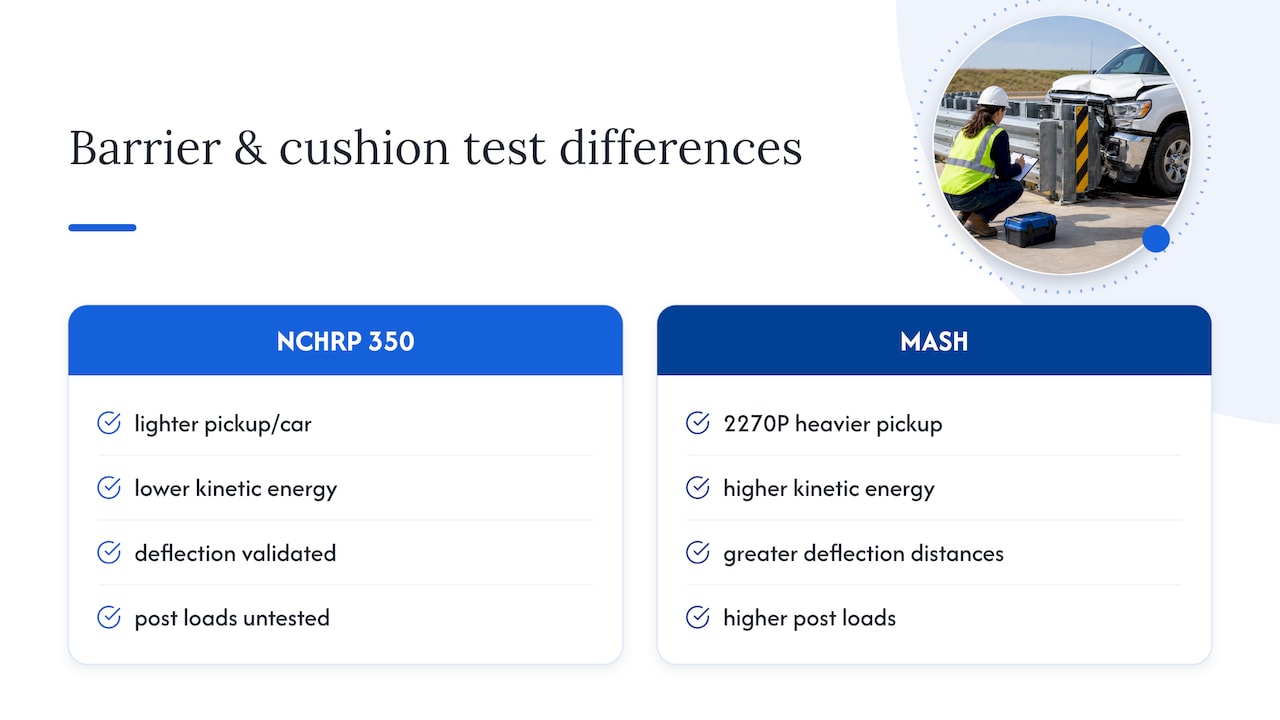
For engineers specifying barrier or crash cushion replacements, the compliance question is not whether the device passed testing at some point but whether it passed MASH testing at the test level required for the specific roadway application. A device with only NCHRP 350 documentation on file should prompt a request for updated MASH test reports before specification.
How the standards shift changed hardware design and manufacturing
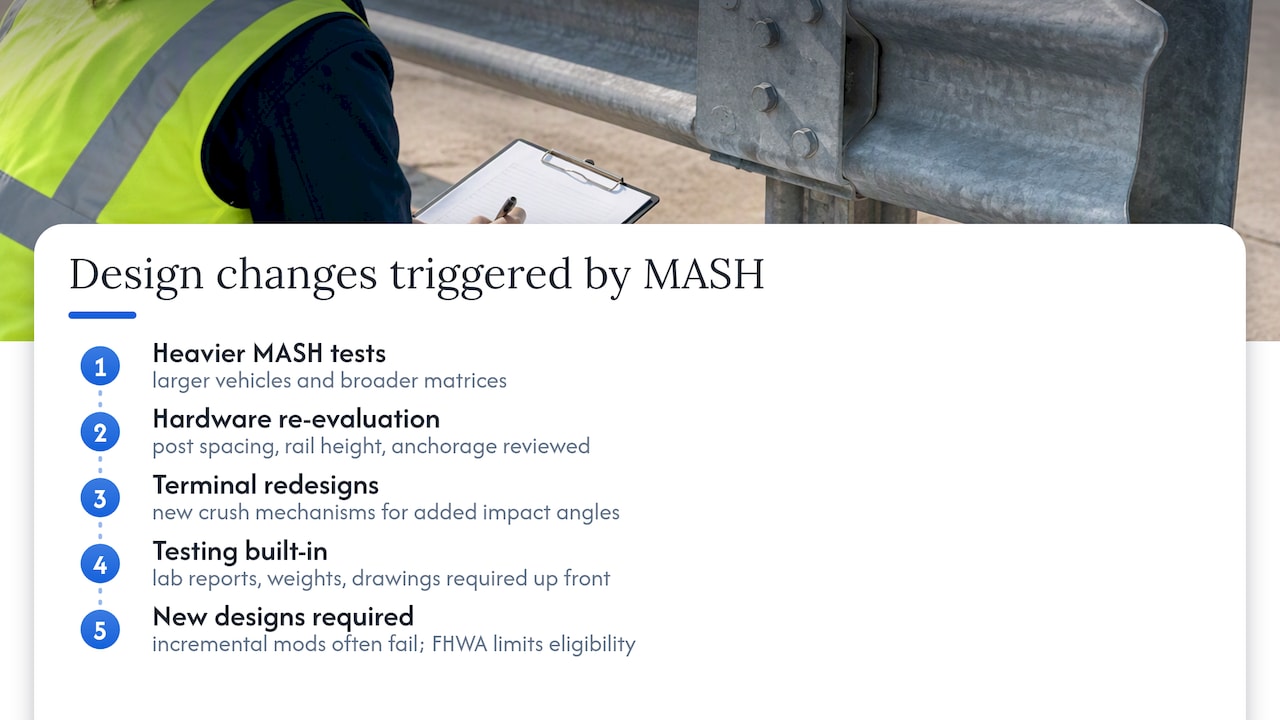
Manufacturers responded to MASH’s heavier test vehicles and broader matrices by revisiting structural elements across entire product lines rather than making isolated adjustments.
Guardrail post spacing, rail height, and anchorage strength all came under review as manufacturers recalculated energy absorption requirements against the 2270P pickup class. Terminals, which absorb the most concentrated energy during end-on impacts, often needed redesigned crush mechanisms to meet MASH occupant risk criteria at the added impact angles in the revised matrices.
This redesign cycle also changed how manufacturers approach testing itself. Because MASH documentation expectations include accredited laboratory reports, declared vehicle weights, and installation drawings tied to the exact tested configuration, product development now builds testing evidence into the design process from the start rather than treating certification as a final step.
For hardware classes where NCHRP 350 versions had been in production for years, some manufacturers found that incremental modification could not meet MASH criteria, requiring new designs rather than updates to existing products. That dynamic is part of why FHWA’s transition policy specifically limited eligibility letters for modified NCHRP 350 devices after certain dates, since incremental changes to older designs often could not satisfy the revised test matrices without a full redesign.
Real-world test examples showing the practical gap
Specific test numbers in FHWA eligibility letters illustrate how the standards diverge in practice rather than only on paper.
The FHWA eligibility letter example SS-183 documents how a specific device’s test results map to MASH test numbers and pass criteria, listing the required documentation elements that a manufacturer submitted to support the eligibility finding. Letters structured this way show reviewers exactly which MASH test number corresponds to which impact condition and vehicle class, which is the level of detail engineers should expect when verifying a supplier’s documentation package.
Jurisdictional guidance from state agencies reinforces the pattern. TxDOT’s roadside safety hardware crash criteria notes that MASH increases the required pickup truck size and weight compared to NCHRP 350, and provides implementation examples showing how that change affects acceptance decisions for devices submitted after the transition dates.
These examples point to a consistent lesson: a device’s NCHRP 350 test history does not predict its MASH performance, and engineers reviewing documentation should look for the specific MASH test number and pass criteria rather than inferring compliance from an older test record.
Prioritizing MASH in procurement and retrofit decisions
We recommend specifying MASH-tested hardware for any new installation or significant modification, full stop. Where legacy NCHRP 350 devices remain in service, document installation geometry carefully and build an ISPE record rather than assuming continued performance. Always request the complete test dossier and accredited lab evidence before accepting a supplier’s documentation.
— Hu
Request guardrail specs, test documentation, or a project quote
When a specification calls for MASH-tested hardware, the paperwork matters as much as the steel. We supply highway guardrail systems and mounting hardware manufactured under consistent in-house quality control, and we provide technical drawings and test documentation on request so your procurement file matches what gets installed in the field.

Our product range covers the structural categories engineers specify most often on highway and infrastructure projects:
- GQ-FL series flexible support for applications needing adjustable energy absorption characteristics.
- GQ-A Series Fixed-Adjustable Mounting System for projects requiring both fixed and adjustable anchorage configurations.
- GQ-F Series Fixed Mounting System for standard fixed installation geometries.
If your project calls for updated test reports, installation drawings, or a quote tied to a specific specification, reach out through our guardrail systems catalog and our team will match the documentation to your contract requirements.
FAQ
What is MASH compliant?
A device is MASH compliant when it passed crash testing under AASHTO’s Manual for Assessing Safety Hardware, using the current test vehicles, impact matrices, and occupant risk criteria defined in the MASH manual. Compliance applies to a specific tested configuration, so the installation must match the drawings submitted with that test report.
What are the MASH test levels?
MASH defines several test levels tied to vehicle type, impact speed, and roadway application, with TL2 and TL3 most commonly cited for guardrail and barrier systems on typical highway corridors. Each test level specifies the exact vehicles and impact angles a device must withstand to earn that designation.
What are the MASH standards for guardrails?
Guardrails tested under MASH must meet the vehicle, matrix, and evaluation requirements in the AASHTO MASH manual, including the heavier 2270P pickup test vehicle and the revised occupant risk and deformation limits. An FHWA eligibility letter confirms a specific guardrail configuration met those requirements during accredited lab testing.
What is the Manual for Assessing Safety Hardware?
The Manual for Assessing Safety Hardware, or MASH, is AASHTO’s crash testing and evaluation framework for roadside safety devices, first published in 2009 and updated in 2016. It replaced NCHRP Report 350 as the reference standard for new eligibility determinations under the joint AASHTO/FHWA implementation agreement.
Sources
- Manual for Assessing Safety Hardware (MASH) — Second Edition (AASHTO)
- FHWA Federal Register notice: Manual for Assessing Safety Hardware (MASH) Transition
- Memorandum: Clarification of Roles and Responsibilities in Implementing the AASHTO/FHWA Joint Implementation Agreement on the AASHTO MASH