

A continuous median barrier is generally warranted when the median is 30 feet or narrower and average daily traffic exceeds 20,000 vehicles per day, according to FHWA median barrier guidance. Cable systems suit wider medians with room to deflect; semi-rigid or concrete barriers fit tighter rights of way. Medians between 30 and 50 feet fall into a gray zone that calls for a formal benefit-cost analysis before you commit to a barrier family.
TL;DR:
- For medians 30 to 50 feet wide, require a benefit cost analysis; above 50 feet with ADT below 20,000, installation is generally optional.
- Choose cable only when the median provides required deflection clearance; use W beam for moderate space and concrete where deflection could reach opposing lanes.
- Prioritize documented cross median crash hot spots using crash history and exposure, rather than applying geometric warrants uniformly across every qualifying mile.
- FHWA evaluations found cable barrier benefit cost ratios of 4.14 to 8.28, while sensitivity cases widened the range to 2.36 to 11.68.
- Cable and rumble strip installations cut fatal and serious cross median crashes, but increased total crashes and demand more frequent repairs, tensioning, and replacement parts.
Table of Contents
- Warranting Criteria and Site Selection: Median Width, ADT, and Roadway Type
- Barrier Types and Safety Trade-Offs: Cable, Semi-Rigid, and Rigid Concrete
- Placement and Design Details: Deflection Space, Offsets, and Maintenance Access
- Cost-Effectiveness and CMFs: Benefit-Cost Ranges and Example Costs
- Maintenance, Operations, and Whole-Life Considerations
- Manufacturing Support for Guardrail and Barrier Projects
- Environmental Impact and Durability Considerations of Different Barrier Materials
- Integration of Median Barriers With Intelligent Transportation Systems
- Case Studies Showing Barrier Performance in Real Road Settings
- Emerging Technologies and Innovations in Median Barrier Design
- Balancing Safety Gains Against Operational Realities
- Get Guardrail Specs and Project Support From Our Team
- FAQ
- Sources
Warranting Criteria and Site Selection: Median Width, ADT, and Roadway Type
The geometric thresholds give you a starting point, not a final answer. FHWA and AASHTO guidance treats a median of 30 feet or less combined with ADT above 20,000 vpd as a clear case for a barrier; a median wider than 50 feet with ADT under 20,000 vpd is generally optional, and the 30 to 50 foot band requires a cost-effectiveness analysis to justify installation, per FHWA’s countermeasure summary.
Width and volume rarely tell the whole story on a real corridor. You still need to weigh:
- Operating speed and posted limits, since cross-median severity rises sharply above 55 mph.
- Truck percentage, which affects both crash severity and the test level you select.
- Documented cross-median crash history at the segment, not just regional averages.
- Horizontal and vertical alignment, including curves and sag vertical curves that reduce sight distance.
- Interchange and ramp density, which can complicate continuous barrier runs and require gaps.
A research brief on systemic median barrier placement argues agencies should move beyond fixed geometric warrants alone and identify high-risk segments using crash history and exposure data together. That systemic lens matters most on long corridors where a few hot spots drive most of the cross-median risk, letting you prioritize continuous runs where they pay off fastest rather than treating every qualifying mile identically.
Barrier Types and Safety Trade-Offs: Cable, Semi-Rigid, and Rigid Concrete
Each barrier family trades one kind of risk for another, and the choice should follow site geometry as much as crash history.
- Cable barriers absorb energy through deflection, which lowers occupant forces but demands lateral clearance.
- Semi-rigid W-beam systems deflect less than cable and fit moderate-width medians with limited space.
- Rigid concrete barriers deflect minimally and suit narrow medians where no room exists for lateral movement.
One documented tradeoff shapes most of this decision: combined cable barrier and shoulder rumble strip installations produced large reductions in cross-median fatal and serious injury crashes, but also an increase in total crashes, according to an FHWA evaluation of cable barrier performance. Agencies trade fewer catastrophic events for more frequent, lower-severity hits.
Test level selection should track vehicle mix and terrain rather than habit. Higher truck percentages and steeper approach grades generally push toward a higher TL rating regardless of barrier family. Narrow medians with heavy truck exposure often favor concrete precisely because deflection space is unavailable at any TL level, while wide, low-truck-volume medians give cable systems room to do what they do best.
Placement and Design Details: Deflection Space, Offsets, and Maintenance Access
Choosing a barrier family is only half the job. Final placement inside the median determines whether that barrier performs as intended.
- Confirm dynamic deflection distance for the selected system and test level, then verify the median offers that clearance under worst-case impact angles.
- Check offset from edge of traveled way to barrier face against state manual minimums; WSDOT guidance flags medians narrower than 8 feet from edge of traveled way to barrier face as requiring special attention.
- Review median cross-slope and drainage, since steep V-ditches or inadequate drainage can rule out certain anchoring methods.
- Confirm end treatment and transition details at interchanges, ramp gaps, and bridge piers.
- Coordinate with maintenance staff before finalizing placement in narrow medians, since repairs there may require temporary lane closures.
TxDOT’s roadside safety design chapter cautions against placing barriers where design deflection would encroach into opposing travel lanes, a detail that rules out cable in some medians that otherwise meet the width warrant.
Pro Tip: Loop in your maintenance division during design, not after construction, since narrow-median repair access shapes which barrier family is actually sustainable long term.
Cost-Effectiveness and CMFs: Benefit-Cost Ranges and Example Costs
A benefit-cost analysis weighs the dollar value of crashes prevented against installation and maintenance costs, and the result depends heavily on which crash-cost figures you use.
- KABC crashes (fatal, incapacitating, non-incapacitating, and possible injury) carry a far higher cost valuation than PDO crashes, so the mix of severity reductions versus PDO increases drives the final ratio.
- Running low and high crash-cost scenarios shows how sensitive your conclusion is before you commit capital.
- Report B/C as a range rather than a single figure so decision makers see the uncertainty.
An FHWA evaluation across Illinois, Kentucky, and Missouri found benefit-cost ratios for cable median barrier installations ranging roughly from 4.14 to 8.28, with sensitivity extending from about 2.36 to 11.68 depending on crash-cost assumptions, using 2017 figures of roughly $498,579 for a KABC crash and $18,877 for a PDO crash, per the FHWA benefit-cost evaluation. Installation costs for cable systems commonly fall in the $60,000 to $100,000 per mile range, with annual maintenance varying widely by hit frequency; treat both figures as order-of-magnitude and date-sensitive rather than fixed quotes.
Maintenance, Operations, and Whole-Life Considerations
The barrier you select today becomes a recurring line item in next year’s maintenance budget, and the three families differ sharply in what they demand.
- Cable systems need frequent cable tensioning and post replacement after even moderate hits, which means more frequent crew dispatches.
- Semi-rigid W-beam repairs sit between cable and concrete in both frequency and cost per incident.
- Concrete barriers need the least recurring attention but cost more to repair when damage does occur.
A Tennessee study on cable barriers and crash composition found that cable systems increase PDO frequency and hit rates, so agencies should plan staffing and spare-parts inventory for more frequent, lower-severity repairs rather than fewer catastrophic events. Snowplow strikes add another layer of wear in northern climates, which pushes some agencies to budget inspection cycles around winter maintenance seasons rather than a flat annual schedule.
Manufacturing Support for Guardrail and Barrier Projects
We offer steel guardrail systems alongside photovoltaic mounting products and energy storage systems, supporting agencies with integrated supply options for highway safety and infrastructure hardware. Our production capabilities and quality control processes support large contract volumes, with components supplied across numerous infrastructure and energy projects globally.
For agencies evaluating barrier type and specification, we provide technical datasheets, OEM and ODM engineered solutions, and specification guidance tailored to project scope. Our highway guardrail systems page outlines current product families for teams building out a supply shortlist alongside their barrier selection analysis.
Environmental Impact and Durability Considerations of Different Barrier Materials
Material choice affects a barrier’s lifecycle footprint as much as its upfront safety performance. Galvanized and weathering steel systems resist corrosion differently, and that distinction determines how often a guardrail or cable system needs replacement in coastal or high-salt-exposure corridors.
Weathering steel develops a stable oxide layer that protects the base metal without ongoing coating maintenance, which can extend service life in moderate climates, though specification details matter. Our technical note on weathering steel thresholds covers the material gauge considerations safety managers weigh when planning for long-term corrosion resistance.
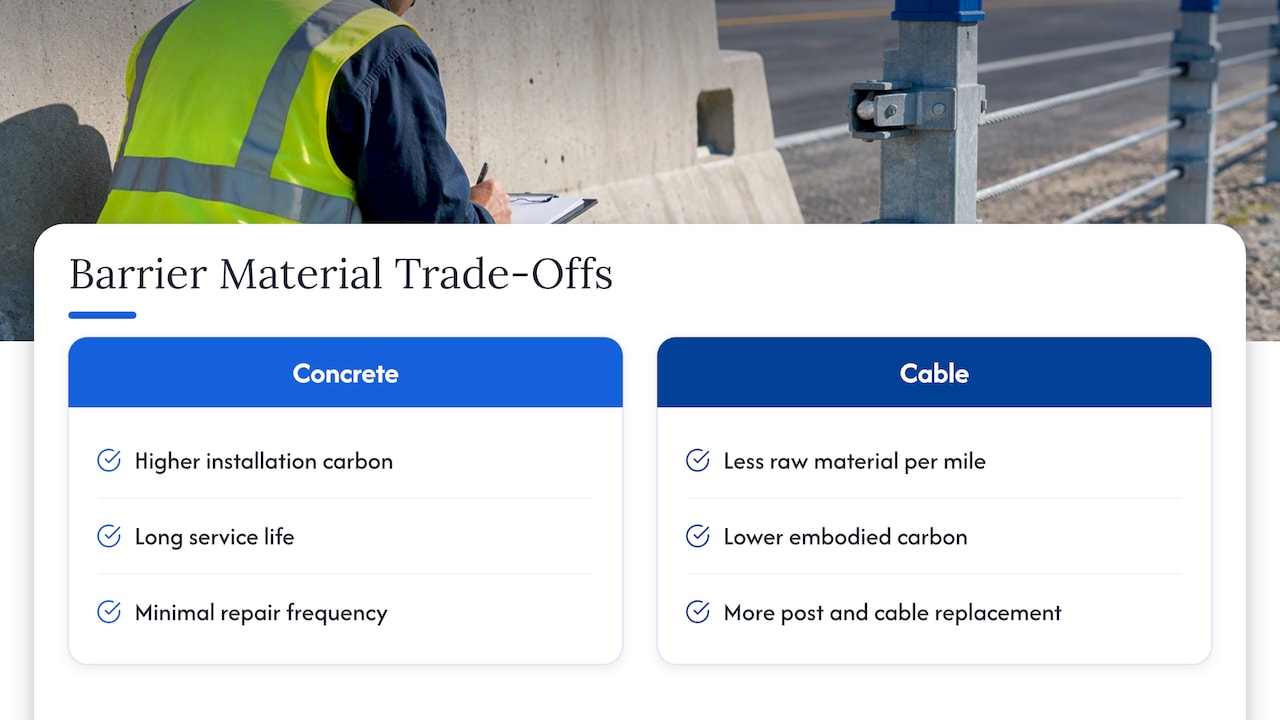
Concrete barriers carry a heavier carbon footprint at installation due to cement production, but their long service life and minimal repair frequency can offset that initial impact over several decades. Cable systems use far less raw material per mile than concrete, lowering embodied carbon, though more frequent post and cable replacement after hits adds recurring material consumption over the barrier’s life.
Drainage design also affects durability regardless of barrier family. Standing water around posts accelerates corrosion in steel systems and can undermine concrete foundations over time, so median cross-slope and drainage planning discussed earlier in this guide doubles as a durability decision, not just a deflection-clearance one. Agencies working in regions with heavy deicing salt use should factor accelerated corrosion rates into replacement cycle planning regardless of which barrier type they select.
Integration of Median Barriers With Intelligent Transportation Systems
Barriers increasingly serve as mounting infrastructure for sensors and communication equipment rather than standing as purely passive hardware. Some agencies now attach vehicle detection sensors, weather stations, and fiber conduit runs to median barrier alignments, using the existing right-of-way corridor to extend ITS coverage without separate pole installations.
Strike detection is one of the more practical integrations for maintenance planning. Instrumented cable systems in some deployments can flag a hit location in near real time, which shortens the gap between a strike and a repair crew dispatch, directly addressing the frequent-hit maintenance burden discussed earlier in this guide. That kind of integration matters most on cable corridors, where hit frequency already drives most of the lifecycle cost.
Connected and automated vehicle planning adds another layer to consider during barrier design. Corridors anticipating future roadside unit placement or vehicle-to-infrastructure communication may benefit from coordinating barrier alignment and conduit routing now rather than retrofitting later. Agencies should treat this as a design coordination question between traffic operations and roadside safety teams rather than a separate procurement decision, since the barrier foundation work and conduit trenching often overlap on the same construction schedule.
Case Studies Showing Barrier Performance in Real Road Settings
Field results consistently track the patterns documented in formal evaluations. A combined cable barrier and inside shoulder rumble strip deployment evaluated across multiple states produced steep reductions in cross-median fatal and serious injury crashes, according to FHWA’s cable barrier and rumble strip study, alongside an increase in total crash counts from more frequent, lower-severity hits.
That tradeoff shows up differently depending on corridor characteristics. High-speed rural interstates with wide medians and heavy truck volumes tend to see the largest fatality reductions from cable installation, since those corridors previously had the highest cross-median severity exposure. Urban and suburban freeways with narrower medians and more frequent interchange gaps see smaller continuous-run benefits, since barrier coverage often has to break for ramps, reducing the length of protected roadway.
Corridors with a documented history of cross-median crashes before barrier installation generally show the clearest before-and-after safety signal, which is why systemic, crash-history-driven site selection tends to outperform blanket geometric warranting alone. Agencies running phased installations across a state system often target these documented hot spots first, then extend coverage to qualifying segments as budget allows, rather than installing barriers uniformly across every mile that meets the width and ADT threshold simultaneously.
Emerging Technologies and Innovations in Median Barrier Design
Barrier hardware continues to evolve toward systems that combine the deflection benefits of cable with faster repair cycles. Quick-release post designs and modular cable tensioning hardware aim to cut the time a crew spends restoring a system to full tension after a strike, directly addressing the maintenance burden that cable systems carry relative to concrete.
Material advances in high-strength steel are also pushing toward thinner-gauge components that maintain the same energy absorption while reducing raw material use per mile, a shift that touches both cost and the environmental footprint discussed earlier. Sensor-equipped barrier sections that report strike location and severity are moving from pilot deployments toward broader adoption, since they shorten the window between a hit and a repair dispatch.
Hybrid systems that pair a semi-rigid rail with supplemental cable elements are another area of development, aimed at medians that sit awkwardly between the clear-cut cable and concrete use cases. None of these innovations change the underlying warranting math from FHWA and AASHTO guidance, but they do shift the cost side of the benefit-cost equation by lowering repair time and, in some cases, repair frequency, which matters most for agencies that have historically avoided cable barriers due to maintenance staffing constraints.

Balancing Safety Gains Against Operational Realities
Cable barriers deliver some of the clearest fatality reductions available in roadside safety, but that gain arrives bundled with more frequent repairs and a maintenance bill that keeps growing. Run the sensitivity cases, talk to your maintenance division before finalizing placement, and treat the benefit-cost range as a planning tool, not a formality.
— Hu
Get Guardrail Specs and Project Support From Our Team
Steel guardrail systems, PV mounting structures, and energy storage products are available to support infrastructure agencies and EPC contractors managing large-scale projects. Our catalog includes:
- GQ-FL series flexible support for applications needing adjustable mounting geometry.
- GQ-A Series Fixed-Adjustable Mounting System for sites requiring tunable installation angles.
- GQ-F Series Fixed Mounting System for straightforward, fixed-position installations.
- ODM/OEM Energy Storge Container and Mobile PV-BESS Power Station for energy project support.
- E-House and GQ-D Series Distributed Bracket for distributed infrastructure builds.
Reach out through our guardrail systems page to request datasheets or a project quote, and review OEM and ODM mounting solutions if your project combines barrier supply with renewable energy infrastructure. For concrete barrier sourcing on narrow-median segments, a concrete products supplier can round out material availability alongside our steel guardrail lines.
FAQ
What is a barrier in traffic?
A traffic barrier is a longitudinal roadside or median device designed to redirect a vehicle leaving its travel lane rather than letting it cross into opposing traffic or off the roadway. Common types include guardrail, cable systems, and concrete barriers, each selected based on available deflection space and crash risk.
What does “median separation” mean?
Median separation refers to the physical divide between opposing traffic directions on a divided highway, which can be a grass or paved median, a depressed ditch, or a median fitted with a continuous barrier. Agencies add a barrier to that separation specifically to prevent cross-median crashes when width and traffic volume meet the thresholds described by FHWA.
What are the 3 main types of safety barriers?
The three main median barrier families are cable systems, semi-rigid W-beam guardrail, and rigid concrete barriers. Cable systems deflect the most and need the widest medians, concrete deflects the least and suits narrow medians, and semi-rigid guardrail fits moderate-width sites in between.
What do median barriers do?
Median barriers redirect vehicles back into their travel lane instead of allowing them to cross into opposing traffic, which is the crash type most likely to produce fatal or incapacitating injuries. Properly placed cable barriers combined with shoulder rumble strips have produced large reductions in cross-median fatal and serious injury crashes in evaluated corridors, according to FHWA research.
When should an agency choose concrete over cable median barriers?
Concrete generally fits narrow medians where there is not enough lateral space for a cable system to deflect safely under impact. TxDOT guidance cautions against placing deflecting barrier systems where design deflection would encroach into opposing travel lanes, which rules out cable on many constrained sites.
Sources
- Median barriers | FHWA
- Cable median barrier + rumble strips evaluation (FHWA 17071)
- TxDOT roadside safety design — median barrier application
- WSDOT design manual — median barrier placement and type guidance