
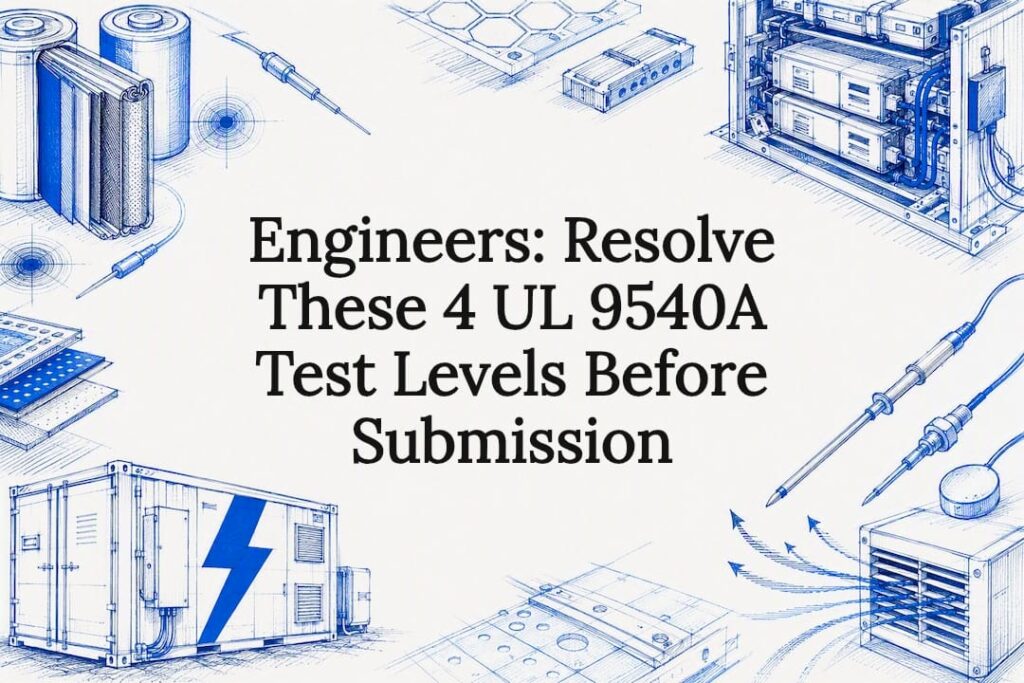
UL 9540A evaluates how battery energy storage systems behave when a cell goes into thermal runaway, generating the temperature, gas, and heat release data that authorities having jurisdiction use to set installation spacing and suppression requirements. A system that passes at the unit level can often qualify for reduced separation distances; one that fails, or skips testing entirely, typically faces stricter clearances, added fire suppression, or outright rejection at permitting.
TL;DR:
- UL 9540A evaluates thermal runaway propagation through four test levels, with escalation only if failure occurs at lower stages, affecting installation safety requirements.
- Gas analysis, temperature tracking, and heat flux measurements are critical in UL 9540A testing, with strict calibration and accreditation standards ensuring data reliability.
- Proper preparation involves early mockups, consistent initiation methods, representative enclosures, and detailed instrumentation documentation to prevent costly re-tests.
- Test results influence code compliance by enabling reduced separation distances and specifying installation conditions, but AHJs retain final authority over interpretation.
- Designing enclosures with ventilation, spacing, and thermal management aligned to UL 9540A testing improves field readiness and reduces propagation risks in real-world deployments.
Table of Contents
- What Is UL 9540A Testing and How Does It Differ From UL 9540?
- What Are the Four Test Levels in UL 9540A?
- What Measurements and Pass/Fail Criteria Does UL 9540A Use?
- How Should Manufacturers Prepare for UL 9540A Testing?
- What Does a UL 9540A Report Contain and How Do AHJs Use It?
- How Does UL 9540A Data Affect Installation and Code Compliance?
- How Product Design Choices Affect Test Readiness
- The Gap Between Passing a Test and Being Field Ready
- Building Enclosures and Mounts Designed With Testing in Mind
- Where to Verify UL 9540A Details
- Sources
- FAQ
What Is UL 9540A Testing and How Does It Differ From UL 9540?
UL 9540A is a test method, not a product certification. It measures whether thermal runaway in one battery cell propagates to neighboring cells, modules, or the entire installation, and it quantifies the fire behavior that results: heat, gas, smoke, and in worst cases, explosion or flying debris.
UL 9540A is the national test method for evaluating thermal runaway fire propagation in battery energy storage systems, and it’s the document NFPA 855 points to when it requires large-scale fire test data for BESS installations. UL 9540, by contrast, is the system-level safety listing standard. Think of it this way: UL 9540 asks “is this energy storage system safe to list and sell,” and it often requires UL 9540A data as evidence to answer that question, particularly regarding fire propagation risk.
Edition changes matter more than most manufacturers assume. The 6th edition adjusts assumptions around installation-level and large-scale fire testing, which affects when a full installation test is required versus when unit-level data suffices. Systems with well-documented cell and module results sometimes avoid installation-level testing altogether; others, especially those with novel enclosure designs or chemistries, still need it.
Key distinctions to keep straight:
- UL 9540A produces test data; it does not itself certify a product as compliant.
- UL 9540 is the listing standard that references UL 9540A results as supporting evidence.
- NFPA 855 uses UL 9540A data specifically to justify reduced separation distances between BESS units and exposures.
- Edition updates can shift which test levels are mandatory for a given system configuration.
What Are the Four Test Levels in UL 9540A?
Testing escalates through four distinct levels, and each one answers a different engineering question. You don’t necessarily run all four. If a lower level demonstrates no propagation, you may stop there. If it doesn’t, you move up.
-
Cell-level testing. This establishes how a single cell fails: what triggers thermal runaway, what gases and how much heat it vents, and whether that failure is violent enough to threaten adjacent components. It’s diagnostic, not pass/fail in the traditional sense, but it sets the baseline data every later level compares against.
-
Module-level testing. Here, one cell is forced into thermal runaway inside an actual module assembly to see whether the fault propagates to neighboring cells. Labs record module-level heat release rate (HRR) and watch for cascading failure. A module that contains the fault to a single cell is a strong sign the design has inherent resistance to propagation.
-
Unit-level testing. This scales the same question up to the full commercial enclosure: does thermal runaway in one module spread to adjacent modules within the unit? Labs also watch for deflagration, meaning a rapid pressure event from accumulated flammable gas, which is one of the more dangerous failure modes a BESS can exhibit.
-
Installation-level or large-scale fire testing (LSFT). The final level examines how the unit interacts with its real installation environment, including walls, suppression systems, and adjacent exposures. This is the most resource-intensive test and is typically reserved for systems that failed to demonstrate non-propagation at the unit level, or for installations that require site-specific validation.
Systems built around high-energy-density chemistries, tightly packed modules, or sealed thermal management enclosures tend to escalate further up this chain, since those design traits often increase propagation risk rather than contain it. Loosely packed, well-vented designs more often stop at module or unit level.
What Measurements and Pass/Fail Criteria Does UL 9540A Use?
Labs don’t just watch for fire. They instrument the entire test to capture a data set that AHJs can act on later, and the specific measurements follow a defined protocol.
Gas analysis is central to the method. Total hydrocarbons (THC) are measured with a flame ionization detector (FID), while carbon monoxide and carbon dioxide use nondirect infrared (NDIR) sensors, and hydrogen gets its own dedicated sensors. Labs sample gas during both the pre-flaming venting period and after ignition, since the volume and composition of vented gas before flaming often predicts how violent the eventual failure will be.
Temperature tracking follows a similar logic. Instrumentation compares the initiating cell against neighboring cells to see how fast and how far heat travels, and separately tracks wall temperatures near the test structure. A widely cited guideline holds that a temperature rise above ambient on room walls signals a level of thermal exposure that could compromise structural elements nearby, which is one reason wall instrumentation gets so much attention in unit-level tests.
Heat flux matters as much as raw temperature. UL Solutions notes a 1.3 kW/m2 heat flux guideline at egress paths for non-residential applications, a threshold tied directly to whether occupants could safely evacuate past a burning unit.
Other criteria labs document:
- Heat release rate (HRR) over time, separating convective and chemical contributions.
- Smoke production and, for residential applications, a cheesecloth indicator placed near the unit to detect particulate deposition.
- Any evidence of deflagration, explosion, flying debris, or reignition after apparent extinguishment.
- Full photographic and diagrammatic documentation of the test setup and post-test condition.
All of this instrumentation has to come from a lab that meets ISO/IEC 17025 accreditation, the international standard for testing and calibration lab competence. An uncalibrated thermocouple or an unaccredited gas analyzer doesn’t just weaken your report. It can get the whole test rejected by the AHJ reviewing it.
How Should Manufacturers Prepare for UL 9540A Testing?
The manufacturers who get through UL 9540A cleanly almost always did their homework months before booking lab time. The ones who scramble tend to repeat the same three mistakes: undocumented state of charge, inconsistent trigger methods, and open-air mockups that don’t resemble the real product.
-
Run pre-compliance mockups first. Test cell and module configurations in a lab setting before committing to full unit testing. Intertek and other accredited labs recommend starting this process early specifically because it surfaces propagation or venting weaknesses while design changes are still cheap to make.
-
Lock down your initiation method and document it. Whatever trigger you use, whether it’s overcharge, external heating, or internal short, it needs to stay consistent from cell-level through unit-level testing. Introducing a different trigger partway through invalidates the comparison the AHJ needs to make. Record state of charge (SOC) at every level too; peer-reviewed research confirms that SOC, cell chemistry, spacing, and initiation method all materially affect how fast and how severely thermal runaway propagates.
-
Test the real enclosure, not a stand-in. Open-air setups are easier to instrument, but they don’t reproduce how heat and gas actually behave inside a sealed or ventilated commercial housing. The same research shows that testing with representative thermal management systems and enclosures produces results that transfer far more reliably to actual field installations.
-
Bring a complete instrumentation package to the lab. Document thermocouple placement, gas sampler positions, and camera angles before test day. Labs move faster, and results hold up better under AHJ scrutiny, when this is settled in advance rather than negotiated on-site.
Pro Tip: Budget for at least one repeat test in your project timeline. Even well-prepared systems sometimes reveal a design flaw at module or unit level, and a lab consultation before you finalize your enclosure design almost always costs less than a failed unit-level test.
What Does a UL 9540A Report Contain and How Do AHJs Use It?
A complete report reads less like a certificate and more like an engineering case file. It documents the test configuration in detail, the initiation method and where it was applied, full instrumentation data (temperature, HRR, heat flux over time), gas volumes at each measurement point, and a photographic and diagrammatic record of the setup before and after the event.
AHJs reviewing that report work from a fairly specific checklist. The Unit Level AHJ Checklist confirms:
- The testing lab holds ISO 17025 accreditation.
- The same initiation method and cell count were used consistently across module and unit tests.
- No mitigation devices or barriers were added to the test unit that aren’t part of the actual commercial product.
- State of charge was verified and documented at each test level.
- Test room and wall construction are documented in enough detail to judge whether the results apply to the proposed installation.
Most report shortcomings that trigger AHJ follow-up questions trace back to one of those five items, usually inconsistent initiation methods between levels or missing SOC verification. Package your report with a clear summary page mapping each checklist item to its supporting data, and reviewers move through it faster.
How Does UL 9540A Data Affect Installation and Code Compliance?
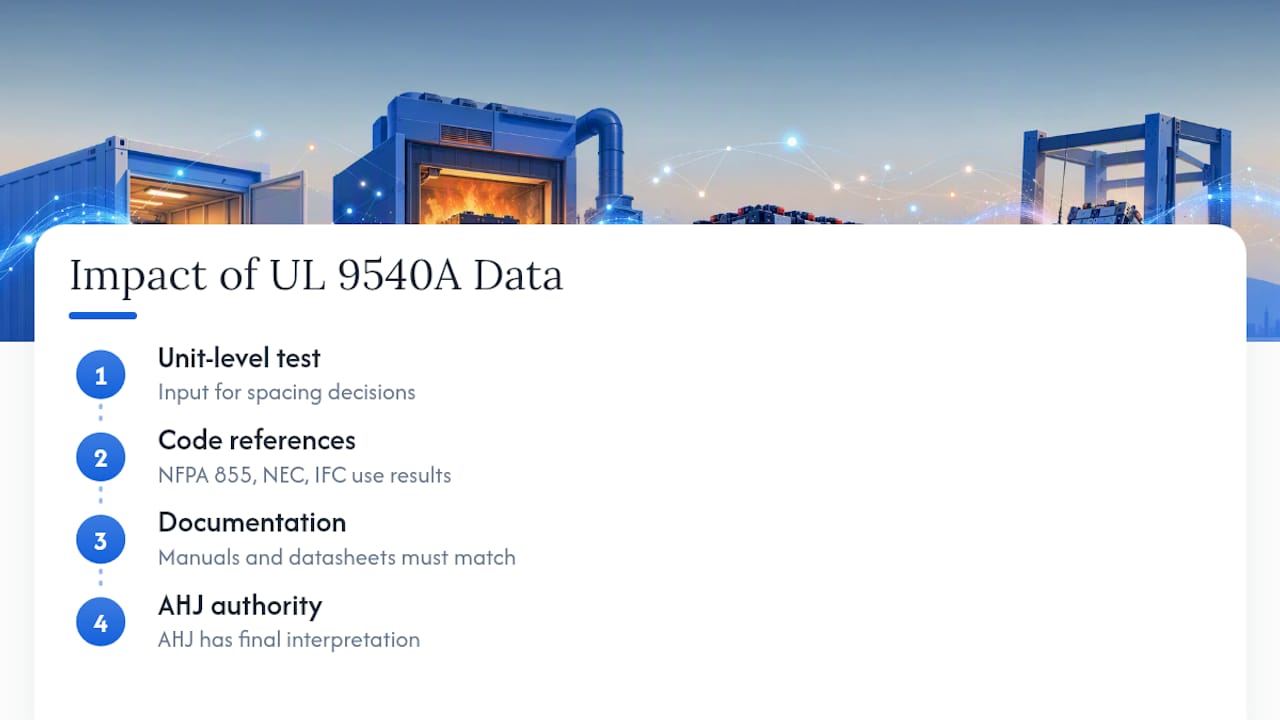
A passing unit-level test isn’t the finish line. It’s the input that lets your customer’s engineer or installer make a code-compliant spacing decision.
NFPA 855 references UL 9540A directly, and documented non-propagation results are often the path to reduced separation distances between BESS units and exposures like buildings, property lines, or other equipment. Without that data, installers usually default to the code’s more conservative spacing tables. The NEC (NFPA 70) and the International Fire Code also draw on UL 9540A results when evaluating suppression system requirements and overall installation layout.
That puts a documentation burden on manufacturers. Whatever spacing, suppression, and enclosure conditions were validated during testing need to show up explicitly in your installation manual and datasheets. An AHJ can’t apply favorable spacing based on a test report if your installation instructions don’t specify the exact conditions that test covered.
One caveat worth repeating: UL 9540A results inform code decisions, but AHJs retain final authority over how those results apply in their jurisdiction. The same test data can be interpreted differently across different fire departments.
How Product Design Choices Affect Test Readiness
A leading industrial manufacturer has built its business around high-strength steel infrastructure, including photovoltaic mounting systems and energy storage enclosures manufactured for demanding real-world conditions.
Enclosure geometry and ventilation paths matter directly to UL 9540A outcomes, since gas accumulation, heat containment, and cell spacing all shape whether thermal runaway propagates or stays contained. An energy storage container with well-planned venting and module separation gives cell and module-level tests a better starting point than a design retrofitted for testing after the fact. The same logic applies to E-House structures used as fielded enclosures, where wall construction and internal layout directly affect the wall-temperature data labs record during unit testing.
None of this substitutes for accredited lab testing. Design choices reduce risk going into the test; they don’t replace the test itself.
The Gap Between Passing a Test and Being Field Ready
Most manufacturers treat UL 9540A as a checkbox: submit a unit, wait for a report, move on. That framing misses what actually separates a smooth certification cycle from a painful one, which is how early and how rigorously a design gets tested against its own worst-case failure before it ever reaches an accredited lab.
The conventional advice, “get UL 9540A tested before you launch,” is technically correct and practically useless. It skips the part that matters: which SOC to test at, whether your trigger method will hold up consistently across three escalating test levels, and whether your enclosure’s real ventilation geometry will behave the way your open-air prototype did. Those decisions get made during design, not during the lab visit, and by the time a unit-level test fails, the fix usually means re-engineering a housing that’s already tooled for production.
If there’s one priority worth stating plainly: pre-compliance testing at the cell and module level, in a representative enclosure, with a documented initiation method, catches the failures that are cheap to fix. Skipping straight to unit-level testing catches the ones that aren’t.
— Hu
Building Enclosures and Mounts Designed With Testing in Mind
Some manufacturers offer purpose-built steel structures designed around the ventilation, spacing, and mounting realities that UL 9540A actually measures.
The product lineup spans several configurations relevant to BESS design. The ODM/OEM Energy Storage Container supports custom housing geometry for manufacturers who need enclosure dimensions matched to specific module layouts. The Mobile PV-BESS Power Station combines mounting and storage in a single mobile unit for field-deployed applications. For fixed installations, the GQ-F Series Fixed Mounting System and GQ-A Series Fixed-Adjustable Mounting System address structural spacing and stability requirements, while the GQ-D Series Distributed Bracket handles distributed module layouts. E-House structures round out the offering for teams needing a complete electrical housing solution.
Manufacturers working through OEM and ODM mounting projects can reach out directly for design-for-test technical consultation and quote requests, whether that means reviewing enclosure ventilation before a pre-compliance run or specifying a mounting configuration for an installation already carrying UL 9540A documentation.
Where to Verify UL 9540A Details
Consult UL’s own test method page, the AHJ checklist PDF, and NFPA 855 directly, and coordinate early with your accredited lab and local AHJ.
Sources
- UL 9540A Test Method for Battery Energy Storage Systems (BESS)
- UL 9540A Testing and Compliance Services — Intertek
FAQ
What Is the Difference Between UL 9540 and UL 9540A?
UL 9540 is the system listing standard that certifies a battery energy storage system as safe. UL 9540A is the test method that generates thermal runaway propagation data, which UL 9540 and codes like NFPA 855 often rely on as supporting evidence.
What Does the UL 9540 Standard Cover?
UL 9540 covers the safety requirements for energy storage systems and equipment as a whole product listing, addressing electrical, mechanical, and fire safety aspects rather than just thermal runaway behavior specifically.
How Do I Test My Lithium-Ion Battery for Thermal Runaway?
Testing starts at the cell level to characterize how the cell fails and vents gas, then escalates through module, unit, and potentially installation-level testing under UL 9540A, using a consistent initiation method and documented state of charge throughout. This requires an ISO 17025 accredited lab; it isn’t a test manufacturers can perform informally in-house.
What Is Included in a UL 9540A Report?
A UL 9540A report documents the test configuration, initiation method, full instrumentation data including temperatures and heat release rate, gas measurements, and photographic evidence, which AHJs use to determine installation spacing and suppression requirements.
How Long Does UL 9540A Testing Take and What Does It Cost?
Duration and cost vary significantly based on how many test levels a system requires and whether installation-level testing becomes necessary; manufacturers should request a scope-specific quote from their accredited lab rather than assume a standard timeline.