
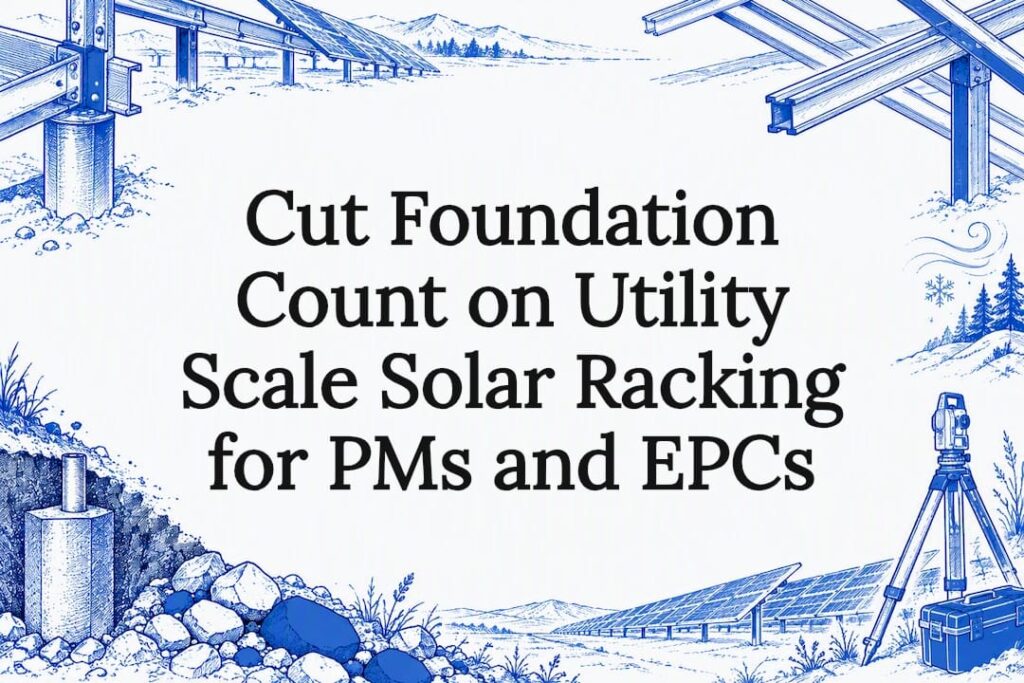
For flat sites with soft to medium soil, long-span fixed-tilt tables remain the most cost-effective standard for utility-scale solar racking. GQ’s GQ-A Series Fixed-Adjustable Mounting System is the recommended starting point, since it balances installation speed, module flexibility, and foundation economy across most site profiles. Rougher or tighter terrain shifts the calculus toward a different configuration, covered below.
TL;DR:
- Long-span fixed-tilt systems can reduce foundation costs by deploying larger module groups, but require stronger structural support to handle wind loads.
- Racking design must match local wind, snow, and seismic standards, with specific certifications like UL 2703 and adherence to regional codes being essential.
- Foundation choice depends on soil conditions; driven piles suit penetrable soil, while ballasted foundations are better for sites with restricted penetration or contaminated land.
- A detailed geotechnical report is crucial before selecting foundation types to avoid costly mid-construction re-engineering.
- Asking manufacturers for clear parts-per-megawatt, installation speed, and coating specifications ensures realistic project planning and long-term durability.
Table of Contents
- Which Solar Racking Type Fits Your Project?
- What Structural Loads and Standards Should You Specify?
- Which Foundation Works Best for Your Site?
- How Fast Can Crews Actually Install Utility-Scale Racking?
- Which Materials and Coatings Hold Up Longest?
- What Should Wind and Snow Ratings Tell You?
- Why GQ’s Manufacturing Scale Matters for Your RFP
- How to Request a Quote on GQ Racking Systems
- What Procurement Teams Get Wrong on Racking Bids
- Sources
- FAQ
Which Solar Racking Type Fits Your Project?
Racking selection comes down to three variables: terrain, module format, and how fast you need crews moving. Get the match wrong and you either overpay for foundations you didn’t need or fight shading losses for 25 years.
- Fixed-tilt tables: The workhorse for flat, buildable land. Lower parts count, straightforward foundation layout, and predictable energy yield make this the default for most greenfield utility projects.
- Table/long-span systems: Stretch a single foundation row across more modules. DCE Solar’s Long-Span system uses tables up to 2×11 modules, cutting foundation count per megawatt while raising wind-load demands on the structure itself.
- East-west and ballasted layouts: Common on rooftops or landfill caps where penetration is restricted; trades peak output for site access and simpler permitting.
- Trackers: Highest energy density per acre through single-axis tracking, at the cost of more moving parts and higher maintenance overhead.
The GQ-A family conceptually maps to fixed-tilt and adjustable-tilt table applications, while the GQ-F Series suits fixed, high-volume table deployments where uniform terrain lets you standardize the build. For projects where tracking pencils out, GQ’s Chaoyang tracker line covers that category separately.
What Structural Loads and Standards Should You Specify?
Wind, snow, and seismic loads drive every steel decision in a racking design, and they should be locked before you request quotes, not after. Design ranges vary by region, but you can use published examples as a sanity check on supplier claims.
Systems in this category are commonly engineered to design ranges up to wind speeds and snow loads typical for their regional codes, with maximum values often cited around 60 m/s wind speed and 2.4 kN/m² snow load, depending on regional code and project customization. Treat those numbers as a ceiling reference, not a universal spec, since your site’s actual design basis comes from local code and a geotechnical report.
- Confirm compliance with IBC, Eurocode, or AS/NZS depending on the project’s jurisdiction, since each governs different load combination methods.
- Request UL 2703 certification for bonding and grounding hardware, which validates that the racking’s electrical continuity has been independently tested.
- Ask how the frame handles large-format modules, since taller module frames change wind uplift calculations and clamp spacing.
- Confirm bifacial clearance: rear-side reflectivity depends on table height and torque tube shadowing, which the 2V Bi-Facial system from ONENESS documents with specific tilt and clearance figures.
Module compatibility isn’t a footnote. A racking system rated for 72-cell modules doesn’t automatically accommodate today’s larger-format panels without reworking clamp positions and rail spans.
Which Foundation Works Best for Your Site?
Foundation choice is usually the single biggest lever on both cost and schedule, and it should follow soil data, not habit. Manufacturer datasheets typically list four options, and each one answers a different site condition.
- Driven piles suit sites with consistent, penetrable soil and no major rock layer; fast installation, minimal concrete, and a proven track record on greenfield utility sites.
- Ground screws work where soil is too loose or too rocky for clean pile driving, or where geotechnical uncertainty makes adjustable embedment depth valuable.
- Ballasted foundations apply where penetration is restricted, such as capped landfills or contaminated sites, trading foundation simplicity for added dead weight and freight cost.
- Concrete pads or piers come into play on very poor soils or high seismic zones, at a real cost and schedule premium compared to driven systems.
Long-span table layouts change this math directly, as explained in Solar Panel Design UAE With Integra for High-Rises, which highlights structural design considerations in complex sites. Fewer, longer tables mean fewer foundation points per megawatt, which is why long-span designs claim higher yield per foundation in freight and labor savings, provided your soil can support the higher point loads that come with longer spans. Pairing table selection with GQ’s pile and foundation product line early avoids a mismatch between rack geometry and foundation type discovered mid-construction.
How Fast Can Crews Actually Install Utility-Scale Racking?
Installed cost lives or dies on three numbers: parts-per-megawatt, frames-per-hour, and crew size needed to hit either. Manufacturers pushing constructability metrics are usually the ones worth a closer look, since reducing parts count is the primary lever for lowering installed labor cost, and it’s a number you can and should ask suppliers to quantify.
- Pre-assembled spines and rails cut field bolting time versus loose-piece kits shipped for full site assembly.
- Integrated module clamps eliminate a separate hardware step per panel, multiplied across tens of thousands of modules.
- Top-down mounting lets crews work from the walkway instead of underneath the table, speeding installation on uneven ground.
- Integrated wire management routes conduit within the structure itself, cutting a separate electrical trade pass.
Pro Tip: Ask every bidder for their frames-per-hour figure under a stated crew size and soil condition, not just a general “fast install” claim. Numbers without context are marketing, not a schedule commitment.
Which Materials and Coatings Hold Up Longest?
Steel grade and coating thickness decide whether your racking survives 25 years or needs mid-life replacement, and this is where lowest-bid procurement often backfires. Coastal sites, landfill caps, and high-salinity soils all accelerate corrosion differently, so the coating spec has to match the actual site chemistry, not a generic default.
- Structural steel grades like S355 paired with hot-dip galvanizing at 80 microns or more are a common baseline for utility-scale ground mount, as ONENESS’s published specs show for HDG steel and AL 6005-T5 aluminum components.
- Aluminum components typically carry anodizing at 15 microns or more where corrosion resistance matters more than raw strength.
- Require mill certificates and third-party coating-thickness reports, not just a supplier’s stated spec sheet.
- Check warranty language for whether it covers coating failure specifically, versus only structural defects.
What Should Wind and Snow Ratings Tell You?
A wind or snow rating only means something when it’s tied to a specific test method and standard, not a headline number on a brochure. Treat every performance claim as a question, not an answer, until you see the paperwork behind it.
- Ask for the specific code basis behind a stated wind speed rating (ASCE 7, Eurocode 1, or AS/NZS 1170), since the same number means different things under different methodologies.
- Request lab or wind-tunnel test summaries, not just a final rated figure with no supporting data.
- Confirm UL or equivalent ISO certification on bonding hardware specifically, since grounding failures are a common field issue that a general structural certificate won’t catch.
- Match warranty duration to the claimed design life; a 10-year warranty on a “25-year design life” system is a signal worth questioning before you sign.
Why GQ’s Manufacturing Scale Matters for Your RFP
Scale like that generally translates to tighter QA on repeat production runs and more predictable lead times on large orders.
- The GQ-A Series fits sites needing tilt flexibility across varied module types and moderate terrain changes.
- The GQ-F Series fits large, uniform sites where standardized fixed-tilt tables minimize part variation.
- OEM and ODM services cover projects with nonstandard module dimensions, unusual foundation constraints, or site-specific engineering requirements.
- Ask for datasheets, structural certificates, and installation manuals up front, along with answers on foundation compatibility, wind/snow design basis, and bonding certification, before including any supplier in a short list.
How to Request a Quote on GQ Racking Systems
Before you call a supplier, pull together your load-case inputs, a geotechnical summary, module specs, and target timeline. That packet is what turns a vague inquiry into a real quote instead of a placeholder number.
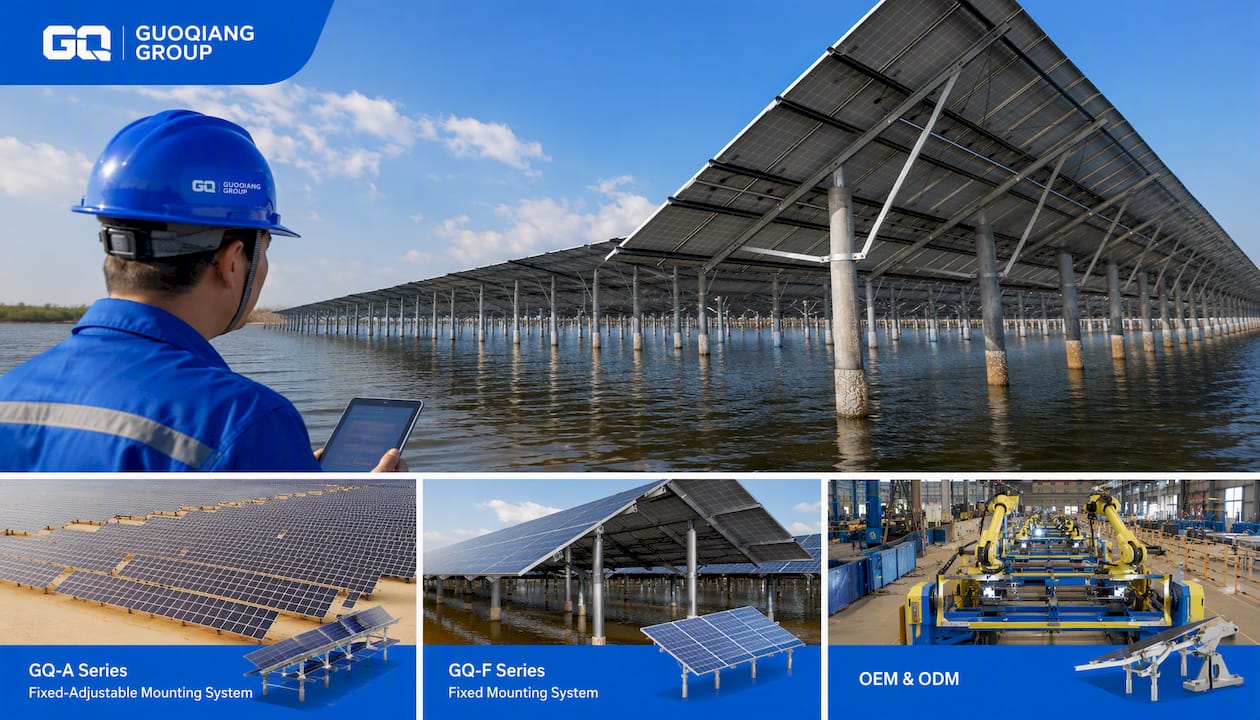
The manufacturer produces steel racking in-house rather than reselling components from third parties, so design changes and volume orders route through one manufacturing chain instead of several subcontractors. Start by reviewing the GQ-A Series product page for fixed-adjustable specs, or the GQ-F Series page if your site favors standardized fixed-tilt tables. Projects with nonstandard module dimensions or unusual foundation constraints should go straight to the OEM and ODM engineering page.
Your RFP checklist should include: wind and snow design basis for your site, module dimensions and frame height, geotechnical report summary, expected foundation type, and target installation timeline. GQ-International’s broader product catalog covers additional components including annular pipe products for adjacent infrastructure needs. Submit your specs through the PV mounting system category page to get a quote scoped to your actual site conditions rather than a generic estimate.
What Procurement Teams Get Wrong on Racking Bids
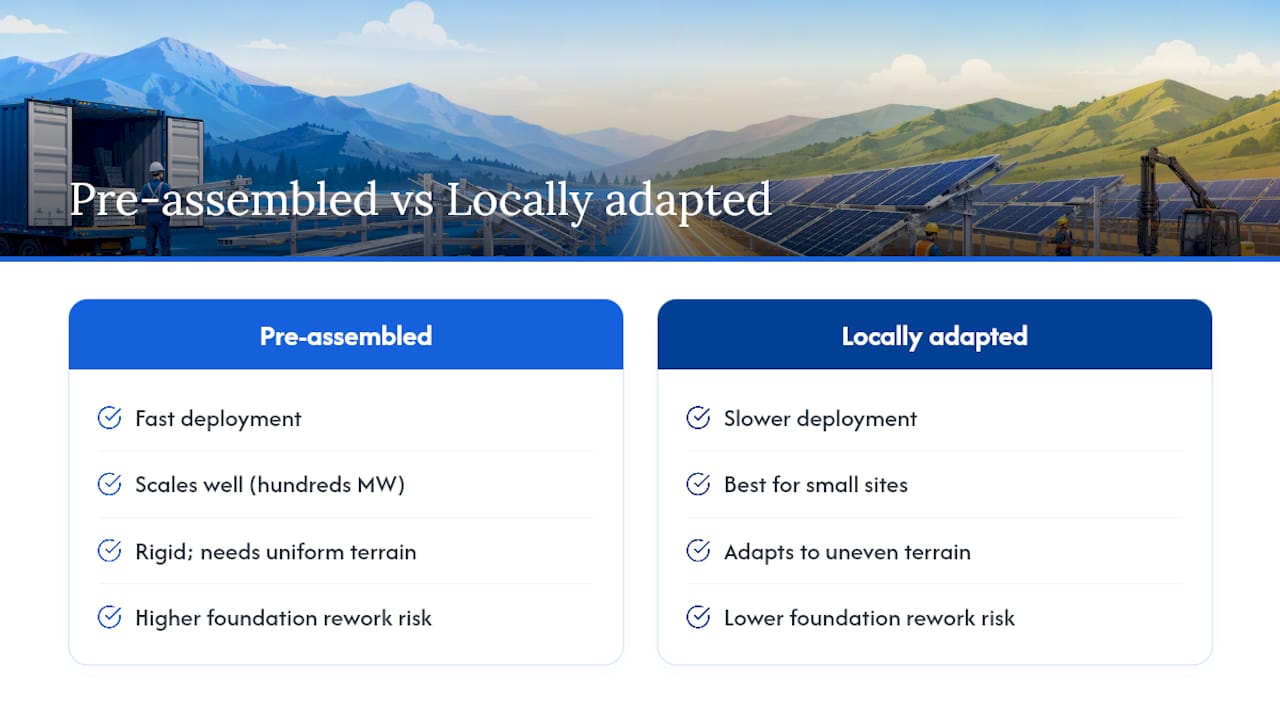
The most expensive mistake in utility-scale racking procurement isn’t picking the wrong product family. It’s under-specifying the foundation design based on a desktop soil estimate instead of an actual geotechnical report, then discovering mid-construction that half the planned pile locations need re-engineering. Pre-assembled systems earn their premium on large, uniform sites where speed compounds across hundreds of megawatts; local field adaptation earns its place on smaller, irregular parcels where a rigid pre-assembled design would fight the terrain at every row.
— Hu
FAQ
What Counts as Utility-Scale Solar?
Utility-scale generally refers to solar farms built to feed power directly into the grid rather than serve a single building or property, typically starting in the multi-megawatt range. Racking systems in this category, like Polar Racking’s CORE series, are designed for projects spanning 500 kW to 500 MW.
What Is the 33% Rule for Solar Panels?
The 33% rule is a rooftop solar guideline, not a utility-scale racking standard. It relates to fire-access setbacks on residential and commercial roofs and does not apply to ground-mount racking design, so it is not relevant when specifying utility-scale systems.
How Much Does a Utility-Scale Solar Farm Cost?
Total project cost varies widely by racking type, foundation choice, and site conditions, with foundation selection being one of the biggest cost drivers on any given site. Gq-international does not publish fixed racking prices; current pricing is available by requesting a quote through the GQ-A Series or GQ-F Series product pages.
What Is the 120% Rule for Solar?
The 120% rule is an electrical code provision governing how much solar capacity can be added to an existing electrical panel or busbar without triggering a full panel upgrade. It applies to interconnection and electrical design, not to racking structure or mounting selection.
Which Foundation Type Should I Choose First?
Start with a geotechnical report before choosing between driven piles, ground screws, ballast, or concrete pads, since soil conditions rule out options faster than budget does. Sites with restricted penetration, like landfill caps, typically default to ballasted systems regardless of what would otherwise be cheapest.