
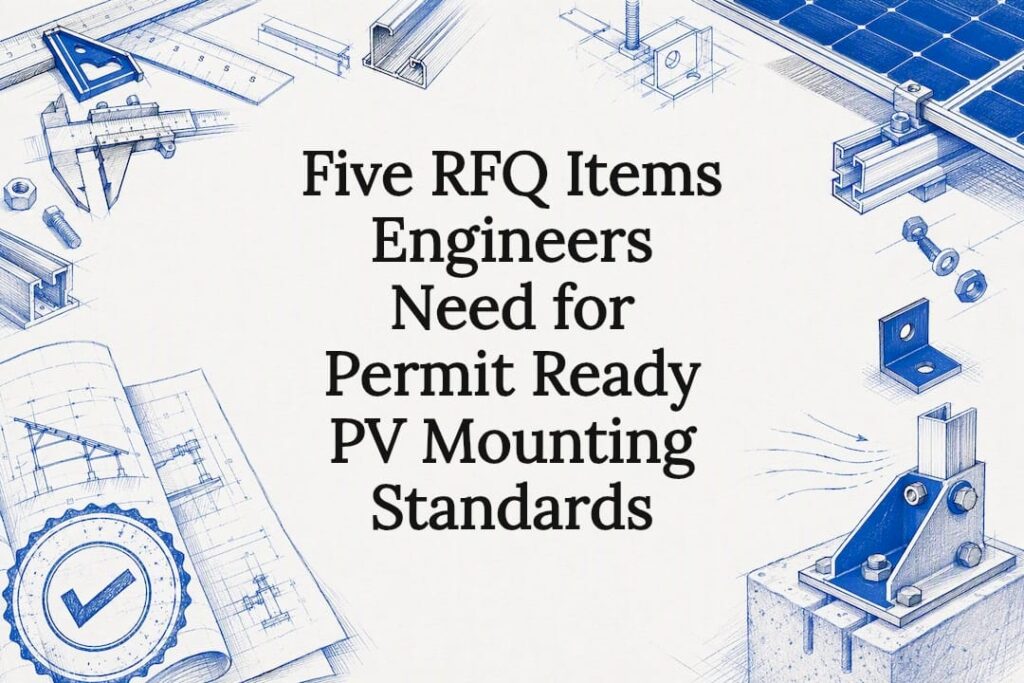
Specify hardware certified to UL 2703 or the equivalent IEC product standards, then back it with a stamped, site-specific structural report calculated to ASCE 7, Eurocode, or AS/NZS 1170 depending on jurisdiction. Neither document substitutes for the other. Local authorities having jurisdiction (AHJs) also layer in fire setback and access rules that no product listing can satisfy on its own.
TL;DR:
- UL 2703 certification confirms mounting hardware can resist rated structural loads, but site-specific calculations are necessary to ensure it can handle actual local wind, snow, and seismic conditions.
- Most AHJs require both UL 2703 listings and stamped load calculations, with some jurisdictions demanding a licensed engineer’s review regardless of product certification.
- IEC standards like IEC 61730, IEC 62852, and IEC 62790 govern module safety, electrical connections, and junction box design, with BIPV systems requiring additional documentation due to their dual function as building materials.
- Use jurisdiction-specific structural codes such as ASCE 7-22 in the U.S., Eurocode EN 1990, or AS/NZS 1170, and include a detailed, stamped calculation report with site-specific load inputs to avoid costly permit delays.
- Specify manufacturer-provided anchor load and torque data in RFQs to streamline permitting, leverage manufacturing scale for faster documentation, and ensure hardware matches site and jurisdiction requirements.
Table of Contents
- What Do PV Mounting Standards Actually Require?
- Which Product Certifications Should You Specify?
- Which Structural Codes Govern Your Region?
- Which Mounting Method Fits Your Site?
- What Electrical Protections Are Part of Mounting Compliance?
- What Do Inspectors Actually Check On-Site?
- How Do You Write an RFQ That Gets Compliant Hardware?
- Where Manufacturing Depth Actually Shows Up in Compliance
- Need Mounting Hardware Ready for Your Next Permit Package?
- Sources
- FAQ
What Do PV Mounting Standards Actually Require?
Product certifications and structural standards answer two different questions, and confusing them is one of the single most common permitting delays in commercial PV projects. A certification tells you the hardware performs as designed under lab conditions. A structural calculation tells you whether that hardware, installed at this specific roof pitch, this wind exposure, and this snow load, will hold.
A UL 2703 listing confirms a racking system resists a rated structural load and maintains bonding continuity between modules and rails. It says nothing about whether that rating covers a 130 mph wind zone in coastal Florida or a 40 psf snow load in the Rockies. That gap is where engineer-stamped site calculations come in, and most AHJs require both documents in the permit package.
- Product certification proves the hardware’s tested capacity in controlled conditions.
- Site-specific calculations prove that capacity matches this project’s actual loads.
- AHJ requirements vary widely; some accept manufacturer span tables, others demand a licensed engineer’s stamp regardless of listing status.
- A UL 2703 listing paired with a stamped local load calculation is the combination most reviewers expect to see together.
Which Product Certifications Should You Specify?
UL 2703 is the reference standard in the United States for mounting system structural load resistance and electrical bonding and grounding continuity. It also determines the fire classification assigned to a rooftop PV assembly, though adoption and interpretation still vary by AHJ. Outside product-level structural testing, a handful of IEC standards cover the components that connect the array electrically.
- IEC 62852 governs PV connectors, including mating force and environmental sealing.
- IEC 62790 covers junction box design, ingress protection, and terminal safety.
- IEC 61730 (EN IEC 61730 in Europe) sets module safety requirements, covering electrical shock, fire, and mechanical hazards.
- CE marking and a Declaration of Performance (DoP), governed in part by EN 50583-1, apply specifically to building-integrated photovoltaics (BIPV), where the module doubles as a construction product.
Statistic callout: UL 2703 is also used to determine the fire classification of rooftop PV assemblies, meaning your mounting hardware choice can directly change what fire rating a roof assembly receives.
BIPV procurement carries a heavier documentation burden than rack-mounted systems. Because BIPV modules function as both electrical components and building envelope materials, they require dual compliance—IEC 61730 for electrical safety, and construction-product conformity under CPR and DoP for structural and weathering performance.
Which Structural Codes Govern Your Region?
Structural design standards for PV mounting are jurisdiction-specific, and picking the wrong reference code is a fast way to fail plan review. In the United States, ASCE 7-22 (referenced by the International Building Code) provides ZIP-code-specific wind maps used in permitting. Australia and New Zealand rely on AS/NZS 1170.2 for wind loading. European projects work from Eurocode EN 1990 and EN 1991, but every member state layers on a national annex that adjusts wind and snow figures for local conditions.
Whichever code applies, the engineer needs a consistent set of inputs before running numbers:
- Regional wind speed or wind region classification
- Site exposure category (terrain roughness, height above ground)
- Ground snow load, where applicable
- Seismic design category, for ground-mount and some rooftop installations
The deliverable package for permitting should include a stamped calculation report, an attachment schedule showing spacing and fastener type, and documented anchor loads for each attachment point.
Pro Tip: Don’t wait for the AHJ to ask for a national annex reference. Confirm which annex applies to your Eurocode project before finalizing wind load inputs. Getting this wrong after drawings are stamped means a costly resubmission.
Which Mounting Method Fits Your Site?
Mounting method choice changes both the structural math and the permitting path, so match the method to the site rather than defaulting to whatever was used on the last project.
- Standoff mounts are the most common rooftop approach. Dead load stays minimal, but each attachment point needs uplift resistance calculated against local wind loads, since the roof deck itself absorbs no lateral load without proper flashing and fastening.
- Ballasted systems avoid roof penetrations but add significant dead load. That means verifying the roof structure can carry the added weight, and in high-wind or seismic zones, adding tethering to prevent array movement.
- Ground and pole mounts shift the engineering problem to foundation design: soil bearing capacity, frost depth, and physical protection from vehicle or foot traffic all factor in.
- Trackers introduce dynamic loads from motor-driven rotation and require additional review for electromagnetic compatibility (EMC) alongside standard structural checks.
- BIPV mounting adds construction-product obligations on top of electrical compliance, since the mounting category under EN 50583-1 determines which national product rules apply beyond CPR and DoP.
A quick illustration: a standoff attachment on a 30-degree pitched roof in a 120 mph wind zone might need to resist several hundred pounds of uplift per point, depending on module size and spacing. That number comes from the structural calculation, not the product datasheet.
What Electrical Protections Are Part of Mounting Compliance?
Mounting hardware isn’t purely mechanical. Bonding and grounding continuity across rails, clamps, and modules is a core requirement under UL 2703 and reinforced by IEC guidance on array design. If a rail system loses continuity at a joint, the entire bonding path for that row can fail inspection.
IEC 62548-1:2023 updated its array insulation monitoring and earth-fault detection provisions, and it now includes Annex F with KI factor calculations specifically for bifacial modules. That matters for mounting design because bifacial arrays often sit higher off the roof or ground to maximize rear-side irradiance, changing both structural loads and grounding path lengths.
- Cable and junction connections should meet EN 50618 or IEC 62930 for DC cable construction.
- DC disconnects and combiner boxes need clear, durable marking per local electrical code.
- Arc-flash awareness and anti-PID (potential-induced degradation) measures are increasingly referenced alongside standard bonding checks.
Statistic callout: IEC 62548-1:2023 replaced the 2016 edition specifically to address array insulation monitoring, earth-fault detection, and bifacial system provisions, a sign of how fast electrical safety requirements are catching up with panel technology.
What Do Inspectors Actually Check On-Site?
Inspection checklists focus on a narrower set of items than the full standards stack might suggest, but missing any one of them is enough to trigger rectification. Regulatory checklists, like the one published by the Clean Energy Regulator in Australia, map specific clauses to common failure points: insecure attachments, missing corrosion protection, and galvanic isolation gaps between dissimilar metals.
- Earthing and bonding continuity verified at every module and rail joint
- Attachment points free of visible corrosion or improper fastener substitution
- Wiring protected from abrasion at penetration points
- Marking and labeling legible and matched to as-built drawings
The document package inspectors expect alongside the physical check includes the product’s DoP or listing certificate, manufacturer installation instructions, the stamped structural report, a wiring diagram, and commissioning records. Most rejected inspections trace back to a missing document, not a hardware failure.
How Do You Write an RFQ That Gets Compliant Hardware?
A tightly written RFQ saves weeks of back-and-forth during procurement, and it forces suppliers to hand over documentation before, not after, the order ships.
- Require test reports and listings: UL 2703, relevant IEC certifications, and TÜV reports where applicable.
- Request the Declaration of Performance and CE documentation for any BIPV component.
- Ask for material and coating specifications, particularly corrosion resistance data for coastal or high-humidity sites.
- Require manufacturer-published anchor loads and torque specifications for every fastener type used.
- Confirm traceability (batch or lot records), warranty terms, and whether the supplier offers engineering support for site-specific load calculations.
Pro Tip: Manufacturer-supplied anchor load and torque data can sometimes eliminate the need for a fully custom engineered attachment report, which shortens permit review meaningfully. Ask for this data before you ask for a quote, not after.
Where Manufacturing Depth Actually Shows Up in Compliance

A supplier’s manufacturing scale matters more than most spec sheets suggest, particularly when a project needs fast documentation turnaround. Jiangsu Guoqiang Holding Group, operating as Gq-international, has built high-strength steel solutions for transportation safety and renewable energy since 1998, and it holds over 40% domestic market share in traffic safety products and over 20% in photovoltaic solutions in China.
That kind of production depth translates into faster access to material certifications, torque specs, and anchor load data when engineers need it for permit packages. Gq-international’s product lineup spans guardrails, intelligent photovoltaic brackets, and flexible energy storage systems, all built on the same in-house manufacturing and quality control processes. For engineers juggling multiple jurisdictions and AHJ requirements, having one supplier who can produce consistent documentation across projects removes a real bottleneck.
— Hu
Need Mounting Hardware Ready for Your Next Permit Package?
Suppliers often manufacture mounting families designed to adapt to diverse site conditions engineers face rather than using generic one-size-fits-all racking. For sloped or irregular rooftops, the GQ-FL series flexible support adapts to uneven structural conditions where standard rigid rails don’t fit cleanly.
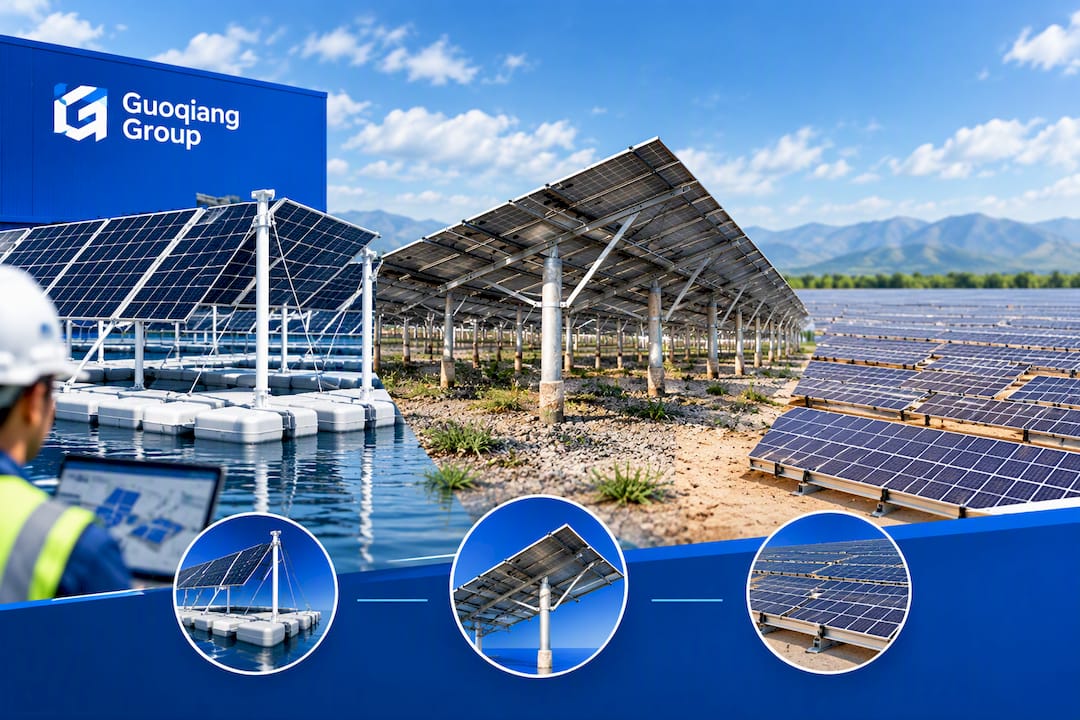
For straightforward pitched-roof arrays, the GQ-F Series Fixed Mounting System covers the standoff applications most commercial and utility projects rely on. Where a site needs tilt flexibility across mixed-orientation fields, the GQ-A Series Fixed-Adjustable Mounting System gives engineers room to adjust angle without redesigning the whole array. If you’re specifying hardware for an upcoming project, request test reports, anchor load data, and a project quotation directly through Gq-international’s PV mounting catalog before you finalize your RFQ.
Sources
- IEC 62548-1:2023 – Photovoltaic (PV) arrays – Part 1: Design requirements
- PV Mounting Systems Certification | UL Solutions
- prEN 50583-1: Photovoltaics in buildings — BIPV modules standard
- Solar PV inspection checklist | Clean Energy Regulator (CER)
FAQ
What Is the 33% Rule in Solar Panels?
The 33% rule usually refers to a rooftop fire code guideline limiting how much of a roof’s ridge or setback zone can be covered by panels, which affects mounting layout and access pathways. It’s a local fire and building code matter rather than a single global standard, so confirm the exact figure with your AHJ before finalizing array layout.
Which Standard Is Recommended for a Solar PV Mounting Structure?
For structural performance and electrical bonding in the U.S., UL 2703 is the recommended product certification, paired with a site-specific structural calculation under ASCE 7/IBC. Outside the U.S., IEC product standards combined with Eurocode or AS/NZS 1170 calculations serve the same function.
What Is the IEC 61730 Standard For?
IEC 61730 (EN IEC 61730 in Europe) sets safety requirements for PV modules, covering electrical shock hazards, fire safety, and mechanical integrity. For BIPV projects, it works alongside construction-product conformity requirements like the DoP referenced in EN 50583-1.
What Is the 20% Rule for Solar Panels?
Always confirm the applicable figure with the AHJ rather than assuming a universal threshold, since this is a code interpretation issue, not a single fixed international standard.