

Trackers usually raise annual energy per installed watt but add CAPEX and O&M, while fixed tilt stays simpler and often wins where land is constrained, terrain is complex, or project bankability favors fewer moving parts. The right call is site-specific, decided on levelized cost of electricity rather than yield alone. We build both architectures, including the GQ-T Chaoyang Series Tracker System and the GQ-F Series Fixed Mounting System, with OEM & ODM tailoring available for non-standard sites.
TL;DR:
- Field validation puts single axis tracking gains at 15% to 25%, while bifacial modules add 7% to 9%, depending on albedo, height, and layout.
- Trackers add $0.15 to $0.35 per watt upfront, so compare lifetime energy, operating costs, and revenue timing in a site specific LCOE model.
- Limited land, irregular terrain, or frequent wind and snow stow requirements can erase tracker gains; consider fixed tilt on constrained sections of mixed sites.
- Tracker financing may require historical uptime, remote monitoring, spare parts plans, and separate warranties for structural components, drives, and control electronics.
Table of Contents
- How fixed-tilt and tracker systems work
- Energy yield comparisons: typical uplifts and what drives them
- Cost trade-offs and LCOE: turning yield into a decision
- Site suitability: land, terrain, wind, and snow constraints
- Operations, reliability, and what lenders want to see
- Design knobs: backtracking, GCR, bifacial, and array height
- A checklist for choosing between tracker and fixed tilt
- Where GQ-T and GQ-F fit common project archetypes
- Get a mounting system evaluation for your project
- FAQ
- Sources
How fixed-tilt and tracker systems work
Fixed-tilt arrays hold modules at a static angle, usually set close to the site’s latitude to balance seasonal output, and that fixed geometry lets rows sit closer together for a high ground coverage ratio. There is no drive train, no control system, and no moving part to maintain beyond the racking and fasteners themselves.
Single-axis trackers, most commonly horizontal single-axis trackers (HSAT), rotate modules east to west through the day to track the sun’s azimuth, while tilted single-axis designs add a fixed north-south tilt for sites at higher latitudes. Dual-axis trackers add a second rotation to follow solar elevation as well, capturing more direct irradiance but at meaningfully higher mechanical complexity.

Backtracking is the control logic that keeps adjacent tracker rows from shading each other during low-sun hours. Instead of pointing straight at the sun, the system calculates a shallower angle so the shadow of one row never falls fully on the next, a trade-off between tracking accuracy and shading loss. Because trackers move, they also change the physical geometry of a plant: rows typically need wider spacing, elevated piers, and dynamic clearance checks that fixed-tilt arrays never have to budget for. Our solar tracker guide walks through these configuration choices in more detail.
Energy yield comparisons: typical uplifts and what drives them
Field and validated modeling work shows single-axis tracking typically raises annual energy capture by 15% to 25% over fixed tilt, with the gain depending on the local mix of direct and diffuse irradiance, according to a single-axis tracking and bifacial validation study. Dual-axis systems can push higher under favorable sky conditions, but peer-reviewed engineering comparisons confirm the added elevation tracking mainly pays off where direct normal irradiance (DNI) is high and diffuse fraction is low, per an ASME solar energy engineering comparison.
Bifacial modules add a second, independent uplift. Measured bifacial energy gains range from 7% to 9%, while the broader benefit varies with ground albedo, row height, and array geometry, and stacks on top of the tracking gain rather than replacing it, per the same NREL-affiliated validation work. Smart tracking algorithms that account for rear irradiance can add another increment on top of standard backtracking logic.
The sensitivity drivers worth modeling explicitly are DNI, diffuse fraction, latitude, ground albedo, ground coverage ratio, and row spacing or module height. Two sites with identical tracker hardware can post very different uplifts once albedo and GCR shift.
One field and model validation reports single-axis tracking energy gains of 15% to 25%, with measured bifacial energy gains of 7% to 9%. (NREL-affiliated preprint) That range is wide enough that a generic assumption is rarely good enough for a bankable model.

Cost trade-offs and LCOE: turning yield into a decision
Trackers typically add $0.15 to $0.35 per watt in upfront capital cost compared with fixed tilt, a premium that has to be earned back through higher annual production, according to PV Tech’s analysis of tracker economics. Our solar tracker cost guide breaks down how that premium splits across drive, control, and foundation costs, while our ground mount cost guide covers the fixed-tilt side of the same budget.
Fixed-tilt O&M is mostly bolt torque checks, vegetation control, and periodic structural inspection.
LCOE folds all three pieces together: CAPEX, OPEX, and lifetime energy production, which is why it is the metric that actually settles the question rather than yield percentage alone. Techno-economic analyses treat LCOE as the most reliable comparison point and recommend running site-specific sensitivity analysis instead of leaning on regional averages, per PVcase’s fixed-tilt versus tracker review. A worldwide techno-economic analysis found bifacial single-axis trackers often produce the lowest LCOE across most land areas, while dual-axis trackers generate the most energy but remain too costly to be broadly competitive, according to a global bifacial-tracking LCOE study. Trackers tend to win on LCOE where DNI is high, land cost is low, and a PPA or time-of-delivery structure pays a premium for the extra morning and evening output that tracking captures.
Site suitability: land, terrain, wind, and snow constraints
Ground coverage ratio is the first filter. Trackers need wider row spacing to avoid self-shading, which lowers the kilowatts you can fit per hectare compared with a tightly packed fixed-tilt field. On expensive or limited land, that density penalty can erase the yield advantage before LCOE math even starts.
Topography is the second filter. Irregular or steep sites often favor fixed arrays, since tracker rows need relatively uniform grading to keep rotation geometry consistent across a row, while fixed racking tolerates more terrain variation with simple post-height adjustments. Our ground mount design guide covers grading and layout choices for uneven sites in more detail.
Several site conditions tend to act as decisive factors rather than minor adjustments:
- Wind exposure: tracker rows need wind-stow logic and stronger foundations to survive gusts, adding engineering and cost.
- Snow load: trackers in heavy-snow regions often need snow-stow modes that tilt panels to shed load, which interrupts generation during storms.
- Geotechnical conditions: soft or variable soils raise foundation costs for both systems but hit tracker piers harder because of the torque loads from rotation.
- Permitting and land-use rules: conservation or setback requirements that force a smaller footprint often push developers toward the higher-density fixed-tilt layout.
Reducing foundation count and standardizing pile design matters for both architectures at utility scale, a point our utility-scale racking guide addresses directly for EPC teams managing civil budgets.
Operations, reliability, and what lenders want to see
Tracker O&M programs need motor and actuator servicing, control electronics diagnostics, and periodic calibration checks on top of the structural inspections every array needs. Fixed-tilt O&M is largely bolt-torque verification, corrosion checks, and vegetation management, a shorter list with fewer specialized parts.
Reliability risk on trackers concentrates in drive components and control firmware, so developers should insist on warranty lines that separate structural warranty from drive-train and electronics warranty, since failure modes and replacement costs differ sharply between them.
Lenders generally favor the lower operational complexity of fixed tilt when underwriting smaller or less-experienced operating teams, and they will typically request historical uptime data, a documented spare-parts plan, and remote monitoring coverage before financing a tracker fleet at scale. Standardized parts across a tracker fleet, remote diagnostics that flag drive faults before they become outages, and a stocked spare-parts strategy can help reduce that underwriting friction.
Design knobs: backtracking, GCR, bifacial, and array height
A handful of engineering choices move the yield-versus-cost trade-off more than hardware selection does.
- Backtracking settings: a more conservative backtracking algorithm sacrifices some direct-tracking energy to avoid shading losses, and the right balance depends on row spacing and GCR.
- GCR optimization: a tighter GCR fits more modules per hectare but caps each module’s energy through more frequent backtracking; a looser GCR raises per-module yield but needs more land.
- Array height: raising tracker clearance improves rear-side irradiance for bifacial modules, which is one reason bifacial-on-tracker combinations post some of the strongest uplifts in field data.
- East-west high-density fixed layouts: these trade some per-module yield for very high land utilization, an option worth modeling against single-axis tracking on expensive land.
Bifacial modules generally perform better on trackers than on fixed tilt because the elevated, rotating structure gives the rear side more consistent exposure to reflected ground light throughout the day, compounding with the tracking gain itself.
Pro Tip: Run your bifacial gain and tracking gain as separate line items in your yield model; stacking them as one blended percentage hides which lever is actually doing the work.
A checklist for choosing between tracker and fixed tilt
Work through resource, land, cost, and commercial constraints in order rather than jumping straight to an LCOE spreadsheet.
- Pull site DNI, diffuse fraction, and albedo data covering seasonal conditions.
- Confirm available land area and compute achievable GCR for both architectures.
- Get CAPEX quotes for both options, including foundation and civil costs specific to your soil report.
- Estimate O&M budgets using tracker-specific line items: actuators, controls, and calibration.
- Check wind and snow design requirements against local code and tracker stow specifications.
- Run LCOE sensitivity across four variables: energy uplift percentage, CAPEX premium, O&M percentage, and PPA or merchant time-of-delivery value.
- Consider a hybrid layout, trackers on the open, regular portion of a site and fixed tilt on constrained or irregular sections, when a single site has mixed terrain.
The minimal inputs for a bankable LCOE comparison are DNI and diffuse irradiance data, GCR and row-spacing assumptions, installed CAPEX per watt for each architecture, projected O&M as a percentage of CAPEX, and the discount rate or PPA structure used for the revenue side.
Where GQ-T and GQ-F fit common project archetypes
Open, regular sites with strong DNI and available land tend to favor the GQ-T Chaoyang Series Tracker System, while constrained, irregular, or high-wind sites often do better on the GQ-F Series Fixed Mounting System. For sites with unusual soil conditions or non-standard racking geometry, our OEM & ODM service adapts foundation and structural design to the project rather than forcing a standard layout. Readers managing rooftop or industrial sites with their own structural constraints may also find the structural and geotechnical guidance from AEC Technical useful background for purlin and truss capacity questions that intersect with mounting choice.
— Hu
Get a mounting system evaluation for your project
We manufacture both ends of this decision, so the choice between tracking and fixed tilt does not have to mean switching suppliers partway through a project. Our GQ-T Chaoyang Series Tracker System suits open sites with strong DNI and available land, while our GQ-F Series Fixed Mounting System fits constrained, irregular, or high-wind terrain where simplicity and density matter more than peak yield.
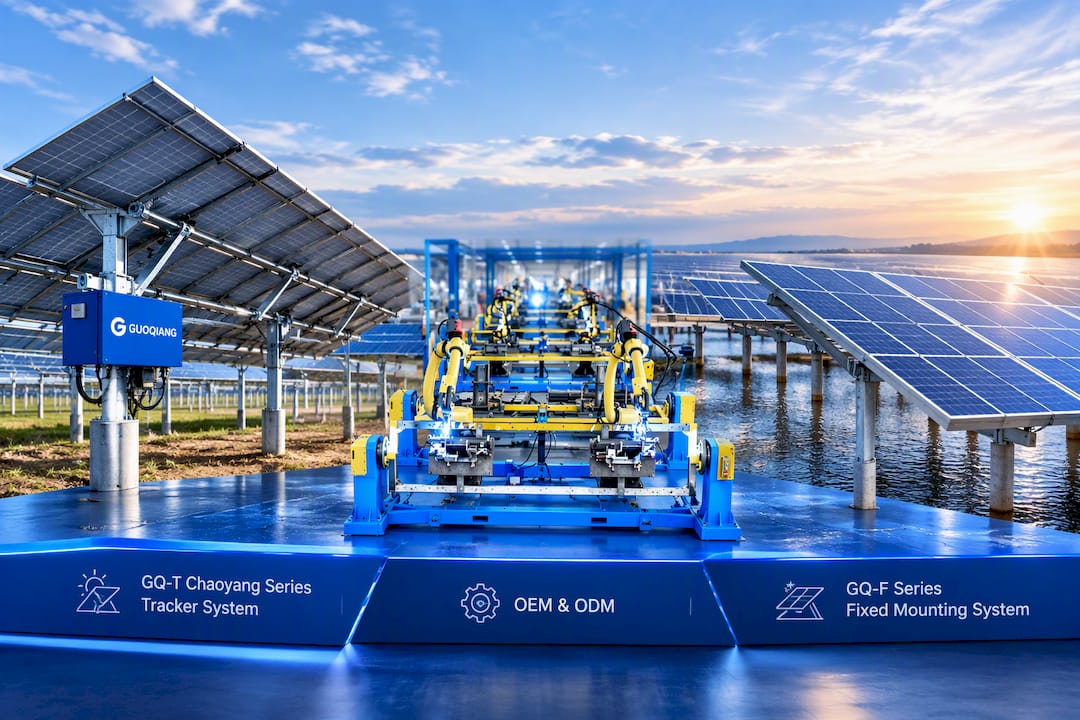
- Request a site-specific engineering review before committing to either architecture.
- Ask about OEM and ODM mounting solutions when your soil report or layout falls outside standard foundation designs.
- Submit a site survey for performance modeling support across our full mounting system range.
Start by sending your site data for a technical evaluation, and our engineering team will map it against both product families before you commit to a layout.
FAQ
How does a dual-axis solar tracker work?
A dual-axis tracker rotates on two axes, one tracking the sun’s daily east-west movement and a second tracking its seasonal elevation change, keeping modules closer to perpendicular to direct sunlight through the day. This design captures more irradiance than single-axis tracking in high-DNI locations, though peer-reviewed comparisons note the added mechanical complexity raises cost and maintenance needs, per ASME’s tracking comparison.
Why do some owners remove solar panels from trackers?
Owners sometimes shift away from tracker-based arrays when O&M costs from motor and actuator servicing outweigh the extra energy captured, particularly on sites with lower DNI or high wind and snow exposure that trigger frequent stow events. In those cases, a fixed-tilt system’s lower mechanical complexity reduces long-term operating risk.
What is the ideal tilt angle for solar panels?
Fixed-tilt arrays are commonly set close to the site’s latitude to balance year-round output, with adjustments made for local shading, snow shedding, or seasonal generation priorities. The exact optimal angle depends on local irradiance patterns and project-specific energy goals rather than a single fixed rule.
What determines whether a tracker lowers LCOE compared to fixed tilt?
A tracker is more likely to lower LCOE where DNI is high, land cost is low, and a PPA or merchant pricing structure rewards the extra morning and evening energy trackers capture. Techno-economic analysis shows bifacial single-axis trackers often achieve the lowest LCOE across much of the land area studied, while dual-axis systems generate more energy but often remain too costly to compete broadly, according to a global bifacial-tracking study.
Sources
Cross-check your own LCOE model against PVcase’s fixed-tilt versus tracker analysis and NREL-affiliated field validation data before finalizing a design.
- Fixed tilt vs tracker system comparison | PVcase
- To track or not to track – PV Tech
- Model and Validation of Single- Axis Tracking with Bifacial Photovoltaics: Preprint
- Bifacial and Tracking Photovoltaic Systems