
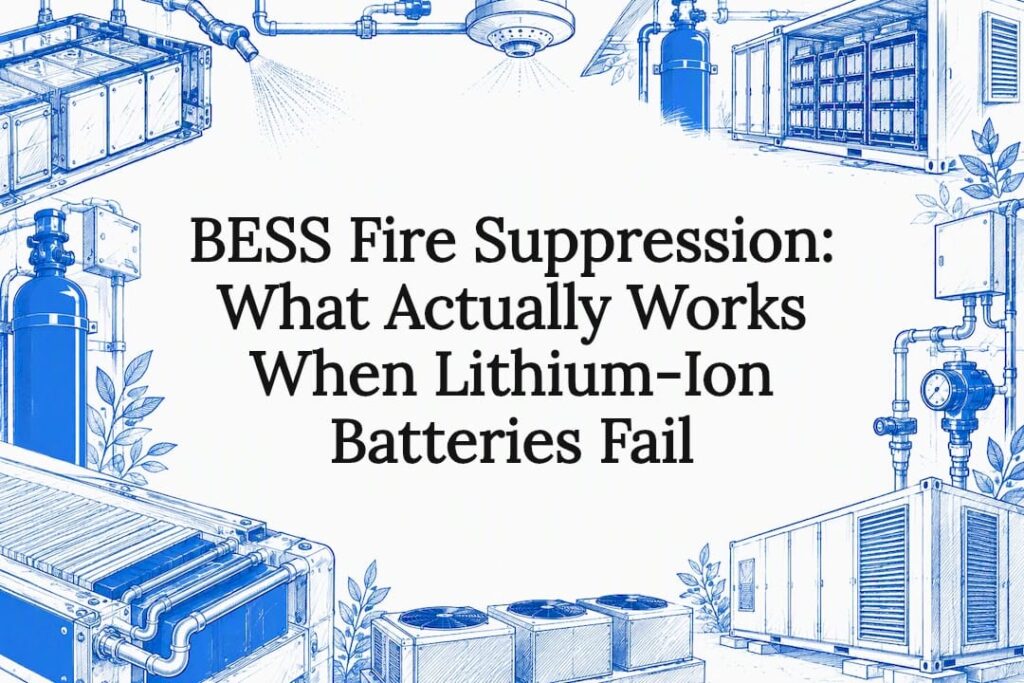
For lithium-ion BESS fires, the immediate priority is containment and cooling, not extinguishment, since putting out visible flames rarely stops the chemical reaction happening inside damaged cells. Water spray limits fire spread between battery units, clean agents help with early-stage knockdown but struggle to cool cascading cells, and the practical goal becomes protecting people, isolating the affected area, and keeping neighboring modules from joining the event.
TL;DR:
- NFPA 855 does not prescribe one agent; requirements depend on hazard analysis, installation size, configuration, and test evidence accepted by local authorities.
- Combine aspirating smoke detection, thermal imaging, gas sensors, and battery telemetry, then verify commissioning triggers charging isolation, exhaust control, and suppression.
- Keep crews upwind and uphill, avoid opening access panels suddenly, and consider exclusion zones of 330 feet or more for larger installations.
- One indoor enclosure design example calls for water at 0.3 gallons per minute per square foot across 2,500 square feet, requiring sustained supply.
- Contain runoff with berms and sealed drainage, and plan disposal because cooling water can carry metals and electrolyte residue from damaged batteries.
Table of Contents
- Why BESS Fires Behave Differently From Ordinary Fires
- How Different Suppression Approaches Perform in Testing
- Detection and Monitoring That Make Suppression Effective
- Standards and Testing That Define Suppression Requirements
- Responding to an Active BESS Event
- Managing Water Runoff and Environmental Impact
- How Container and Thermal Design Reduce Suppression Demands
- A Safety Checklist Worth Following Before the Alarm Sounds
- Reducing Fire Risk Starts With How the System Is Built
- FAQ
- Sources
Why BESS Fires Behave Differently From Ordinary Fires
Thermal runaway starts when a cell’s internal temperature crosses a threshold where exothermic reactions feed themselves. Heat from one failing cell transfers to its neighbors, so a single damaged cell can trigger a chain reaction through an entire module before anyone notices smoke. Unlike a fuel fire that stops once the fuel source is removed, a battery in runaway generates its own oxygen and heat internally, which is why crews sometimes see a fire die down and return hours later.
A few characteristics set these events apart:
- Off-gassing releases a flammable, toxic vapor mixture before flames appear, and that vapor can ignite or explode if it accumulates in an enclosed space.
- Propagation between modules can happen within minutes or stretch out over days depending on cell chemistry, rack spacing, and thermal barriers.
- Re-ignition is common because residual heat in damaged cells can restart combustion after an initial fire appears extinguished.
- Responders face a mixed hazard: heat, open flame, and toxic gas exposure simultaneously, which changes how close anyone can safely get.
The EPA’s guidance on BESS incident response notes that lithium-ion fires can be difficult to extinguish and may reignite hours or days after the initial event, which is the central reason suppression strategy for these systems looks different from suppression strategy for a server room or a warehouse.
How Different Suppression Approaches Perform in Testing
No single agent solves a BESS fire on its own, so facility teams typically layer approaches based on what large-scale testing has actually shown.
- Water spray delivered through ceiling-mounted heads remains the most tested and most reliable tool for limiting unit-to-unit propagation, even though it has limited effect on the module where the failure started.
- Total-flooding clean agents such as Novec 1230 or FM-200 can suppress an incipient fire quickly, but large-scale tests found they gave insufficient cooling to stop propagation once thermal runaway was underway.
- Foam and aerosol systems serve a narrower role, typically supplementing water-based cooling rather than replacing it, and hybrid combinations are increasingly specified where a site needs both quick knockdown and sustained cooling.
- Deflagration venting and explosion protection reduce the risk of a pressure event from accumulated off-gas rather than addressing the fire itself, which is a distinct hazard from the thermal event.
Testing from UL’s work on safer battery energy storage system design compared water spray against Novec 1230 in full-scale scenarios: water spray limited propagation between separate battery units, while the clean agent did not reliably prevent that spread. The practical lesson for anyone specifying a system is that suppression choice cannot be separated from containment design, detection speed, and ventilation control. A system that activates agent discharge correctly but lacks adequate compartmentalization will still lose the fight against a cascading module.
Pro Tip: Treat suppression agent selection as one variable in a fire protection system, not the system itself, and size cooling capacity for sustained duration rather than a single discharge.
Detection and Monitoring That Make Suppression Effective
Suppression only works if it activates early enough and accurately enough, which puts real weight on the sensors feeding the system. Aspirating smoke detection (often referred to by the VESDA brand name), thermal imaging, and direct telemetry from the battery management system each catch different stages of a developing failure, and combining them closes gaps that any single sensor type leaves open.
- Aspirating smoke detectors catch particulate before visible smoke develops, giving the earliest practical warning window.
- Thermal imaging flags abnormal cell or rack temperatures that a smoke sensor would miss entirely.
- Gas detection panels monitor for the specific off-gas signatures associated with thermal runaway, though sensitivity and placement both affect how reliable that signal is.
- Battery management system telemetry ties voltage and temperature anomalies at the cell level directly into the fire safety sequence.
USFA guidance on responding to energy storage system fires cautions that there may be no reliable visual, thermal, or portable gas meter indication confirming battery involvement in a room fire, which is why remote, continuous monitoring piped to a control room or incident commander matters more than a handheld reading taken at the scene. Commissioning should verify that detection actually triggers the intended sequence: isolating charging, controlling exhaust, and actuating suppression, rather than assuming each device works in isolation.
Standards and Testing That Define Suppression Requirements
NFPA 855 sets the baseline that most jurisdictions reference for detection, suppression, explosion control, and commissioning in stationary battery installations. The standard does not mandate one suppression agent; instead, it ties requirements to hazard mitigation analyses, system size thresholds, and test evidence.
- NFPA 855’s code provisions cover fire detection, suppression, explosion control, and commissioning acceptance criteria tied to installation size and configuration.
- UL 9540A large-scale fire testing lets manufacturers and integrators demonstrate how a specific battery configuration actually propagates, which authorities having jurisdiction (AHJs) can accept in place of prescriptive suppression requirements.
- NFPA 68 and 69 deflagration protection provisions apply when a hazard mitigation analysis shows off-gas accumulation could reach explosive concentrations, which is common in enclosed container installations.
- Documentation matters as much as hardware: AHJs generally expect commissioning records, sequence-of-operation testing, and the underlying hazard mitigation analysis before sign-off, not just a suppression system installed to spec.
Responding to an Active BESS Event
Facility teams and fire services need a decision framework before an incident, because the choices made in the first minutes shape outcomes for hours afterward.
- Confirm whether the event is still growing or has stabilized before committing to an active extinguishment attempt rather than a defensive cooling posture.
- Establish an exclusion zone and keep personnel upwind and uphill of the unit, since off-gas plumes carry toxic and flammable components.
- Pre-charge hose lines before approaching and avoid opening doors or access panels suddenly, since accumulated vapor can deflagrate when fresh oxygen reaches it.
- Plan water supply for sustained duration rather than a quick knockdown. A jurisdictional design example from Hydro One’s fire protection risk and response assessment standard specifies water at 0.3 gallons per minute per square foot over 2,500 square feet, a substantial hose demand and sustained water application duration for certain indoor enclosures.
The EPA’s safety guidance notes that isolation zones for larger commercial installations may need to extend 330 feet or more depending on site layout, reinforcing that distance is often a more reliable safety tool than any suppression agent in the first minutes of a response.
Pro Tip: Brief responding crews that a quiet, smokeless battery enclosure is not necessarily a safe one; treat vapor accumulation as a standing hazard until monitoring confirms otherwise.

Managing Water Runoff and Environmental Impact
Water used for cooling or suppression can pick up metals and electrolyte residue, so containment berms, sealed drainage, and controlled discharge points reduce the footprint of a response before runoff ever reaches a storm drain or waterway.
- Diking or berming the area around a BESS installation during a water-based response keeps contaminated runoff contained for later sampling and proper disposal.
- Compiled incident reviews found that environmental sampling after several BESS events did not show contaminant concentrations that would pose a public health concern when runoff was managed and handled correctly.
- Coordination with environmental regulators and hazardous material transporters determines proper disposal of contaminated water and damaged battery material, and that coordination works best when planned before an incident rather than during one.
How Container and Thermal Design Reduce Suppression Demands
Prevention-first engineering lowers how often suppression gets tested in the first place. Our thermal management approach uses 28 mm cold plates and Tmax alarm thresholds along with advanced residential battery storage controls to catch abnormal heat buildup before it reaches runaway conditions, which keeps containment and detection systems ahead of the problem rather than reacting to it. Our BESS container designs separate racks with compartmentalization intended to slow propagation if a cell does fail. For installations that need to relocate or scale quickly, a mobile power station can pair generation and storage in one engineered enclosure, which keeps thermal management and containment features consistent across deployment sites rather than relying on site-built protection.

A Safety Checklist Worth Following Before the Alarm Sounds
Prevention beats suppression every time, so verify detection sequencing, commissioning records, and hazard mitigation analysis with your AHJ before relying on any agent to save a module. Accept that controlled consumption of a failing unit is sometimes the safer outcome than aggressive intervention, and document that decision with your AHJ in advance. Push for remote gas monitoring and continuous telemetry on every new installation.
— Hu
Reducing Fire Risk Starts With How the System Is Built
Suppression design matters, but the systems that need it least are the ones built with containment and thermal control from the start. Our Mobile PV-BESS Power Station combines engineered thermal management with containerized separation, giving facility teams a deployable option that carries consistent safety design into every site rather than depending on local construction quality. We also supply project-specific engineering support for teams working through hazard mitigation analysis or commissioning documentation ahead of an AHJ review.
If you are evaluating a new storage installation or replacing an aging system, request specifications for our containerized and mobile energy storage options, or reach out for engineering input on your commissioning plan, through our full product catalog.
FAQ
What type of fire suppression system is used in BESS systems?
Most BESS installations use water-based suppression, typically ceiling-mounted water spray, because large-scale testing shows it reliably limits fire spread between units even when it cannot fully extinguish the initiating module. Clean agents like Novec 1230 are sometimes included for early-stage knockdown but are generally paired with water rather than used alone.
What are the disadvantages of BESS?
Lithium-ion battery storage carries fire risks that can be difficult to extinguish completely, with off-gassing and re-ignition risk persisting hours or days after an apparent fire is out, according to EPA guidance. Other tradeoffs include the need for large exclusion zones during incidents and the ongoing maintenance and monitoring that safe operation requires.
How do you extinguish a BESS fire?
Full extinguishment is often not the realistic goal. Response generally focuses on cooling adjacent units with water spray to prevent propagation, isolating the area, and allowing a damaged unit to burn out under controlled conditions, since USFA guidance notes there may be no reliable way to confirm a fire is fully out from the outside.
How many BESS fires have there been in the US?
There is no single authoritative national count cited across available incident reports, though compiled case reviews, including events at Surprise, Arizona, Warwick, New York, and the Gateway and Moss Landing facilities, document a range of outcomes from contained fires to controlled consumption. Readers researching a specific jurisdiction’s incident history should check state regulatory filings rather than a single aggregated figure.
Sources
- Battery Energy Storage Systems: Main Considerations for Safe Installation and Incident Response | US EPA
- Designing, installing and maintaining safer battery energy storage systems | UL
- Responding to fires that include energy storage systems (USFA)
- Hydro One — Fire Protection Risk and Response Assessment Standard (FPRRAS)
- NFPA 855 standard overview and code excerpts