
The best coating for structural steel is the one matched to the environment the steel will live in, applied over properly prepared steel, and maintained on schedule. Protective coatings for steel work in one of two ways: as a barrier (epoxy, polyurethane, most paints) or as a sacrificial layer (zinc-rich primer, hot-dip galvanizing). Most long-life systems combine both. This guide shows how to pick between them, which numbers to put in a specification, and where coatings usually fail.
TL;DR
- Start from the exposure, not the product: classify the site under ISO 12944 (C1 to CX) and the service life you need, then select the system.
- Barrier coatings (epoxy, polyurethane) suit moderate exposure. Zinc-rich primers or galvanizing are the foundation for high-corrosivity sites (C5 and CX).
- Surface preparation decides performance. Blast cleaning to SSPC-SP 5 or SP 10 and removal of soluble salts matter more than the brand on the can.
- Durability ratings estimate time to first major maintenance. They are not a warranty, so plan inspections and spot repairs.
Table of Contents
- How coatings protect structural steel
- Types of structural steel coatings
- Start with ISO 12944 exposure categories
- Hot-dip galvanizing and duplex systems
- Surface preparation: where most failures begin
- Application windows, pot life and film build
- What we see from the fabrication side
- Specifying a coating system: a checklist
- Common mistakes
- Coated steel from Gq-international
- FAQ
- Sources
How coatings protect structural steel
Corrosion is an electrochemical process. It needs an anode, a cathode, an electrolyte (water or moisture) and a metallic path between them. Coatings work by breaking that circuit, either by acting as a barrier or by providing sacrificial cathodic protection.
The two mechanisms behave differently in service:
- Barrier coatings such as epoxies, polyurethanes and powder coatings form a continuous film that blocks moisture and oxygen from reaching the steel, as the Epoxy Interest Group’s overview of steel coating describes. They depend on film integrity. A scratch or pinhole is a path for moisture.
- Sacrificial coatings such as zinc-rich primers and hot-dip galvanizing corrode in place of the steel. Damage to the film does not immediately expose the steel to attack, because the zinc around the break keeps protecting it.
A second point matters for specifiers: most paint and powder barriers are permeable to some degree. Over time water vapor moves through the film, which is one reason local damage left unrepaired can turn into rapid underfilm corrosion.
Types of structural steel coatings
Google’s top guides group coatings into primers, topcoats and specialty systems. For specification work it is more useful to group them by function.
| Coating type | Protection mechanism | Typical role | Watch for |
|---|---|---|---|
| Zinc-rich primer (organic or inorganic) | Sacrificial plus barrier | First coat in high-corrosivity systems | Needs a clean, profiled surface; topcoat compatibility |
| Epoxy (intermediate or primer) | Barrier | Build thickness, surface-tolerant repair | Chalks in sunlight, so it normally needs a topcoat outdoors |
| Polyurethane or polysiloxane topcoat | Barrier, UV and color stability | Finish coat | Recoat windows and humidity during application |
| Hot-dip galvanizing | Sacrificial plus barrier | Bridges, towers, guardrails, supports | Steel chemistry affects thickness; part size limited by kettle |
| Duplex (galvanizing plus paint or powder) | Combined | Severe or aesthetic-critical exposure | Surface prep of zinc before painting |
| Thermal-sprayed metal | Sacrificial | Offshore and hard-to-maintain assets | Requires skilled application |
The AMPP guidance on structural steel coatings is blunt that selection is not one-size-fits-all. It balances environmental exposure, required service life, application method and budget. Zinc-rich primers are essential in high-corrosivity environments (C5 and CX), while epoxy systems are favored where requirements are moderate and the surface is less than perfect.
Which paint is best for structural steel?
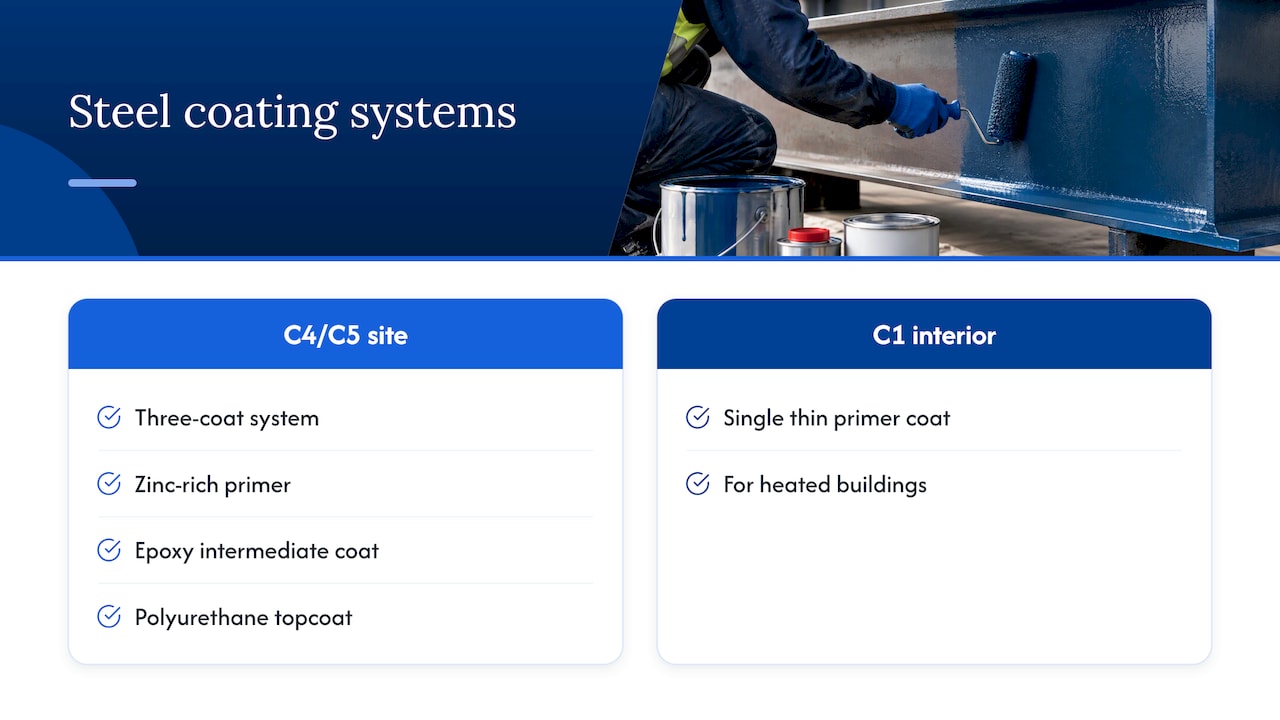
There is no single best paint. A common three-coat system for a C4 or C5 industrial site is a zinc-rich primer, an epoxy intermediate coat for thickness and a polyurethane topcoat for weathering. Inside a heated building (C1), a single thin primer coat may be all the project needs. The exposure category tells you which one you are in.
Start with ISO 12944 exposure categories
ISO 12944 is the internationally recognized standard for protecting steel structures with paint systems. It covers corrosivity categories, durability expectations and test protocols, and Steel Construction Info’s summary of standard corrosion protection systems shows how the categories map to real environments. For example, C1 (very low) covers heated buildings with clean atmospheres such as offices, shops and schools.
Under ISO 12944-2 as described in a peer-reviewed offshore coating study, corrosivity runs from C1 (very low) to CX (extreme offshore or industrial). Offshore work typically needs C5-M or Im2 (immersion) protection, with total dry film thickness (DFT) from 320 µm up to 1,000 µm depending on the zone:
| Zone | Typical total DFT |
|---|---|
| C5-M atmospheric | 320–500 µm |
| Splash and submerged (Im2) | 480–1,000 µm |
The same standard classifies durability, which is a different thing from lifespan. It is the time to first major maintenance:
| Durability range | Time to first major maintenance |
|---|---|
| Low (L) | 2–5 years |
| Medium (M) | 5–15 years |
| High (H) | 15–25 years |
| Very High (VH) | More than 25 years |
These values come from the same ISO 12944 evaluation. A spec that says “C5, high durability” tells a coating supplier far more than “heavy-duty epoxy.”
Coastal and salt-laden sites
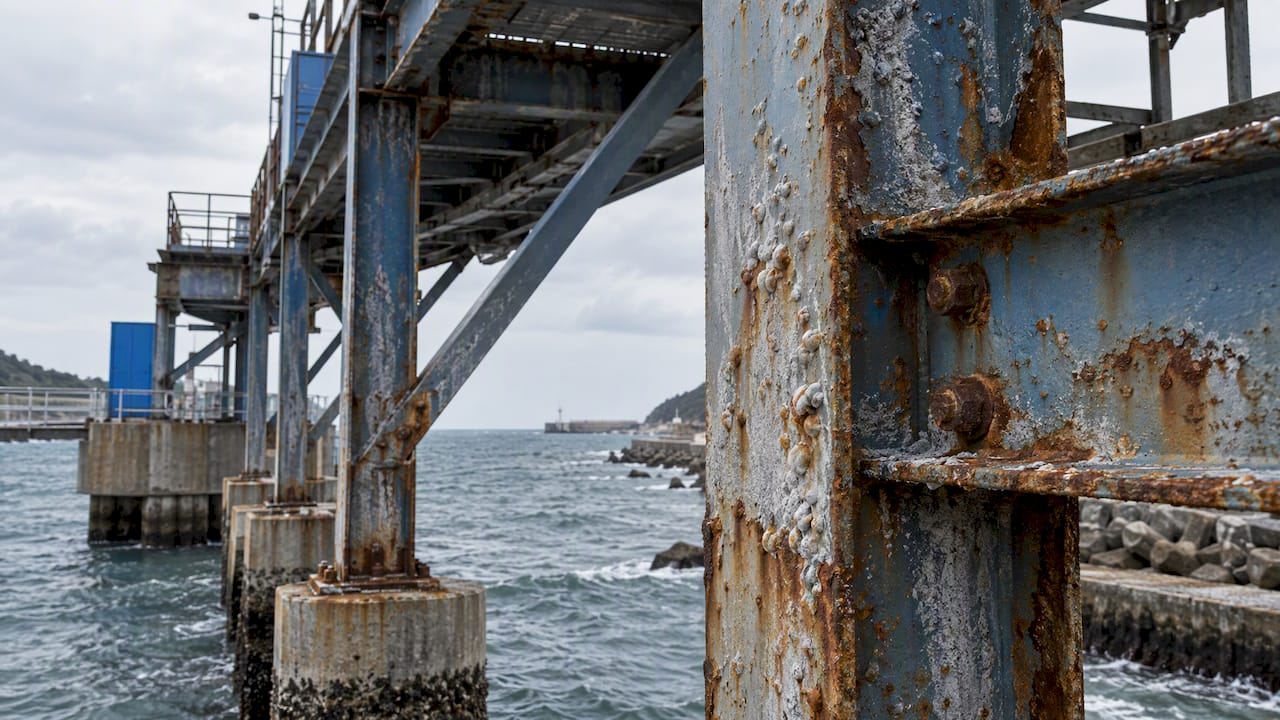
Salt is the harshest everyday contaminant. It attracts moisture, drives corrosion rates up and leaves soluble residues that cause blistering. If your steel stands near the sea, the same logic applies to any exposed metalwork, from structural frames to solar arrays. A practical look at coastal salt corrosion protection shows how exposure class changes what should be specified. For structural steel, treat marine and splash-zone sites as C5-M or CX until a corrosivity assessment says otherwise.
Hot-dip galvanizing and duplex systems
Hot-dip galvanizing immerses fabricated steel in molten zinc. The result is a metallurgically bonded coating that covers edges, corners and internal surfaces, places where brushed or sprayed paint is thinnest. Thickness depends on the steel. Under ASTM A123, steel at least 1/4 in thick receives at least 3.9 mils (99 microns) of zinc, and silicon and phosphorus content in the steel influence the final thickness. Ask your galvanizer about the steel chemistry before the parts are dipped.
Where conditions are severe, or where color or extra life is required, the answer is often a duplex system: galvanizing followed by paint or powder coat. Industry guidance from the American Galvanizers Association explains the synergy. The zinc is the primary corrosion barrier, the coating protects the zinc, and service life extends beyond what either method gives alone. Two cautions:
- Galvanized surfaces need the correct preparation (cleaning, light sweep blasting or a suitable etch primer) before painting. Poorly prepared zinc is a classic cause of peeling.
- Specify the paint system for compatibility with zinc from the start, not after the steel arrives.
This is why roadside safety hardware is so commonly galvanized. Guardrails sit in splash from de-icing salts, take impact damage and cannot easily be repainted in live traffic. If you are writing a specification for that kind of asset, see our guides on guardrail corrosion prevention for procurement and weathering steel guardrails, which cover when a bare, galvanized or weathering solution makes sense.
Surface preparation: where most failures begin
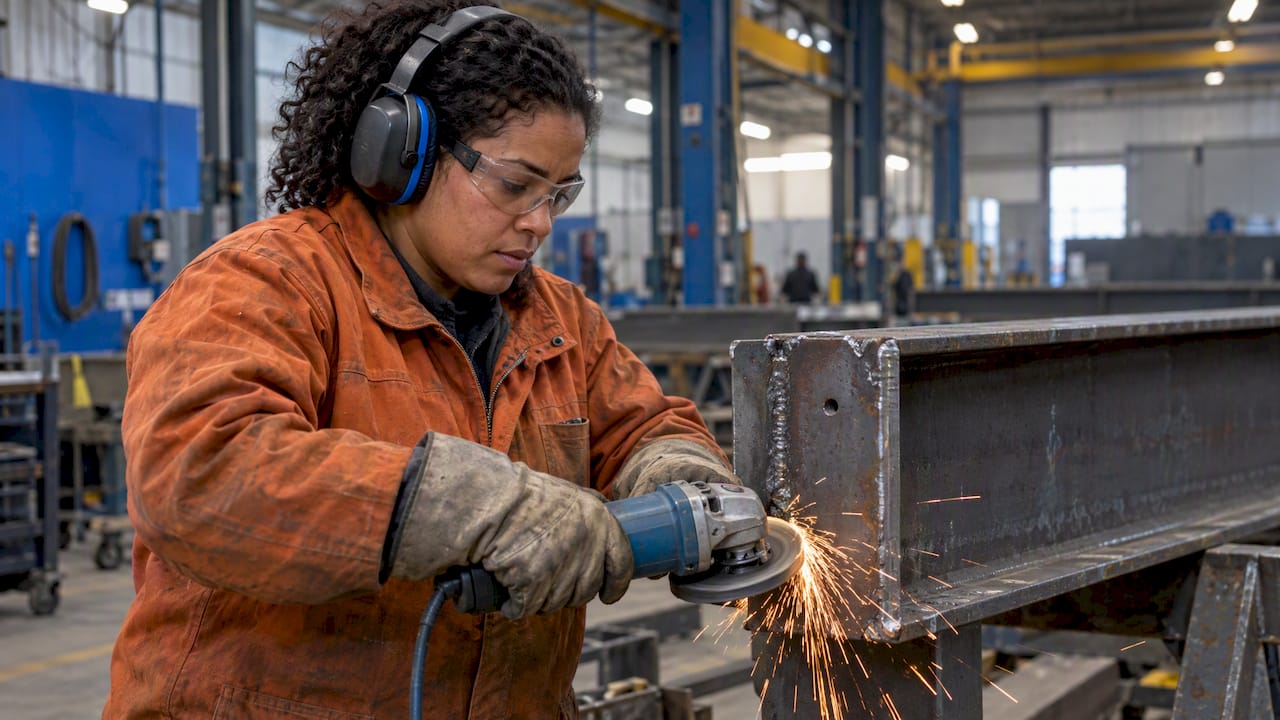
Surface preparation is critical to coating performance. For high-performance systems the preferred standards are SSPC-SP 5/NACE No. 1 (white metal) or SSPC-SP 10/NACE No. 2 (near-white metal) blast cleaning. These remove mill scale, rust and contaminants and create the anchor profile the coating grips. The AISC Specification and SSPC documents govern painting requirements for structural steel, and AISC’s engineering FAQs on painting and surface preparation are a good place to see how they apply to fabricated members.
The hidden culprit is often contamination you cannot see. Water-soluble residues left on steel, even when it looks clean, cause localized osmotic blistering at the coating-substrate interface once moisture arrives. For that reason, a good specification includes:
- A named cleanliness grade (for example SP 10) and a blast profile range.
- A maximum soluble-salt level, checked with a conductivity test before coating.
- A time limit between blasting and priming. One public example of a state specification requires outdoor steel to be prime coated within 10 hours of final surface preparation in some cases; check the requirement in your own contract documents rather than assuming it.
- Edge rounding and weld spatter removal, since sharp edges thin the film.
Application windows, pot life and film build
A good system on paper can still fail in the field. Two practical points from manufacturer data sheets are worth building into schedules.
First, shelf age affects performance. One high-performance epoxy lining product allows more than 60 mils per coat when fresh, but that maximum drops below 30 mils after six months in the container. That is a tank lining product rather than a general structural primer, but the lesson carries over: check batch dates and do not stockpile coatings against a delayed schedule.
Second, single-coat systems are not always easier. The same data sheet notes that some high-solids epoxies need heated plural-component spray equipment and a narrow temperature window of 35°F to 125°F, which can be hard to hold in field conditions. For site-applied work, ask whether a multi-coat system with more forgiving temperature and humidity limits is the safer choice.
What we see from the fabrication side
We are a manufacturer of high-strength steel products, and coatings are part of what makes our guardrails, photovoltaic mounting structures and cooling pipe last in service. Here is how we think about the topic.
First, coating is a manufacturing decision, not a finishing touch. When a producer controls fabrication, welding and surface treatment in-house, defects such as sharp edges, trapped weld spatter and inconsistent surfaces can be fixed before they become paint failures. That is the thinking behind our emphasis on in-house production and strict quality control.
Second, match the system to the asset’s maintenance reality. A guardrail beside a highway, a ground-mount solar array in a desert or a coastal site, and cooling pipe inside a data hall have very different access and exposure. The right specification for one is the wrong one for another. Our write-ups on corrosion under insulation and on data center pipe supports come from that same principle.
Third, ask for documentation. On procurement, the bids that hold up are those where coating type, thickness, test method and inspection records are written down. Our guide on guardrail tender specifications explains how missing paperwork can sink an otherwise strong bid.
— Hu
Specifying a coating system: a checklist
Use this order when writing or reviewing a structural steel coating specification:
- Classify the environment. Use ISO 12944 categories for the atmosphere, plus Im categories for immersion and buried parts.
- State the durability target. Low, medium, high or very high, understanding that this is time to first major maintenance.
- Choose the system family. Paint only, galvanizing only or duplex. Zinc-rich primers or galvanizing for C5 and CX.
- Set the surface preparation. Cleanliness grade, profile, soluble-salt limit and recoat timing.
- Set film thickness. Nominal DFT per coat and total, with acceptable range and measurement method.
- Define application conditions. Temperature, humidity and dew-point margin, plus shop versus field application.
- Plan inspection and repair. Hold points, a mock-up where appropriate, and touch-up procedures for damage during transport and erection.
- Plan maintenance. The Bureau of Reclamation’s guide to protective coatings inspection and maintenance shows how a large asset owner treats coatings as the primary means of controlling corrosion on hydraulic structures.
On maintenance, note that durability ratings are estimates and not guarantees. Regular minor repairs of localized damage are what keep a system from sliding into expensive, large-scale recoating.
Common mistakes
- Choosing by price per liter. Surface preparation and labor dominate total cost. A cheaper paint over poor preparation is the costly option.
- Ignoring steel chemistry when galvanizing, which changes zinc thickness and appearance.
- Skipping the topcoat on epoxy exposed to sunlight.
- Painting over unprepared zinc in a duplex system.
- Treating every site as the same category. Sheltered underside and splash zone on the same structure can fall into different classes.
- Leaving damage unrepaired after shipping or erection.
Coated steel from Gq-international
If your project needs coated steel in volume, we supply high-strength steel guardrails for roads and bridges, photovoltaic mounting systems, energy storage containers and stainless steel data center cooling piping, along with custom steel infrastructure products. For roadside work, start with our galvanized steel guardrail systems or highway guardrails. Send us your exposure category, durability target and project drawings through our site, and our engineers can discuss project-specific engineering solutions. We do not publish prices, as each contract is quoted to the project.
FAQ
What are the different types of steel coatings?
The main families are zinc-rich primers, epoxy and polyurethane paint systems, hot-dip galvanizing, thermal-sprayed metal and duplex systems that combine galvanizing with paint. They split into barrier coatings, which block moisture, and sacrificial coatings, which corrode in place of the steel. Most severe-exposure designs use both.
How do you stop corrosion on steel?
Prepare the surface properly, apply a system rated for the exposure category, and keep it intact. In practice that means blast cleaning, removing salts, applying the specified film thickness and repairing local damage early. Corrosion needs moisture and an electrical path, so removing either one, or sacrificing zinc instead, stops it.
How long does a structural steel coating last?
It depends on the environment and system. ISO 12944 rates durability in four bands, from 2 to 5 years up to more than 25 years before first major maintenance. These are planning figures, not warranties, and maintenance extends them.
Is galvanizing better than paint?
Neither wins everywhere. Galvanizing gives sacrificial protection and covers edges and internal surfaces well, while paint offers color, chemical resistance and field application. Where conditions are severe, a duplex system uses both and typically outlasts either alone.
Sources
- Coatings: the first line of defense in protecting structural steel (AMPP)
- Evaluation of Protective Coatings for High-Corrosivity Category Atmospheres in Offshore Applications (PMC)
- Coating for the Protection of Structural Steelwork (NPL Corrosion Guide No. 3)
- Steel Coating Methods and Applications (Epoxy Interest Group)
- Standard corrosion protection systems for buildings (Steel Construction Info)
- Service Life Chart for Hot-Dip Galvanized Coatings
- Protective coatings (American Galvanizers Association)
- Painting and Surface Preparation (AISC)
- Plasite 4550 data sheet
- Guide to Protective Coatings Inspection and Maintenance (Bureau of Reclamation)