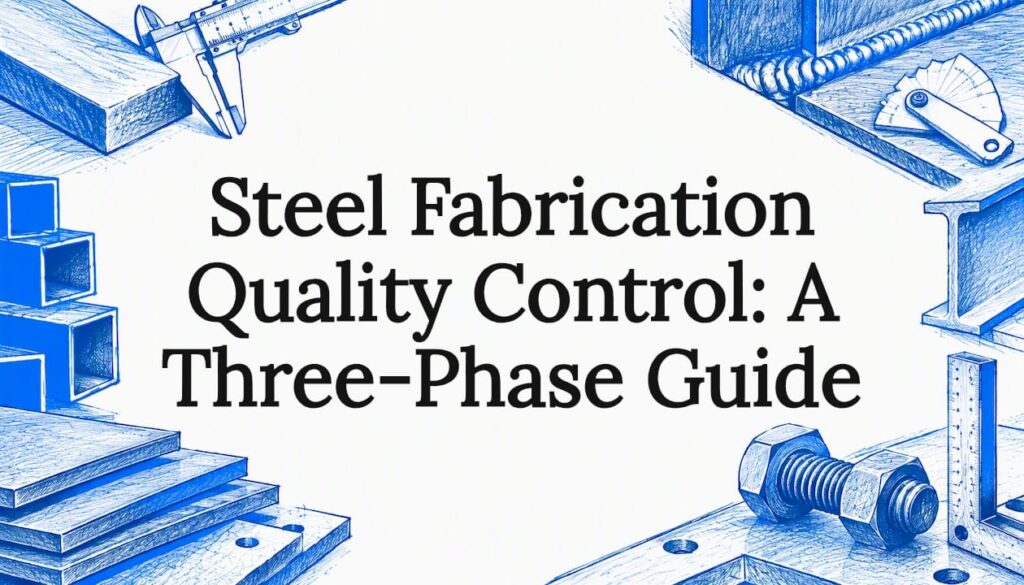
Steel fabrication quality control is a system that runs from the mill to the erected structure. It is not a final inspection. The fabricator controls material identity, welding procedures, dimensions and documentation at every stage. The owner then verifies that control independently. If you buy or specify fabricated steel for bridges, highways, solar structures or energy projects, this guide shows what that system contains and how to check it before you sign a contract.
TL;DR
- Quality control (QC) is the fabricator’s job. Quality assurance (QA) is the owner’s verification of that QC. Projects go wrong when the two blur.
- Think in three phases: mill, shop and site. Traceability by heat number links all three.
- Welding quality rests on a code (AWS D1.1 in the US) or a standard (ISO 3834 internationally). Pick the level that fits the project’s risk.
- A certified quality management system can replace some third-party special inspections. Ask for the audit record, not just the certificate.
- Documents that match the piece in the shop today are the best sign of a mature system.
Table of Contents
- QC and QA: who does what
- The three phases: mill, shop and site
- Welding: the code behind the inspection
- Certification: what it does and does not prove
- A buyer’s checklist for auditing a fabricator
- How we see it
- Applying this to our product lines
- FAQ
- Sources
QC and QA: who does what
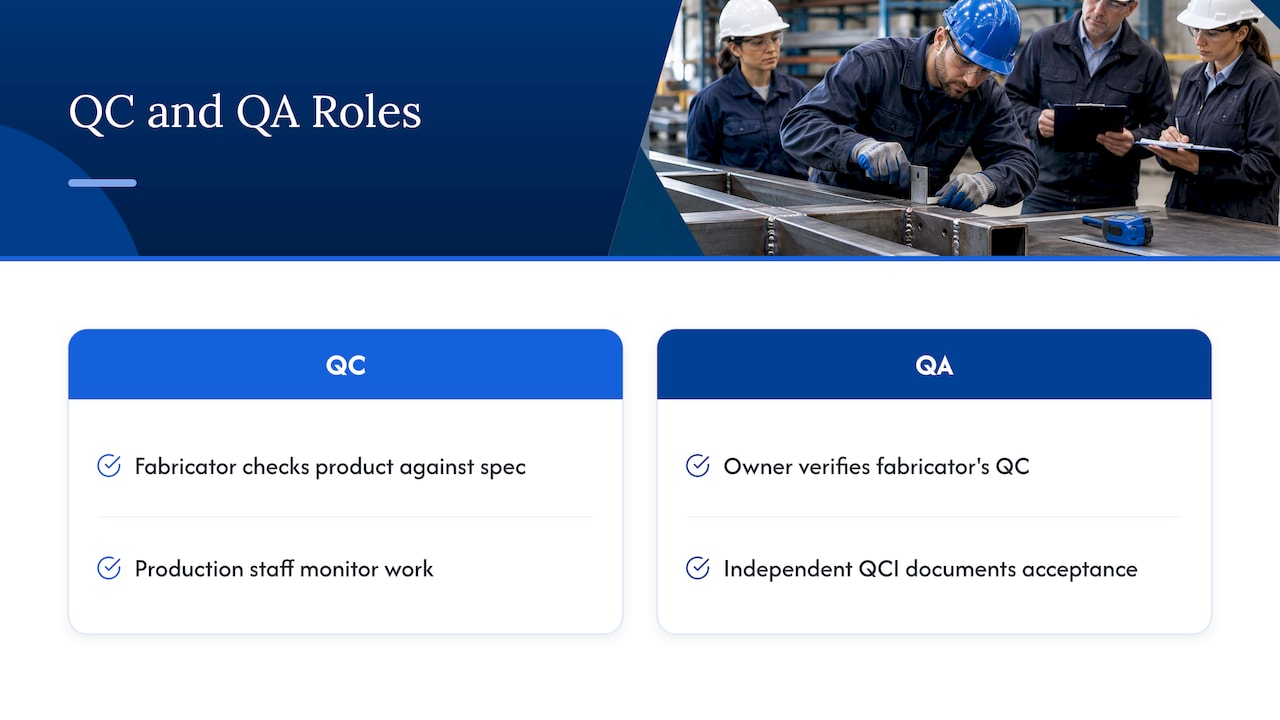
The two terms are often used as one. They should not be. QC is what the fabricator does to make sure the product meets the specification. QA is what the owner or the owner’s representative does to verify that the fabricator’s QC works. The AISC and AASHTO/NSBA steel bridge guidelines are written for owner agencies, fabricators and contractors, and they keep this separation at the center.
The practical consequence is about independence. Production staff can monitor their own work as it goes. Final inspection and documented acceptance should come from a qualified quality control inspector (QCI) who is not under daily production pressure. A foreman who signs off his own weld is not QC. He is a schedule risk.
The three phases: mill, shop and site
The same guidelines describe fabrication quality as a lifecycle of three phases. Each has its own checks, and a gap in one shows up as a failure in the next.
| Phase | What is controlled | Typical records |
|---|---|---|
| Mill | Steel grade, chemistry, mechanical properties, plate identity | Mill test reports, heat numbers |
| Shop | Cutting, fit-up, welding, bolting, dimensions, coating | WPS, welder qualifications, inspection reports, NDT results |
| Site | Erection, field welds, bolt installation, alignment | Field inspection reports, as-built records |
The fabricator’s role is not only to build to drawings. It is to run a quality management system (QMS) that tracks every piece from the source of its material through final erection. Misreading this lifecycle is a leading cause of delays and non-conformances, according to the same bridge fabrication guidelines.
Mill: incoming material
Quality starts when steel arrives. Check each delivery against the purchase order and the mill test report. Confirm the grade and match heat numbers to what is stamped or marked on the plate. Mark the material and keep that mark through cutting, so a finished beam or post can be traced back to its heat. Cut offcuts without transferring the mark, and you have lost traceability.
Traceability is also a measurement problem. Shops that gauge parts during machining catch drift before it becomes scrap. A practical piece on in-process gauging explains how traceable measurement cuts waste. It is written for Australian machine shops, but the logic carries over to any shop that wants to find errors early.
Shop: cutting, fit-up, welding
Most defects get built in here. Typical hold points include:
- Verify the material and the marks before cutting.
- Check dimensions and fit-up before welding: root gap, alignment, joint prep.
- Confirm that the weld procedure and welder qualification match the joint.
- Inspect visually during and after welding.
- Apply NDT where the specification requires it.
- Check final dimensions, straightness and distortion.
- Inspect surface preparation and coating or galvanizing.
Distortion deserves its own line. Heat input moves steel, and correcting it by rework costs time and can damage the part. We cover it in more depth in our article on FEM-verified welding distortion control.
Site: erection and field work
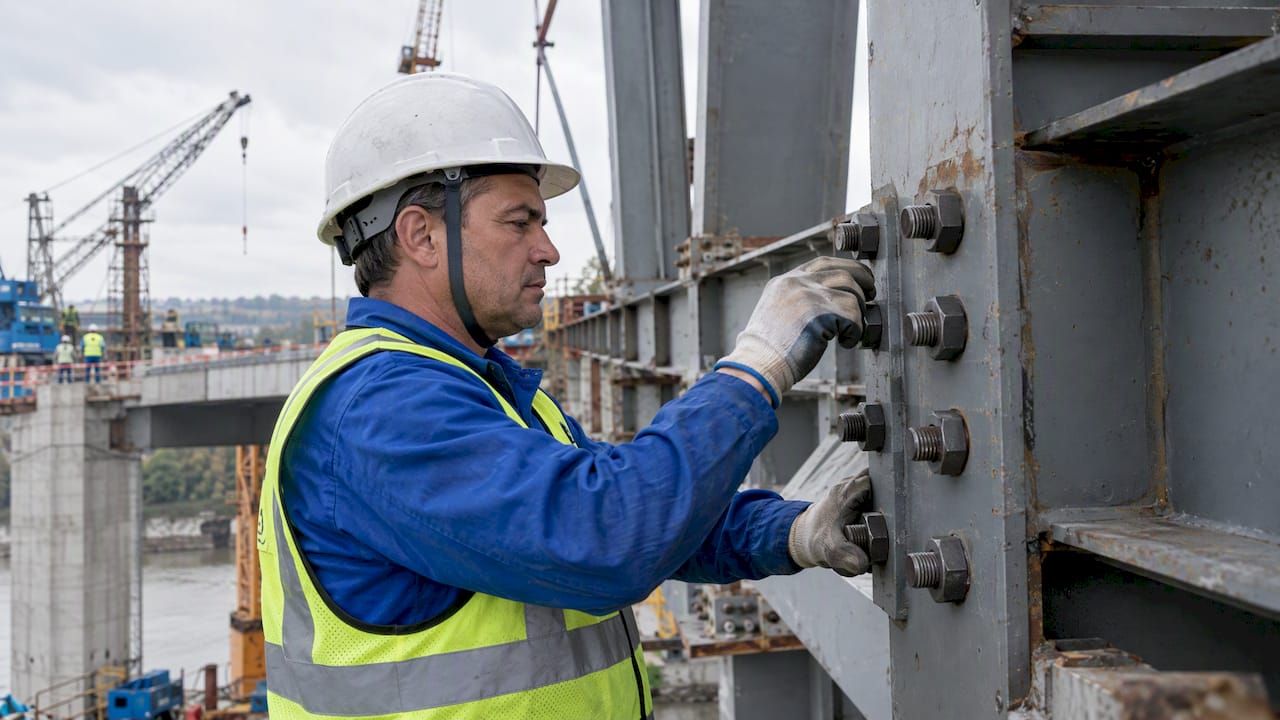
Field work brings its own controls: bolt installation checks, field welds and alignment. The mill and shop records must arrive with the steel. An inspector on site who cannot trace a member to its heat number cannot close the file.
Welding: the code behind the inspection
In the US, the AWS D1.1 Structural Welding Code for Steel defines how structural steel is welded, qualified and inspected across buildings, bridges and infrastructure. It covers the qualification of welding procedures and of welders, and the inspection methods used to confirm integrity. The 2025 edition is the 25th edition of the code, with updated provisions for magnetic particle and penetrant testing and revised visual inspection acceptance criteria. Check which edition your contract cites. Do not assume it is the newest.
The acceptance criteria decide what passes. Visual inspection comes first and is the cheapest check. Surface methods such as magnetic particle (MT) and penetrant (PT) find surface-breaking flaws. Volumetric methods such as ultrasonic or radiographic testing look inside the weld. The specification should state which method applies to which joint and at what frequency.
ISO 3834 for international work
Outside US code-driven work, ISO 3834 is a common baseline for the quality of fusion welding. Part 1 helps you choose among three levels of quality requirements. Part 2 sets the comprehensive level, and Part 3 the standard level. The choice is a project decision. It sets how rigorous the documentation, personnel qualification and NDT frequency must be. A highway barrier and a nuclear-grade pressure part do not need the same level, and paying for the wrong one wastes money or hides risk.
Certification: what it does and does not prove
AISC Certification examines a company’s quality management system as a whole, not individual products. According to AISC, fabricators that complete the audits and continue to pass annual in-person audits hold the certification. Chapter N of the AISC Specification also lets special inspection move from a third-party inspector to an approved fabricator, the process the code calls waiving. For an owner, this can reduce reactive third-party inspection cost and schedule risk.
Remember two limits. First, certification covers a defined scope. A shop certified for building steel is not automatically certified for bridge work, which has its own bridge and highway component program. Second, a certificate is a snapshot. Ask for recent audit results and sample job files.
Audits are practical. Fabricators tend to fail them not for lack of skill, but because they cannot produce records for the work happening during the visit: a bolt pre-installation verification, or a QCI report for the exact piece on the table. Current welding procedure specifications and their qualification records are the most common hurdle. Auditors also evaluate against the current AWS D1.1 requirements, whether or not the sampled contract requires it. That is a useful test for any buyer: walk the floor, pick a piece, and ask to see its paper.
A buyer’s checklist for auditing a fabricator
Use these questions in pre-award audits and RFQs.
- Which code and edition govern? AWS D1.1, ISO 3834 level, or an owner specification.
- Who is the QCI, and who do they report to? Independence from production matters.
- Can you trace a finished piece to its heat number? Pick one at random.
- Are WPS and qualification records current and linked to the joint? Expired qualifications void the work.
- What is the NDT plan? Method, extent and who performs it.
- How are non-conformances handled? Look for a log with root cause and closure, not verbal fixes.
- What is in the final data book? Mill reports, inspection records, coating records and dimensional reports.
- What does the coating or galvanizing record show? Corrosion life depends on it. See what procurement should require on guardrail corrosion protection.
How we see it
We make high-strength steel guardrails, photovoltaic mounting systems, energy storage containers and data center cooling piping. In our view, quality is built by keeping production in-house under one control system, not by inspecting a pile of parts at the end. When cutting, forming, welding and finishing sit under one roof and one set of records, a defect can be traced to its cause. Outsourced chains rarely allow that.
The second thing we believe is that documentation should be part of the product. A buyer shipping guardrail to a highway project, or mounting structures to hundreds of solar sites, needs consistency from the first unit to the ten-thousandth. That is why we talk about strict quality control and large-scale capacity together. One without the other does not hold up.
The third is about specifications. Many disputes start with paperwork that was never asked for. Our guides on guardrail tender specifications and installation specification mistakes come from that experience. Ask early for the records you will need later.
— Hu
Applying this to our product lines
The same logic of heat traceability, qualified welding and documented coating applies across our range. For roads and bridges, see our steel galvanized guardrail systems. For solar projects, our PV mounting system range includes OEM and ODM solutions and project-specific engineering. For cooling infrastructure, see annular pipe products for data centers. If you have a drawing set and a quality plan, send them with your inquiry through our site and we can review them against your requirements.
FAQ
What is the difference between QC and QA in steel fabrication?
QC is what the fabricator does to ensure the product meets specifications. QA is the owner’s or the owner’s representative’s verification that the fabricator’s QC works. Keeping them separate is what makes independent final acceptance possible.
Which standard applies to structural steel welding?
In the US, AWS D1.1 is the structural welding code for steel. Internationally, ISO 3834 sets quality requirements for fusion welding, with comprehensive and standard levels. Your contract documents decide which governs, so check the edition.
Can certification replace third-party inspection?
Sometimes. Chapter N of the AISC Specification allows special inspection to be waived to an approved certified fabricator, subject to the authority having jurisdiction. Confirm the scope of certification and the local approval before you count on savings.
What records should come with fabricated steel?
At minimum: mill test reports with heat numbers, welding procedure and welder qualification records, inspection and NDT reports, dimensional reports and coating records. The set should let you trace any piece back to its material.
Sources
- AISC G4.1 Steel Bridge Fabrication QC/QA Guidelines
- AWS D1.1 Structural Welding Code, Steel
- AWS D1.1/D1.1M:2025 code PDF
- ISO 3834-1:2021
- ISO 3834-2:2021
- AISC Certification: consistent quality, lower risk
- AISC Certified Erectors
- AISC Supplemental CPT, bridge and highway components
- AISC Supplemental CSE audit requirements