Passivating stainless pipe means chemically cleaning the surface so the chromium-rich oxide film can form evenly and protect the steel. In practice that means removing free iron and other contaminants left by fabrication, usually with a nitric or citric acid treatment, then rinsing and verifying. It does not remove heavy weld scale or heat tint. That job belongs to pickling, and getting the two confused is one of the most common reasons a piping job fails its corrosion expectations.
This guide is written for engineers, procurement leads and project managers who have to write a passivation requirement into a purchase order or a commissioning plan, and who need to know what to ask for, in what order, and how to check it was done.
TL;DR
- Passivation removes surface contamination such as embedded iron so the passive chromium oxide film can form. ASTM A967 covers nitric acid, citric acid and electrochemical treatments.
- Passivation does not remove significant scale or heat tint. If welds are discolored, pickling comes first.
- Do not write “passivate” alone in a spec. Name the standard, the method, the acceptance test and the sampling.
- Free-machining grades such as 303 and 416 often need an alkaline pre- and post-treatment around the acid step.
- Degrease first, document everything, and test the result. A passivation step on a dirty surface is wasted money.
Table of Contents
- What passivation actually does to stainless pipe
- Pickling and passivation: which one your pipe needs
- The standards behind the word “passivation”
- Nitric or citric acid: choosing the chemistry
- How passivation is carried out on pipe
- Verifying the result
- Common mistakes that cause failures
- Our perspective: passivation starts before the acid bath
- Specifying stainless cooling pipe with us
- Drafting the specification clause
- FAQ
- Sources
What passivation actually does to stainless pipe
Stainless steel resists corrosion because chromium at the surface reacts with oxygen and forms a thin chromium oxide layer. That layer forms by itself whenever a clean surface meets enough oxygen. The British Stainless Steel Association describes this self-passivation as the way stainless steels are designed to behave.
The trouble starts in the shop and in the field. Cutting, bending, grinding, handling with carbon steel tools and storing near carbon steel all leave particles of free iron on the surface. Welding adds oxides and heat tint. Those contaminants sit on top of the steel and interrupt the passive film. Rust blooms, pitting and, in sanitary or high-purity systems, rouge follow.
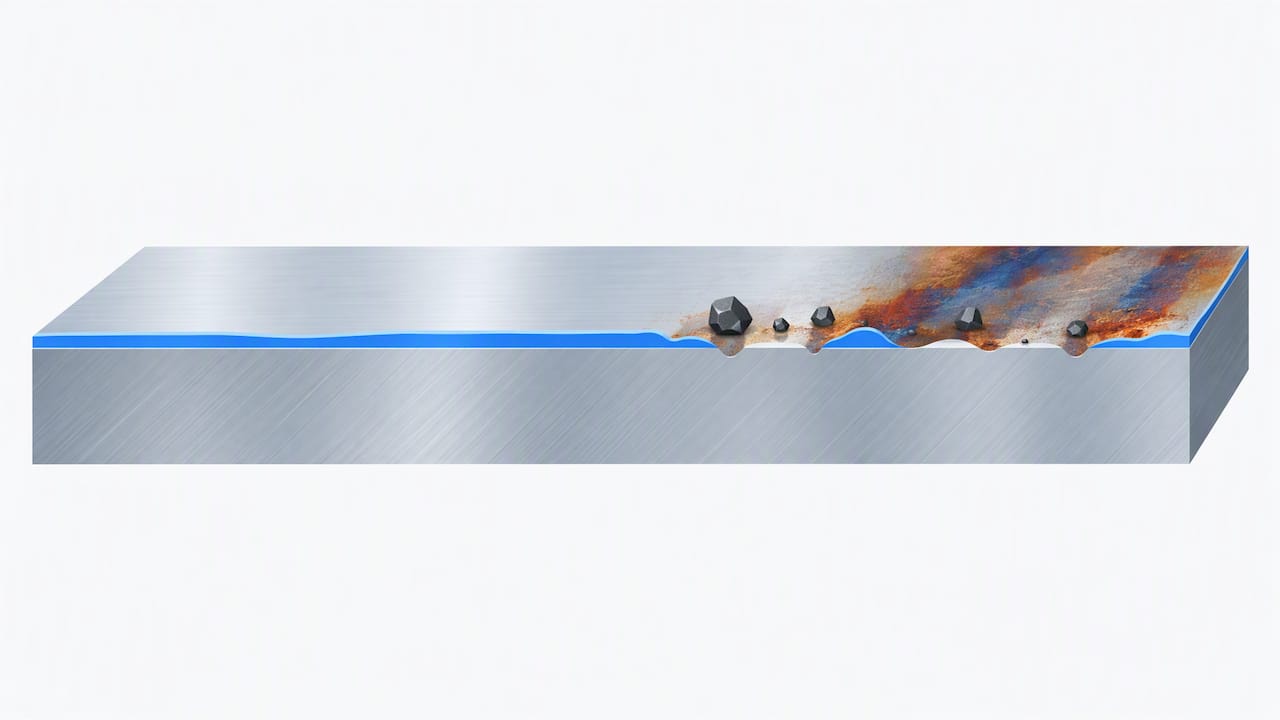
Chemical passivation addresses this. ASTM A967 defines it as a chemical treatment, most commonly with nitric or citric acid, that removes exogenous iron and other contaminants so the protective film can form spontaneously. The ASSDA makes the same point from another angle: passivation promotes the film on a freshly created surface, for example after grinding or machining.
Two practical consequences follow:
- Passivation is a cleaning and restoration step. It is not a coating, and it does not make poor material good.
- It only works on a surface that is already clean enough for the acid to reach the metal.
Pickling and passivation: which one your pipe needs
Readers often search for “pickling and passivation” as a single phrase because the two are frequently performed together. They are different processes with different jobs.
| Pickling | Passivation | |
|---|---|---|
| Purpose | Remove weld scale, heat tint, embedded iron and a thin layer of metal | Remove free iron and contaminants, then let the oxide film form |
| Chemistry | More aggressive acids, often nitric and hydrofluoric mixtures | Milder nitric or citric acid solutions |
| Removes heavy oxides | Yes | No |
| Typical order | First, when welds are discolored | Second, or alone on an already clean surface |
The World Stainless guidance is direct on this: passivation does not remove significant scale or heat tint, and pickling is needed as a precursor when heavy oxides are present. Skipping pickling on a heavily oxidized weld and going straight to a passivating bath leaves the acid working on scale rather than on metal.
For pipework, the same document recommends circulation pickling when the pipe will carry corrosive liquids: the pickling solution is pumped through the system rather than applied from outside. That matters for installed lines where the inside weld bead is the real concern and cannot be reached with a brush or paste.
A quick field test for which you need
- Clean, bright, machined or ground surface, no discoloration: passivation alone is normally the right call.
- Visible straw, blue or gray heat tint at welds: pickling, then passivation.
- Oil, grease, cutting fluid or marking ink on the surface: degrease first. Acid will not work through it.
- Rust staining after shipping or storage: clean, then assess whether passivation or a stronger step is needed, and document the decision.
The standards behind the word “passivation”
Three documents come up in almost every US specification.
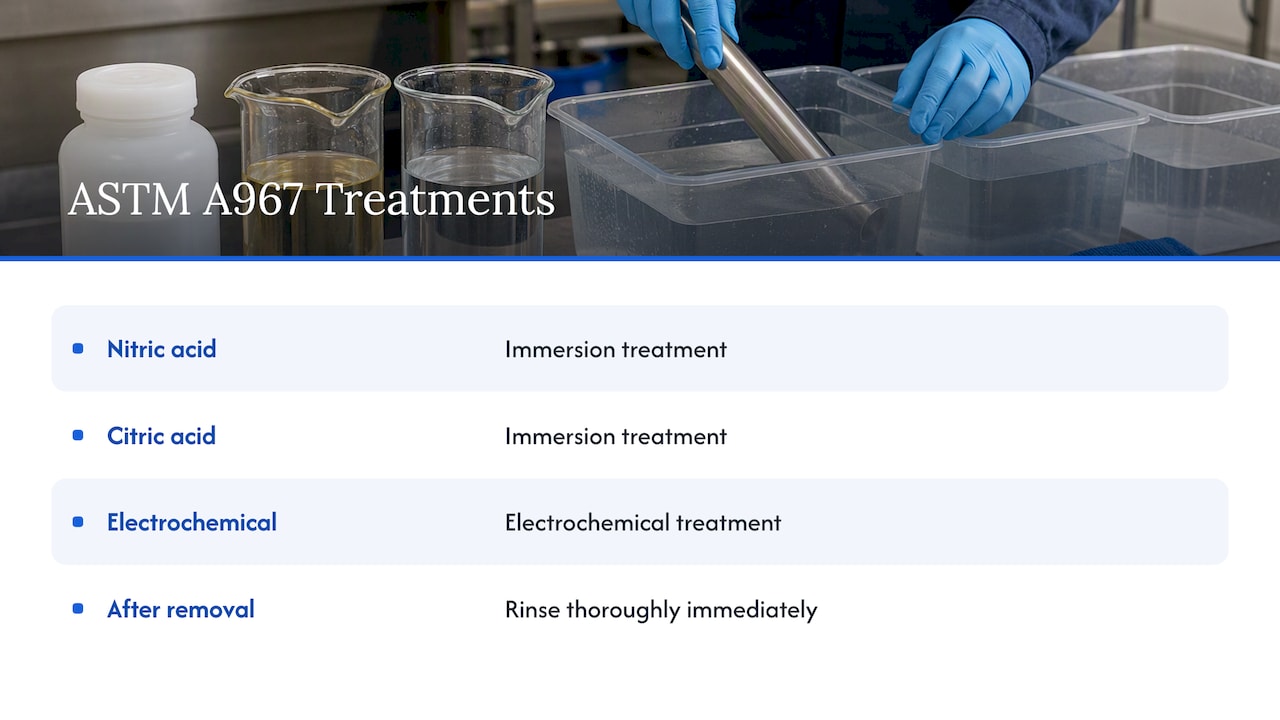
ASTM A967/A967M is the specification for chemical passivation treatments. The current edition covers immersion in nitric acid solutions, immersion in citric acid solution and electrochemical treatment. It also requires that parts be thoroughly rinsed immediately after removal from the solution, as the ASTM listing for an earlier edition shows.
ASTM A380 is the practice for cleaning, descaling and passivation. Its scope covers new parts, assemblies, equipment and installed systems, which is why it is the usual reference for piping that has already been welded into place.
IS 10117 is an Indian standard code of practice for passivation of stainless articles, including pipelines. If you buy or install in India, that document is the local reference. For US work, ASTM A967 and A380 are the ones to cite.
There is a trap here. Practitioners note that the term “passivation” gets used loosely, and purchasing specifications should define whether they mean spontaneous formation of the film or a chemical treatment, and which of A380 or A967 governs. A purchase order that says only “stainless pipe, passivated” leaves the supplier free to decide, and leaves you with no clear basis for rejecting the result.
Nitric or citric acid: choosing the chemistry
Traditional passivation uses nitric acid baths. Citric acid has gained ground because it is easier to handle and dispose of. Astro Pak reports a significant shift toward citric acid as a safer and more environmentally friendly option, with one condition: the specific citric process must be validated for the alloy grade so that it actually removes the contaminants.
Here is how to think about the choice.
- Austenitic grades such as 304 and 316: both nitric and citric processes are widely used. Pick based on your site’s safety and waste constraints, and confirm the process is qualified for the grade.
- Free-machining and precipitation-hardening grades: be careful. A national laboratory study on citric acid passivation found that for grades such as 303 and 416, standard acid passivation is often not enough because inclusions in the alloy are not addressed by the acid alone. The practitioners in that work added an alkaline soak before and after, for example 5 wt% sodium hydroxide at 70°C for 30 minutes, to reach satisfactory results.
- Installed systems: the choice is often driven by what can be circulated safely through the line and drained and neutralized on site.
The point is not that one acid always wins. The point is that the process, the grade and the acceptance test belong together in the spec.
How passivation is carried out on pipe
Shop-fabricated spools and field-installed systems are treated differently.
Shop spools and fittings
Short lengths and fabricated spools can be immersed in a tank. ASTM A967 prefers that all parts are immersed in the solution, though it allows other techniques as long as the temperature window of the chosen process can be held. Common explainers describe bath times of roughly 20 to 30 minutes, but the right time and temperature come from the process you specify, not from a general rule.

Installed pipework
Once pipe is welded into a system, immersion is impossible. Contractors then circulate the cleaning and passivating solutions through the line, or apply gels and pastes to accessible areas such as external welds. A specialist field-service provider describes the goal in terms of avoiding rouge, pitting, galvanic and other corrosion that leads to cleaning and validation problems, downtime and shorter equipment life.
A typical sequence for an installed line looks like this:
- Flush and degrease to remove oils, cutting fluids and dirt.
- Pickle if heat tint or weld scale is present, using circulation for pipework carrying corrosive media.
- Rinse thoroughly.
- Passivate with the specified nitric or citric solution at the specified temperature and time.
- Rinse again, neutralize if the process requires it, and dry.
- Test and document.
Practitioners stress that passivation is not a substitute for pre-commissioning cleaning. Degreasing and pickling to remove welding oxides, heat tint and embedded iron come before the acid step, and skipping them is a well-known cause of passivation failure.
Verifying the result
A passivated pipe looks much like an unpassivated one, so acceptance has to rest on tests. ASTM A967 defines seven qualitative tests: water immersion, high humidity, salt spray, copper sulfate, potassium ferricyanide, damp cloth and boiling water immersion. They differ in sensitivity and in which alloy they suit. The copper sulfate test, for example, is meant to reveal free iron, while the salt spray test is a corrosion exposure.
What to put in the spec:
- the standard and edition (for example ASTM A967/A967M-25)
- the treatment method and, if relevant, the acid
- the acceptance test, chosen to suit the alloy
- lot definition and sampling rule
- documentation required: process record, solution parameters, test results
This is where purchasers have leverage. If the document trail is part of the order, a supplier cannot easily say it was “passivated” without showing how.
Common mistakes that cause failures
- Passivating over contamination. Oil, scale or heat tint blocks the acid. Clean and pickle first.
- Using the wrong tool. Carbon steel wire brushes and grinding wheels that have touched carbon steel re-embed iron right after cleaning. Use stainless-only tools.
- Treating all grades the same. Free-machining grades behave differently, as the research above shows.
- Assuming citric always works. Validation for the grade is the condition, not a formality.
- Writing a vague requirement. “Passivate per industry practice” is not a specification.
- Ignoring what happens after. Storage near carbon steel, or insulation that stays wet, can undo good surface work. Our guide to corrosion under insulation covers inspections and specs for that second problem.
Our perspective: passivation starts before the acid bath
We make high-strength steel products for roads, solar plants, energy storage and data centers, including stainless piping for data center cooling. From that vantage point, the most useful thing we can say about passivation is that its outcome is largely decided upstream.
A pipe that arrives clean, with controlled welds and no iron contamination from shop handling, passivates predictably. A pipe that arrives with oxidized welds and tool marks needs rescue work. That is why we put weight on in-house production and strict quality control: when forming, welding and handling happen under one roof and one quality system, you remove many of the contamination events that passivation is later asked to fix. Our notes on steel fabrication quality control and on limiting welding distortion and rework describe how we think about that.
Our advice to buyers is simple. Treat the passivation line in your specification as a contract clause, not a footnote. Name the standard, the method and the test, and ask for the records. If a supplier cannot tell you which of those they will apply, you have learned something before the order is placed.
— Hu
Specifying stainless cooling pipe with us
If you are sourcing stainless piping for data center cooling loops, our annular pipe products are the place to start, and our team can discuss project-specific requirements for surface condition and documentation. Send your drawings, grades and the standards your project calls for, and we will review them against what we can supply. Related reading on the mechanical side: pipe supports for data center cooling and choosing expansion loops.
Drafting the specification clause
A short, testable clause beats a long vague one. A workable structure:
- Scope: which pipe, fittings and welds are covered, new fabrication or installed system.
- Reference standard: ASTM A967/A967M for the treatment, ASTM A380 for cleaning and descaling practice, with the edition.
- Pre-cleaning: degreasing required before any acid; pickling required where heat tint or weld scale is present.
- Treatment: nitric or citric, with the grade-specific validation for citric and any alkaline steps for free-machining grades.
- Rinse and finish: rinse immediately after the bath; water quality as your system demands.
- Acceptance: named test from the A967 list, applied per lot.
- Records: solution concentration, temperature, time, operator, test result, traceable to lot or heat number.
Have your corrosion or materials engineer review the clause for your alloy and service. A line carrying chlorides, for instance, or a pharmaceutical system with validation requirements, may demand more than a general clause provides.
FAQ
How long does passivation last?
There is no fixed lifespan. The oxide film regenerates on its own wherever the surface is clean and has access to oxygen. It breaks down when contamination, chlorides, crevices or mechanical damage overwhelm it, and then the affected area needs cleaning and possibly re-passivation.
What is the difference between pickling and passivation?
Pickling uses stronger acids, often nitric and hydrofluoric mixtures, to remove weld scale, heat tint and embedded iron. Passivation is a milder treatment that removes free iron and contaminants from an already clean surface so the protective film can form. Heavily oxidized welds need pickling first.
Do I need to passivate stainless pipe at all?
Not always, but you often should after welding, grinding or machining, and always where the contract or standard demands it. Systems with strict cleanliness or validation requirements usually specify it. Ask your materials engineer to confirm for your service conditions.
Is citric acid as good as nitric acid for passivation?
It can be, when the citric process is validated for the alloy. Research shows free-machining and precipitation-hardening grades may need extra alkaline steps with either acid. Match the process to the grade and prove it with the acceptance test.
Sources
- ASTM A967/A967M-25 standard specification
- ASTM A967/A967M-17 listing
- ASTM A380 standard practice
- Unpacking ASTM A967, Astro Pak
- Pickling and Passivating Stainless Steel, World Stainless
- Refinement of Citric Acid Passivation Methods, OSTI
- Pickling and Passivation, ASSDA
- Passivation of stainless steels, British Stainless Steel Association
- Passivation of Piping and/or Equipment, Allegheny Surface Technology
- IS 10117 (2000), Bureau of Indian Standards