
For most piping jobs, the choice comes down to three families. Use 304/304L for general service with low chloride exposure. Use 316/316L when chlorides, salt or mild acids are present. Move to duplex such as 2205 when chloride stress corrosion cracking or high strength is the deciding factor. Specialty austenitic grades such as 321 and 347 cover higher-temperature work. This guide explains how those grades differ, which standards define them, and where mistakes usually happen on real projects.
TL;DR
- Most US stainless pipe is bought to ASTM A312, which covers seamless, welded and heavily cold-worked austenitic pipe in grades such as TP304, TP304L, TP316, TP316L, TP321 and TP347.
- Molybdenum is what separates 316 from 304 in chloride service. Duplex 2205 goes further, with better resistance to chloride stress corrosion cracking and higher strength.
- Pipe dimensions come from ASME B36.19M, not the carbon steel standard. The “S” in 10S, 40S and 80S matters.
- Do not mix grades in one system without checking weldability, thermal expansion and strength mismatch.
- Choose the grade from the service conditions first (chloride level, temperature, H2S, pressure), then the schedule, then the price.
Table of Contents
- What a stainless steel pipe grade actually tells you
- The grades you will meet most often
- Standards: grade is only half the specification
- How to choose a grade: a practical sequence
- Mixing grades in one system
- Fabrication pitfalls that undo a good grade
- Our perspective
- Stainless piping for data center cooling from Gq-international
- Quick checklist for your RFQ
- FAQ
- Sources
What a stainless steel pipe grade actually tells you
Stainless steel is not one alloy. It is a group of iron-based alloys with a minimum of 10.5% chromium, with other elements added to tune corrosion resistance and heat resistance. A grade is shorthand for that recipe.
The three-digit system is the one most piping buyers see. In the 300 series, which is austenitic, the nickel content helps toughness and durability. The 400 series is ferritic or martensitic and rarely used for process pipe. Duplex grades carry a UNS number, such as S32205 for 2205, and are often called by that name.
Two letters follow many grade names:
- L means low carbon. It limits sensitization when you weld, so 304L and 316L are the usual picks for welded systems.
- H means a higher carbon range for elevated temperature. ASTM A312 includes H-grades such as TP304H and TP316H for improved creep and stress-rupture resistance.
Many suppliers stock “dual-certified” 304/304L and 316/316L, meaning the material meets both chemistry limits. Check the mill test report if your specification demands one or the other.
The grades you will meet most often
| Grade | Family | Main strength | Typical use | Watch out for |
|---|---|---|---|---|
| 304 / 304L | Austenitic | General corrosion resistance, easy to weld | Water, food, structural supports, indoor process lines | Pitting in chloride-rich or marine conditions |
| 316 / 316L | Austenitic with molybdenum | Better resistance to chlorides and pitting | Coastal, chemical, wastewater, cooling loops | Higher cost than 304; chloride SCC at elevated temperature |
| 321 | Austenitic, titanium stabilized | Resists sensitization at elevated temperature | Heat-exposed lines | Titanium variability in welds |
| 347 | Austenitic, niobium stabilized | Similar role to 321 | High-temperature service | Check availability and welding procedure |
| Duplex 2205 (S32205) | Duplex | High strength, strong resistance to chloride SCC | Chloride-rich, high-pressure, long-life infrastructure | Heat treatment and welding control |
The austenitic grades listed above all appear in the ASTM A312 grade list. Duplex pipe is generally specified under a separate standard, so confirm which one your project calls for rather than assuming A312 covers it.
304 and 304L: the default
Type 304L is the workhorse. It handles a wide range of fresh water, food, and general industrial duties, and it welds well. It is also the grade most often over-specified or under-specified. Over-specified, when a project pays for 316L where the environment never needed it. Under-specified, when a line near deicing salt, seawater or a chlorinated process gets 304L because it was in stock.
316 and 316L: when chlorides are present
The addition of molybdenum gives 316 enhanced chloride resistance over 304. That is why it dominates coastal, wastewater and chemical applications. It is also common to use it for a few critical components inside a 304L system. The Nickel Institute notes that using Type 316L for a few components in a 304L piping system for corrosive service is commonly done, though the reverse needs more thought.
321 and 347: stabilized grades
These add titanium (321) or niobium (347) so carbon is tied up and the pipe resists sensitization when held at elevated temperatures. Both appear in the A312 grade list, together with their H variants. If your line sees sustained heat, ask your engineer whether a stabilized grade or an H-grade is the better match to the design temperature.
Duplex 2205: strength and SCC resistance
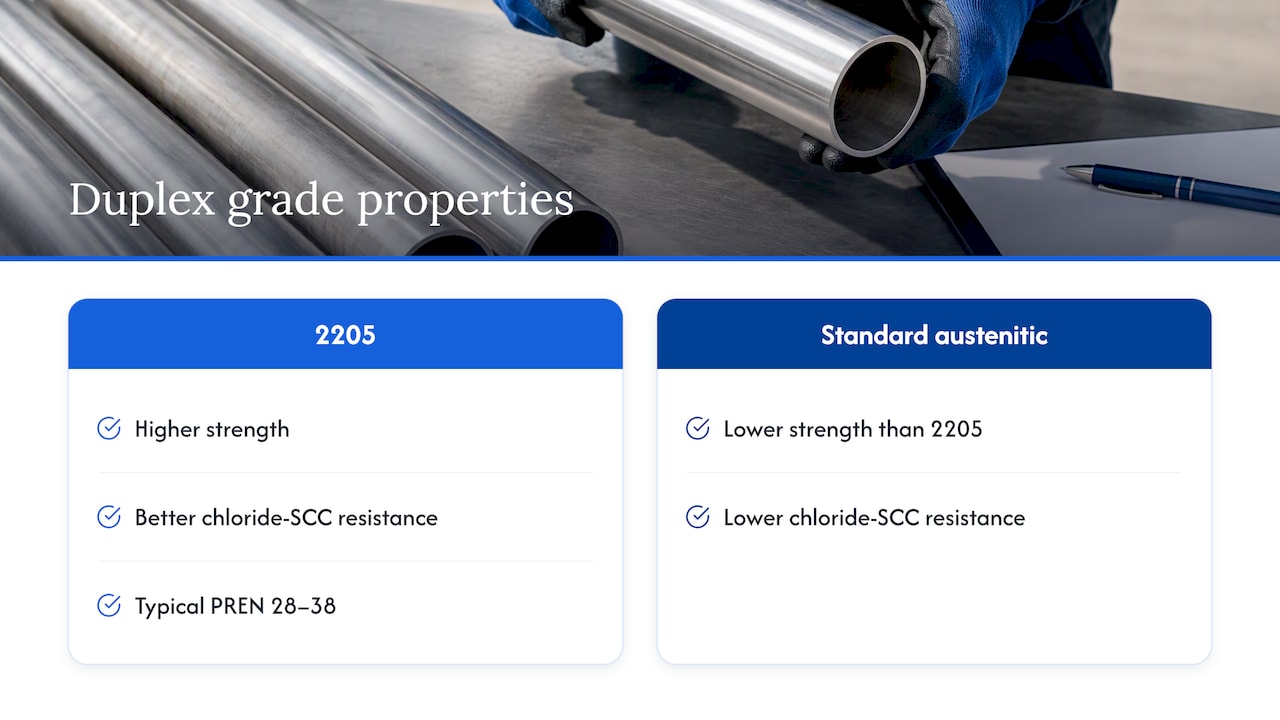
Duplex grades combine austenite and ferrite. According to the ISSF duplex guide, 2205 offers higher strength and better resistance to chloride-induced stress corrosion cracking than standard austenitic grades. That guide also gives a typical PREN range of 28 to 38 for 2205.
PREN, the Pitting Resistance Equivalent Number, is calculated as Cr + 3.3Mo + 16N. Use it to rank grades against each other for pitting, not as a guarantee of life in a given environment.
For the harshest chloride service, super-duplex and hyper-duplex grades exist for conditions where 316L would fail by stress corrosion cracking.
Standards: grade is only half the specification
A complete pipe callout names the grade, the product standard, the dimensional standard and the design code.
ASTM A312: the product standard
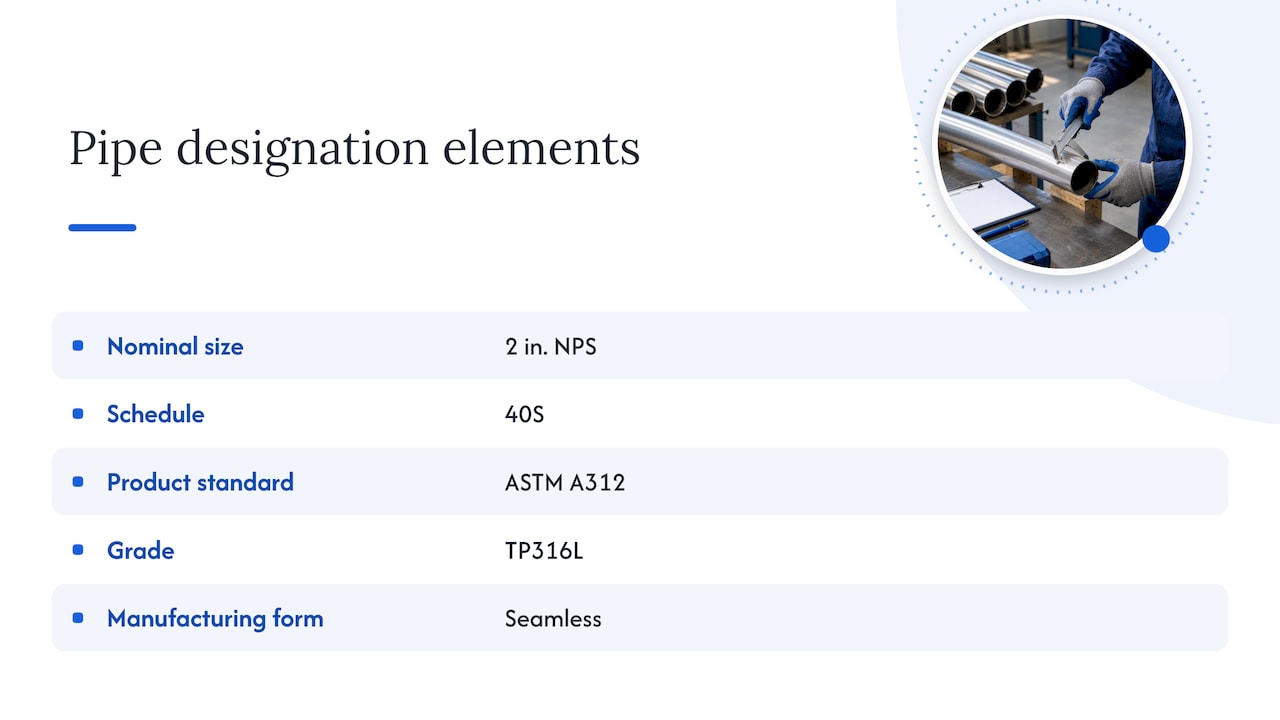
A312 is the main specification for austenitic stainless pipe. It covers seamless, straight-seam welded and cold-worked welded pipe for high-temperature and corrosive service. A line on a purchase order might read: “2 in. NPS, Schedule 40S, ASTM A312 TP316L, seamless.” Each element removes a question the supplier would otherwise have to guess at.
ASME B36.19M: sizes and schedules
ASME B36.19M standardizes outside diameter and wall thickness for stainless pipe. Two points trip up newcomers:
- For NPS 12 and smaller, the outside diameter is numerically larger than the size designation. This is different from tubing, where the outside diameter equals the stated size.
- The “S” suffix in 5S, 10S, 40S and 80S separates stainless dimensions from carbon steel dimensions in B36.10M. At some sizes, such as NPS 12 Schedule 40S, wall thickness differs significantly from the carbon steel schedule of the same number. Never convert a carbon steel drawing to stainless by swapping the grade alone.
ASME B31.3: the design code
For process piping in refineries, chemical plants, power generation and similar facilities, ASME B31.3 sets the design, fabrication and testing requirements. Grade and schedule feed into the allowable stress and pressure calculations that code requires. Your piping engineer owns that calculation; the buyer’s job is to make sure the purchase order matches it exactly.
How to choose a grade: a practical sequence
- Define the environment. Record chloride concentration, temperature range, pH, and whether H2S is present. The Nickel Institute and World Stainless guidance is that these factors drive selection between austenitic and duplex grades.
- Pick the family. Low chlorides and moderate temperature: 304L. Chlorides or salt: 316L. Chloride SCC risk or strength-driven design: duplex.
- Choose the schedule from B36.19M after the pressure and temperature calculation under your design code.
- Choose the form. Seamless is common for higher pressure or critical lines. Welded pipe often offers cost and size advantages for large diameters. Both are covered in A312.
- Plan welding and fabrication before you order. Procedure, filler metal and heat treatment can be as important as the grade.
- Compare lifetime cost, not just price per foot.
On the last point, practitioners note that duplex stainless has become a baseline for many long-cycle, high-performance projects because its total cost of ownership can beat repeatedly replacing inhibited low-alloy systems. That finding comes from oil and gas production tubing, so apply it by analogy, not as a rule for every system.
A worked example
Suppose you are specifying a chilled-water loop at a coastal facility. Fresh potable make-up water and a protected indoor mechanical room may be fine in 304L. Run the same loop through an outdoor rack exposed to salt-laden air, and external pitting at supports and under insulation becomes the risk, so 316L is the safer starting point. Our guide on inspections and specs to reduce corrosion under insulation covers the insulation side of that problem, which grade choice alone does not solve.
Mixing grades in one system
Mixed systems are common and not always a problem, but they need analysis. The Nickel Institute lists corrosion compatibility, weldability, strength, toughness and hardness as the factors to consider.
The riskiest pairing is duplex with austenitic. Duplex grades have much higher proof stress, and the thermal expansion coefficients differ. In complex layouts that can create stress mismatches at joints and attachments. The same source warns that even a lean duplex tank paired with duplex piping demands careful weld procedures and support design.
Thermal movement is exactly where expansion loops and supports earn their place. If your layout mixes materials or runs long, read how to choose 2D or 3D pipe expansion loops before sizing anything.
Fabrication pitfalls that undo a good grade
- Duplex heat treatment. Solution annealing dissolves detrimental phases such as sigma and nitrides. After annealing, fast cooling matters: Outokumpu notes that failing to quench to below 260°C (500°F) can sharply reduce corrosion resistance and toughness. Field-welded infrastructure work is where this tends to be missed.
- Weld distortion and rework. Thin-wall stainless moves when welded. See our piece on FEM-verified distortion control for fabricators.
- Inspection discipline. Material certificates, positive material identification and documented checkpoints prevent wrong-grade deliveries. Our three-phase guide to steel fabrication quality control outlines how to structure that.
- Supports. Poorly designed supports cause as many cooling-loop failures as the pipe itself. We cover this in data center pipe supports for engineers.
Our perspective
We manufacture stainless steel piping for data center cooling, so we see the same pattern in RFQs: the grade is named, but the standard, schedule, form and fabrication method are left vague. That vagueness is where cost and quality drift apart between bids.
Our view is that a grade decision belongs in the same conversation as the weld procedure, the support layout and the inspection plan. A pipe in the right alloy still fails when it is poorly welded or poorly supported. That is why we pair in-house production with strict quality control, and why we treat project-specific engineering as part of the supply, not an add-on.
For buyers, our advice is simple. Write the environment into the RFQ. State the product standard and dimensional standard. Ask every supplier to quote against the same sheet. Then compare on lifecycle cost, not the first line of the quote.
— Hu
Stainless piping for data center cooling from Gq-international
If your project is a cooling loop, we can help you work through grade, size and fabrication before you issue an RFQ. Jiangsu Guoqiang makes high-performance stainless steel data center cooling piping, including annular pipe products, with project-specific engineering available. Share your service conditions and drawings, and our team will respond with a supply proposal. Pricing is quoted per project.
Quick checklist for your RFQ
- Grade and UNS number (for example TP316L, S31603)
- Product standard (ASTM A312 or the applicable duplex standard)
- Nominal pipe size and schedule per ASME B36.19M, including the “S”
- Seamless or welded, and the end finish
- Design code (for example ASME B31.3) and design temperature and pressure
- Environment: chloride level, temperature, H2S, external exposure
- Welding procedure and post-weld heat treatment requirements
- Required certificates and inspection or testing
FAQ
What is the difference between 304 and 316 stainless steel pipe?
The main difference is molybdenum. 316 contains it, which gives better chloride and pitting resistance than 304. Use 304L for general service with low chlorides, and 316L for coastal, salt or chemical exposure. 316 typically costs more, so match the grade to the environment.
What does the L in 304L or 316L mean?
L stands for low carbon. The lower carbon limit reduces the risk of sensitization during welding, which is why L-grades are the usual choice for welded pipe systems. H-grades, by contrast, have a higher carbon range for elevated-temperature strength.
What does Schedule 40S mean on stainless pipe?
It is a wall-thickness designation from ASME B36.19M. The “S” distinguishes stainless dimensions from carbon steel ones, and at some sizes the wall thickness differs from the carbon steel schedule with the same number. Always check the standard for your specific NPS.
Which stainless grade is best for chloride environments?
Start with 316L for moderate chloride exposure. For high chlorides, higher temperature or stress corrosion cracking risk, duplex 2205 or a super-duplex grade is the next step, as the ISSF duplex guide explains. A materials engineer should confirm the choice against your actual conditions.
Can I mix different stainless grades in one piping system?
Often yes, but only after checking corrosion compatibility, weldability and strength. Pairing 316L components in a 304L system is commonly done. Mixing duplex with austenitic needs a full analysis of thermal expansion and weld procedures.
Sources
- ASTM A312/A312M standard specification
- ASME B36.19M stainless steel pipe
- ASME B31.3 Process Piping 2024
- ISSF Duplex Stainless Steels
- World Stainless: stainless steel is not a single alloy
- Nickel Institute: Stainless Steel Mix and Match
- Nickel Institute: control of corrosion in oil and gas production tubing
- Outokumpu